
Facelift
in Seoul, Korea
AVA's detail lies in reconstructing the invisible core structures beneath the skin.
Facelift
This is not simply about pulling the skin tight. We perform anatomical dissection down to the SMAS (superficial musculoaponeurotic system) layer and the retaining ligaments — the true underlying causes of facial ageing — to pursue genuine contour restoration. Only Dr Seungsoo Kim enters the operating theatre. No other patient is ever treated simultaneously (sole-surgeon responsibility, Zero Ghost Surgery). ※ Surgical technique follows internationally recognised literature (Mendelson BC, Clin Plast Surg 2008 — Surgical Anatomy of the Midcheek). Results and recovery may vary between individual patients.
A facelift releases the stretched retaining ligaments and repositions and secures the sagging SMAS layer, restoring the midface and jawline.
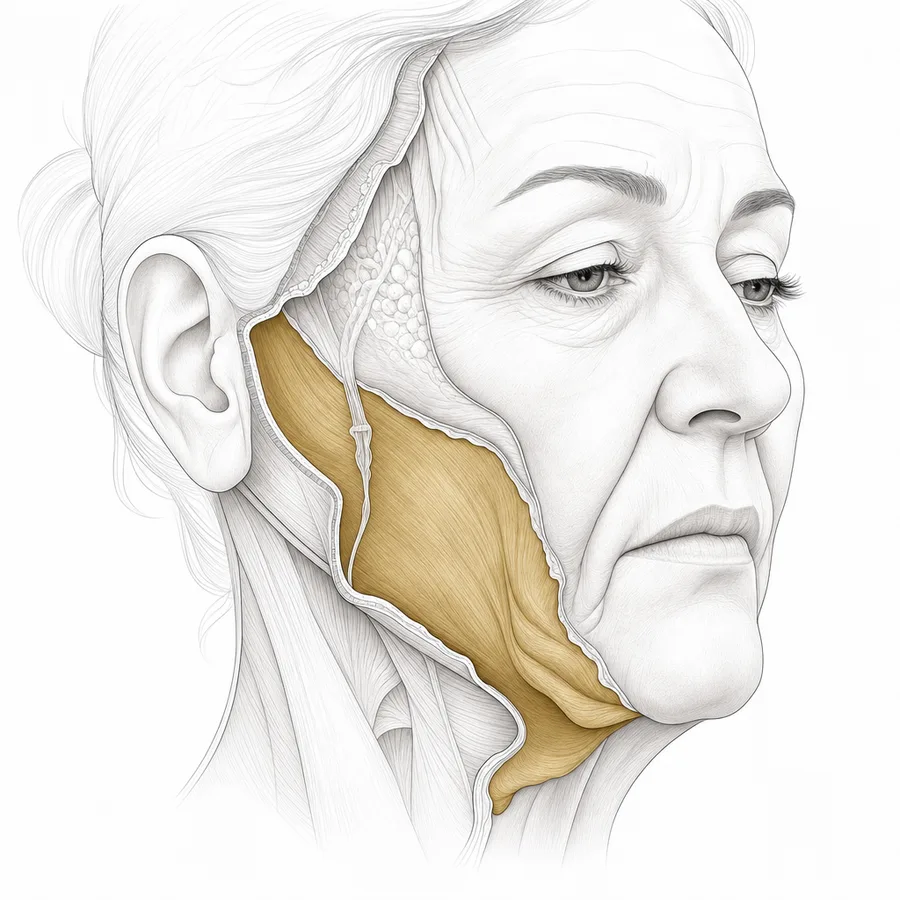
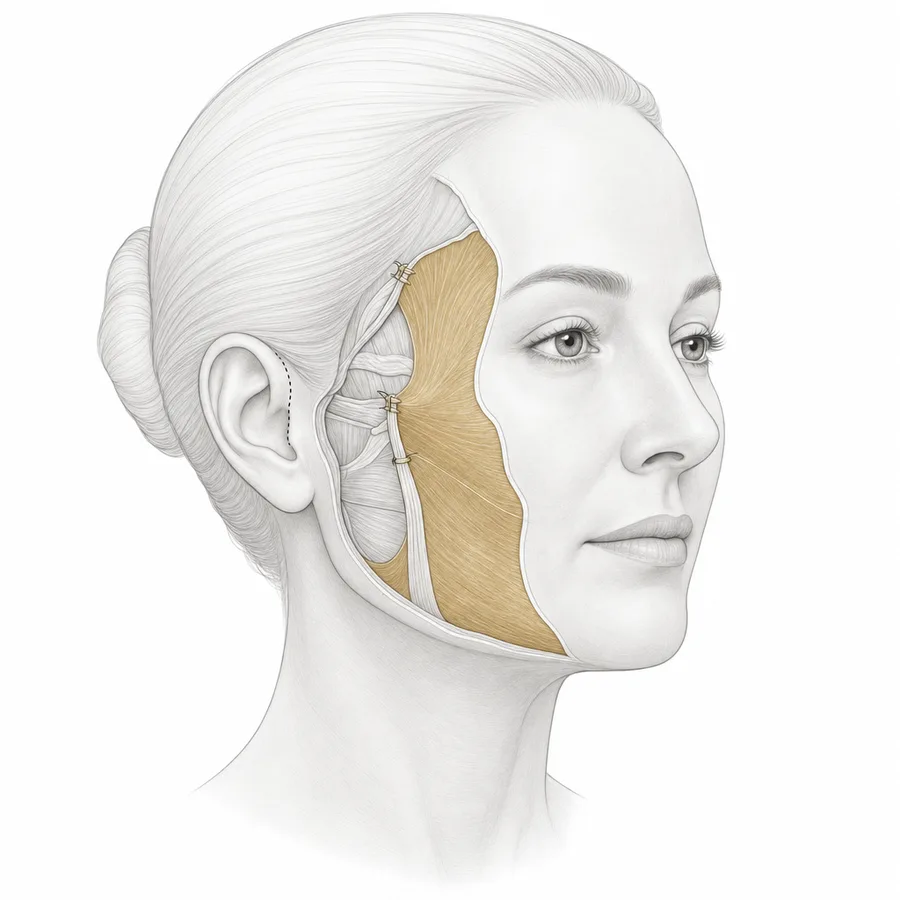 Structure beforeStructure after
Drag to compare
Quick Facts
| Procedure | Facelift · Full Face Lift |
|---|---|
| Surgeon | Dr. Seungsoo Kim (Board-certified Plastic Surgeon, 10+ yrs) |
| Key Technique | AVA Plastic Surgery 'Dual-Plane' Lifting |
| Time | 3 hours |
| Anesthesia | IV Sedation |
| Hospitalization | Not required |
| Stitch Removal | Day 10 |
| Follow-up Visits | 3–4 times |
| Recovery | From 2 weeks |
| Best For | Significant jowling and pronounced nasolabial folds · Loss of jawline definition · Desire for long-lasting, durable results |

The Key is the SMAS Layer
The SMAS — a thin muscular fascia situated just beneath the skin — acts as the structural scaffold that supports the face. As ageing progresses, this SMAS layer gradually loosens, causing the skin to sag and descend. Therefore, lifting the skin alone is insufficient; the lax SMAS must itself be repositioned for a truly fundamental lift.
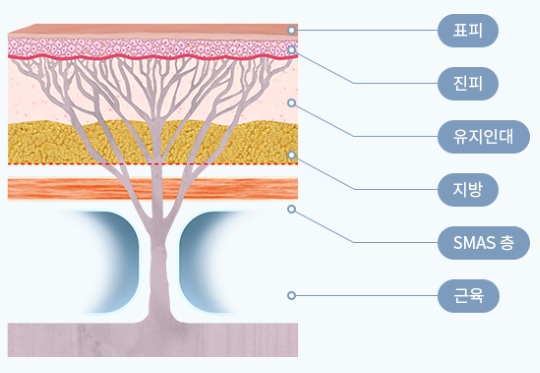
AVA Plastic Surgery 'Dual-Plane' Lifting
Dual-Layer Full Dissection
An advanced technique is applied in which the skin layer and the SMAS layer are each separated independently, then lifted in two distinct passes.
Long-Lasting Results
Unlike procedures that simply tighten the skin, direct manipulation of the fascial layer produces effects that last considerably longer.
Minimal Scarring
Because tension is directed to the SMAS rather than the skin, virtually no tension is placed on the incision line, allowing the scar to heal cleanly with minimal visibility.
Check Point Highly Recommended For
Facelift Procedure
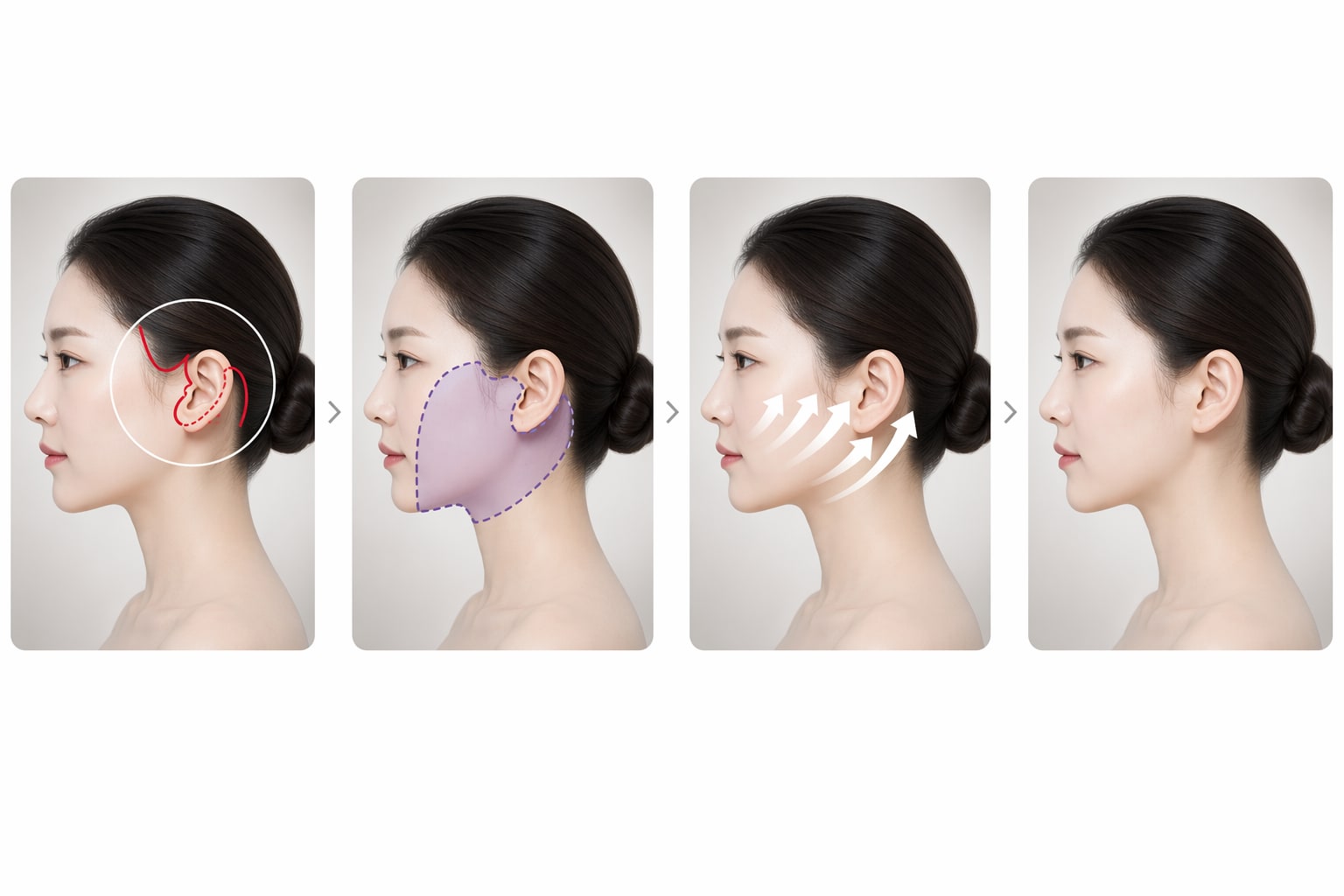
Hidden Incision Design
Incisions are designed to follow the natural contours in front of the ear and within the hairline, keeping any scarring concealed
Dual Dissection
The skin and SMAS layers are dissected separately to create the necessary space for independent lifting
SMAS Lifting
The lax SMAS layer is firmly lifted upward and secured in its elevated position
Skin Excision & Closure
Redundant skin is excised and the incisions are meticulously closed
Facelift Recovery Timeline
What can you expect, and when, after surgery?
Immediately Post-Op
You may return home once you have recovered from the anaesthetic. Keep the compression dressing in place and rest. Pain is well managed with prescribed medication.
Peak Swelling
Swelling and bruising reach their maximum during this period. Cold compresses are helpful. Please attend the clinic for your first dressing change.
Suture Removal
Sutures are removed. Swelling and bruising improve by 60–70%, and light outings are possible. The incision sites can be naturally concealed with your hairstyle.
Return to Daily Life
Most everyday activities can be resumed. More than 80% of swelling has subsided and the changes become visibly noticeable.
Settling Phase
Residual swelling has almost entirely resolved and the refreshed facial contour becomes clearly defined. Light exercise may be resumed.
Final Result
Scarring has fully matured and the dramatic improvement in skin elasticity represents the final outcome. The face reflects a rejuvenation of 10–15 years.
Single-Plane vs Dual-Deep Plane — Technique Comparison
The layer of dissection determines the result and recovery of a facelift. Below are the clinical characteristics of the Dual-Deep Plane technique applied at our clinic.
| Comparison Item | Standard Facelift | AVA Facelift |
|---|---|---|
| Dissection Approach | Skin-only / Single-layer dissection (Single-Plane) | Skin + SMAS dual-layer dissection (Dual-Deep Plane) |
| Tension Distribution | Tension concentrated on the skin | Tension distributed to the SMAS layer → Pursuing tension-free skin closure at the incision site |
| Scarring Burden | Tension on incision-site skin → potential for visible scarring | Multi-layer closure technique to minimise scarring burden (Individual variation) |
| Durability (Medical Literature) | Single-Plane: 5–10 years per Aesthet Surg J reports | Dual-Deep Plane: 5–15 years reported (Jacono AA, Aesthet Surg J 2015; individual variation) |
| Natural Appearance | Varies by technique | Pursuing three-dimensional restoration through multi-layer suspension (Results vary by individual) |
Deep Plane vs Dual-Deep Plane — Technical Differences
The names sound similar, but the dissection layers, closure methods, and outcomes are entirely different. The key distinction is whether the SMAS is treated as a single layer or divided into two independent layers.
| Comparison Item | Deep Plane | Dual-Deep Plane (AVA) |
|---|---|---|
| Dissection Layer | Skin → below SMAS Single-layer dissection only | Skin layer + SMAS layer Dissected separately as two layers |
| Lifting Method | Skin and SMAS are elevated together as a single unit | Skin and SMAS are lifted independently for precise adjustment |
| SMAS Management | Repositioned without incision → Overlapping suture (overlap) | SMAS is incised → Edge-to-edge suture |
| SMAS Incision Location | Lateral (primarily near the ear) | Closer to the midline (enabling precise contouring) |
| Skin Dissection Extent | Relatively limited | Wider dissection → Greater tissue redistribution possible |
| Lifting Strength | Moderate to strong | Strong (proportional to the extent of dissection) |
| Facial Contour Finish | SMAS overlap may result in a thickened contour | Edge-to-edge closure achieves a smooth, refined contour |
| Scarring | Limited skin dissection extent restricts tension distribution | Wider dissection distributes tension more evenly, favouring scar quality |
| Recovery Timeline | 1–3 months (improvement timeline is the same) | 1–3 months (improvement timeline is the same) |
| Early Step-Off Contour | Smaller dissection area means less initial step-off | Larger dissection area means a slightly more noticeable initial step-off may be visible |
| Degree of Swelling | Less | Slightly more may occur |
AVA Plastic Surgery adopts Dual-Deep Plane as the standard for facelift.
Which Technique Is Right for Which Patient?
Dual-Deep Plane is fundamentally the technique that produces superior results. Deep Plane is an option that may be selected based on recovery preferences or anatomical considerations.
| Patient Profile | Suitable for Deep Plane | Suitable for Dual-Deep Plane |
|---|---|---|
| Default Recommendation | An available option when minimising recovery step-off is a priority | Results-first approach (recommended for the majority of patients) |
| SMAS Thickness | Thin (overlap causes minimal contour change) | Average to thick (incision and closure manages thickness) |
| Cheekbone Prominence | Flat or gently contoured | Prominent (SMAS overlap must be avoided) |
| General Ethnic Tendency | Caucasian patients (often thin SMAS and flatter cheekbones) | Asian patients (often average-to-thick SMAS and prominent cheekbones) |
| Recovery Priority | Minimising early step-off contour | Maximising the final result (early step-off resolves naturally over 1–3 months) |
| Expected Outcome | Moderate to strong | Maximum |
| Final Recommendation | Deep Plane is also an excellent choice when anatomical conditions and recovery circumstances favour it | Intrinsically superior results → Default recommended technique |
Anti-Aging Procedures — At a Glance
The right fit depends on where the laxity is, how deep it runs, and your recovery window.
| Procedure | Area | Time | Anesthesia | Recovery | Key Technique |
|---|---|---|---|---|---|
| Facelift Full Face Lift | Full face, jaw, neck | 3 hours | IV Sedation | From 2 weeks | AVA Plastic Surgery 'Dual-Plane' Lifting |
| Mini Facelift Customised Mini Lift | Mid / lower face (choose) | 2 hours | IV Sedation | 1–2 weeks | Only the Incision Is Shorter — SMAS Dissection Is the Same |
| Forehead Lift Endoscopic Forehead Lift | Forehead, glabella, brow | 1 hour | IV Sedation | From 1 week | '1.5 cm × 4 Minimal Incisions' — No Visible Scarring |
| Sub-Brow Lift Sub-brow Lift | Upper lid, eye corners | 1 hour | Local / IV Sedation | From 1 week | AVA 'Dual-Plane' Sub-Brow Lift |
| Upper Blepharoplasty Upper Blepharoplasty | Upper eyelid | 1 hour | Local / IV Sedation | 1–2 weeks | Incisional Ptosis Correction — An Important Addition |
| Lower Blepharoplasty Lower Blepharoplasty | Lower eyelid | 1 hour | Local / IV Sedation | 1–2 weeks | Surgeon-customized approach |
| Philtrum Reduction Philtrum Reduction | Philtrum (nose-to-lip) | 1 hour | Local / IV Sedation | 1–2 weeks | Dual-Plane Philtrum Reduction |
| Corner Lip Lift Corner Lip Lift | Mouth corners, lips | 30–50 minutes | Local / IV Sedation | From 1 week | Scar Management Is the Essence — Triangular Flap Transposition |
Click a row to open that procedure.
The AVA Difference
AVA Dual-Deep Plane Lifting
Multi-layer dissection of SMAS and deep tissue with tension applied at the SMAS layer.
The incision-site skin is designed to remain tension-free.
Anatomy-Based Long-Term Design
Dissection depth and lift vectors are individually calibrated
based on Mendelson's midcheek anatomy and Jacono's long-term outcome data.
Patient Satisfaction Defines Completion
Surgery is complete not when sutures are removed,
but when the patient smiles in front of the mirror.
Who it’s not for
Not advised if you cannot set aside one to two weeks for recovery.
What we suggest instead
For mild sagging we start with a mini lift or an energy-based lifting treatment (Ulthera, Thermage); if hollow cheeks are the main issue, fat grafting comes first.
What are the possible side effects?
Pick a surgery date to see stitch removal, return to daily life and the earliest flight home as calendar dates. Confirmed at consultation.
- Arrive in Seoul · consultationD-1Fri, Sep 25
- SurgeryD+0Sat, Sep 26
- Stitch removalD+10Tue, Oct 6
- Back to daily lifeD+14Sat, Oct 10
- Earliest flight homeD+14Sat, Oct 10
- Major swelling settledD+30Mon, Oct 26
Individual recovery and combined procedures change the dates.
Cost depends on the extent of surgery, anesthesia and any combined procedures, and is quoted at consultation. The same criteria apply to every patient.
See current offersQ&A
- Mendelson BC, Jacobson SR. Surgical anatomy of the midcheek: facial layers, spaces, and the midcheek segments. Clin Plast Surg. 2008;35(3):395-404
- Jacono AA, Malone MH, Talei B. Three-dimensional analysis of long-term midface volume change after vertical vector deep-plane rhytidectomy. Aesthet Surg J. 2015;35(5):491-503
RELATED · Medical Terms
Post-op Instructions
- Do not rub the surgical area strongly for about a week.
- Avoid alcohol and smoking for at least 2 weeks as they delay recovery.
- Swelling and bruising vary individually but will gradually improve.
- Light walking or stretching helps reduce swelling.
Curious About This Procedure?
Our head surgeon provides a one-on-one assessment and a tailored treatment plan just for you. Results and recovery may vary by individual.