
Lower Blepharoplasty
in Seoul, Korea
AVA's detail lies in reconstructing the invisible core structures beneath the skin.
Lower Blepharoplasty
This procedure addresses the three age-related changes that occur beneath the eye — prolapsing fat, lax skin, and a descended orbicularis oculi muscle — and restores the under-eye area to its youthful state through precise management of all three components. Dual-plane dissection and lifting produce a fundamental rejuvenating effect.
Lower blepharoplasty adjusts the bulging fat, loose skin and lax muscle under the eye together, restoring the lower eyelid to its younger state.
Quick Facts
| Procedure | Lower Blepharoplasty · Lower Blepharoplasty |
|---|---|
| Surgeon | Dr. Seungsoo Kim (Board-certified Plastic Surgeon, 10+ yrs) |
| Key Technique | Custom surgical plan |
| Time | 1 hour |
| Anesthesia | Local / IV Sedation |
| Hospitalization | Not required |
| Stitch Removal | Days 5–7 |
| Follow-up Visits | 1–2 times |
| Recovery | 1–2 weeks |
| Best For | Prolapsing or prominent under-eye fat · Deepened fine lines beneath the eyes · Laxity of both skin and orbicularis oculi muscle · Cases where transconjunctival fat repositioning alone has limitations · Dark circles accompanied by structural laxity · Laxity of the lateral canthal tendon resulting in loss of the lower lid margin definition |

Three Age-Related Changes Beneath the Eye
It is not simply a matter of excess fat. Fat, skin, and muscle all change simultaneously — addressing all three is what delivers a truly fundamental solution.
| Area of Change | Aging Changes | Result |
|---|---|---|
| Fat | Prolapse (increased volume and projection) | Puffiness beneath the eye with a shadow forming below the bulge |
| Skin | Stretches and descends | Fine lines + lax skin + roughening of the surface texture |
| Muscle (orbicularis oculi) | Descent + loss of tone | Accelerated skin laxity + tired, heavy overall appearance |
Lower Blepharoplasty — Four-Component Management: Fat, Skin, and Muscle All Addressed
AVA lower blepharoplasty is not simply a skin-excision procedure. Four distinct age-related structures are each individually addressed to produce a fundamentally rejuvenating result.
Prolapsed fat
Precise excision
Reduction of under-eye puffiness
Orbicularis oculi (OOM) released from periosteum
Release + fat repositioning
Elimination of shadowing + restoration of a smooth transition
Lax skin
Dual-plane dissection + lifting + excision
Improvement of fine lines + restoration of smooth skin surface
Descended muscle
Dual-plane dissection + lifting + refinement
Fundamental rejuvenating effect (on a different level from skin-only tightening)
Check Point Highly Recommended For
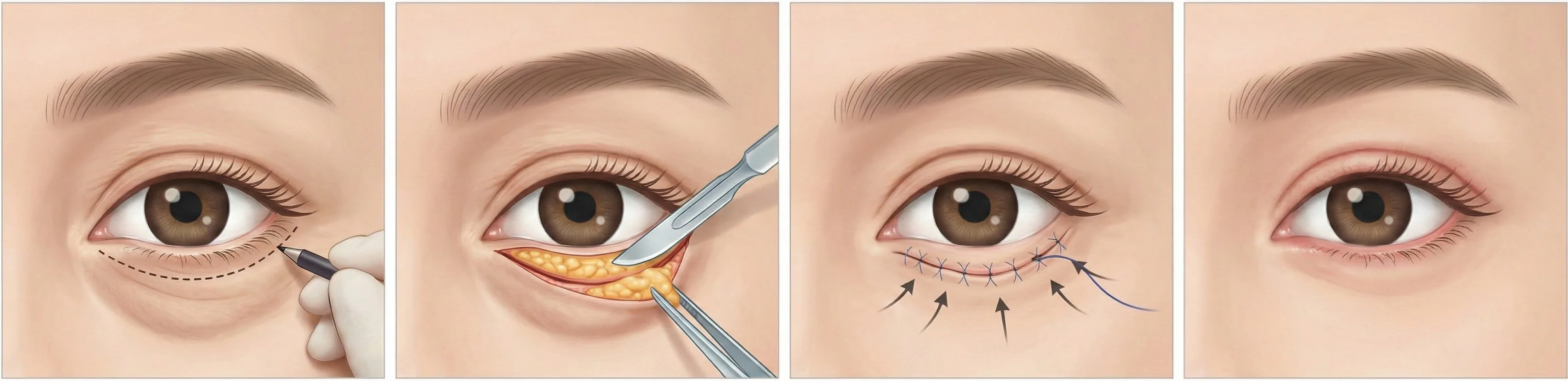
Lower Blepharoplasty Procedure
Incision Design
Precisely designed along a natural crease line immediately below the lash margin
Fat Management
Prolapsed fat excised + orbicularis oculi (OOM) released from periosteal adhesions + fat repositioning
Dual-Plane Lifting
Skin and muscle are dissected independently and elevated as two separate layers
Excision & Closure
Redundant skin and muscle tissue are removed, followed by tension-free micro-suture closure. Lateral canthal fixation is performed simultaneously if required.
The Hammock Structure of the Lower Lid — Why Lateral Canthal Fixation May Be Needed
The lower eyelid functions like a hammock, with the tarsal plate suspended between the periosteum on either side. As the supporting ligaments loosen with age, lateral canthal fixation or canthoplasty may need to be performed simultaneously.
| Normal (Young) | The lower lid tarsal plate is firmly suspended from the periosteum on both sides in a hammock-like structure — the lower lid margin remains taut and well defined. |
|---|---|
| Age-Related Changes | As the supporting ligaments loosen, both ends of the hammock begin to sag. The lower lid margin loses definition and the overall appearance becomes descended and tired. |
| Significantly Lax | Canthopexy or canthoplasty must be performed simultaneously with lower blepharoplasty. In this situation, a reinforcing procedure to re-anchor the supporting structures is essential. |
※ During consultation, the degree of lateral canthal laxity is assessed using the snap test and distraction test to determine whether simultaneous fixation is required.
Transconjunctival Fat Repositioning vs Lower Blepharoplasty — Which Is Right for You?
The mid-to-late 30s is the key turning point. Once laxity has begun, transconjunctival repositioning alone has inherent limitations.
| Comparison Item | Under-eye Fat Repositioning (Conjunctiva) | Lower Blepharoplasty |
|---|---|---|
| Recommended Age Group | Before mid-30s (sufficient in most cases) | From mid-40s onwards (or from late 30s when laxity is present) |
| Incision Location | Conjunctiva (inside the eyelid) No external scarring | Immediately below the lash margin (scar barely visible after healing) |
| Scope of Treatment | Fat only (repositioning) | Fat + skin + muscle All three components addressed |
| Laxity Resolution | Not possible (skin and muscle not addressed) | Possible (Dual-plane lifting) |
| Fine Line Improvement | Limited (only the base is changed) | Improvement possible (skin excision included) |
| Fundamental Rejuvenating Effect | Primarily shadow removal | Fat, skin, and muscle all restored to a more youthful state |
| Recovery Period | 1 week | 1–2 weeks |
| Lateral Canthal Reinforcement | Requires a separate procedure | Can be performed simultaneously (lateral canthal fixation or canthoplasty if needed) |
Anti-Aging Procedures — At a Glance
The right fit depends on where the laxity is, how deep it runs, and your recovery window.
| Procedure | Area | Time | Anesthesia | Recovery | Key Technique |
|---|---|---|---|---|---|
| Facelift Full Face Lift | Full face, jaw, neck | 3 hours | IV Sedation | From 2 weeks | AVA Plastic Surgery 'Dual-Plane' Lifting |
| Mini Facelift Customised Mini Lift | Mid / lower face (choose) | 2 hours | IV Sedation | 1–2 weeks | Only the Incision Is Shorter — SMAS Dissection Is the Same |
| Forehead Lift Endoscopic Forehead Lift | Forehead, glabella, brow | 1 hour | IV Sedation | From 1 week | '1.5 cm × 4 Minimal Incisions' — No Visible Scarring |
| Sub-Brow Lift Sub-brow Lift | Upper lid, eye corners | 1 hour | Local / IV Sedation | From 1 week | AVA 'Dual-Plane' Sub-Brow Lift |
| Upper Blepharoplasty Upper Blepharoplasty | Upper eyelid | 1 hour | Local / IV Sedation | 1–2 weeks | Incisional Ptosis Correction — An Important Addition |
| Lower Blepharoplasty Lower Blepharoplasty | Lower eyelid | 1 hour | Local / IV Sedation | 1–2 weeks | Surgeon-customized approach |
| Philtrum Reduction Philtrum Reduction | Philtrum (nose-to-lip) | 1 hour | Local / IV Sedation | 1–2 weeks | Dual-Plane Philtrum Reduction |
| Corner Lip Lift Corner Lip Lift | Mouth corners, lips | 30–50 minutes | Local / IV Sedation | From 1 week | Scar Management Is the Essence — Triangular Flap Transposition |
Click a row to open that procedure.
The AVA Difference
AVA Dual-Deep Plane Lifting
Multi-layer dissection of SMAS and deep tissue with tension applied at the SMAS layer.
The incision-site skin is designed to remain tension-free.
Anatomy-Based Long-Term Design
Dissection depth and lift vectors are individually calibrated
based on Mendelson's midcheek anatomy and Jacono's long-term outcome data.
Patient Satisfaction Defines Completion
Surgery is complete not when sutures are removed,
but when the patient smiles in front of the mirror.
Who it’s not for
Not advised if you only have hollowing under the eyes, without bulging fat or loose skin.
What we suggest instead
If you are younger and only the fat bulges, fat repositioning is used; if there is only hollowing, fat grafting or filler takes its place.
Pick a surgery date to see stitch removal, return to daily life and the earliest flight home as calendar dates. Confirmed at consultation.
- Arrive in Seoul · consultationD-1Fri, Sep 25
- SurgeryD+0Sat, Sep 26
- Stitch removalD+7Tue, Oct 6
- Back to daily lifeD+14Sat, Oct 10
- Earliest flight homeD+14Sat, Oct 10
- Major swelling settledD+30Mon, Oct 26
Individual recovery and combined procedures change the dates.
Cost depends on the extent of surgery, anesthesia and any combined procedures, and is quoted at consultation. The same criteria apply to every patient.
See current offersQ&A
Lower Blepharoplasty vs. Under-Eye Fat Repositioning — Why the Mid-30s Is the Dividing Line
2026-09-18 · AVA Journal
Under-Eye Fat Repositioning 101: Benefits, Transconjunctival Technique, Recovery & Precautions
2026-09-13 · AVA Journal
Why I Performed a Deep-Plane Facelift & Eyelid Surgery on My Own Mother — 2-Month Recovery Log
2026-10-06 · AVA Journal
RELATED · Medical Terms
Post-op Instructions
- Do not rub the surgical area strongly for about a week.
- Avoid alcohol and smoking for at least 2 weeks as they delay recovery.
- Swelling and bruising vary individually but will gradually improve.
- Light walking or stretching helps reduce swelling.
Curious About This Procedure?
Our head surgeon provides a one-on-one assessment and a tailored treatment plan just for you. Results and recovery may vary by individual.