
Non-incisional Double Eyelid Surgery in Seoul, Korea
Customized design for the most important part of your facial impression, restoring your natural beauty.
Natural Adhesion Double Eyelid
Addressing the drawbacks of conventional burial suture techniques, this method encourages natural adhesion between skin and muscle, creating a crease line that looks as though it has always been yours — subtle when eyes are closed and with a lower risk of loosening.
Quick Facts
| Procedure | Natural Adhesion Double Eyelid · Natural Adhesion |
|---|---|
| Surgeon | Dr. Seungsoo Kim (Board-certified Plastic Surgeon, 10+ yrs) |
| Time | 30 minutes |
| Anesthesia | IV Sedation / Local |
| Hospitalization | Not required |
| Stitch Removal | 3–5 days post-op |
| Follow-up Visits | 1–2 visits |
| Recovery | From day 3–4 |
| Best For | Thin eyelid skin with minimal ptosis or sagging · Concerns about incision scarring or reluctance to undergo full incision surgery · Desire for a natural result that remains invisible when eyes are closed · Need for a quick recovery and early return to daily activities · Previously had burial suture surgery with crease loosening |

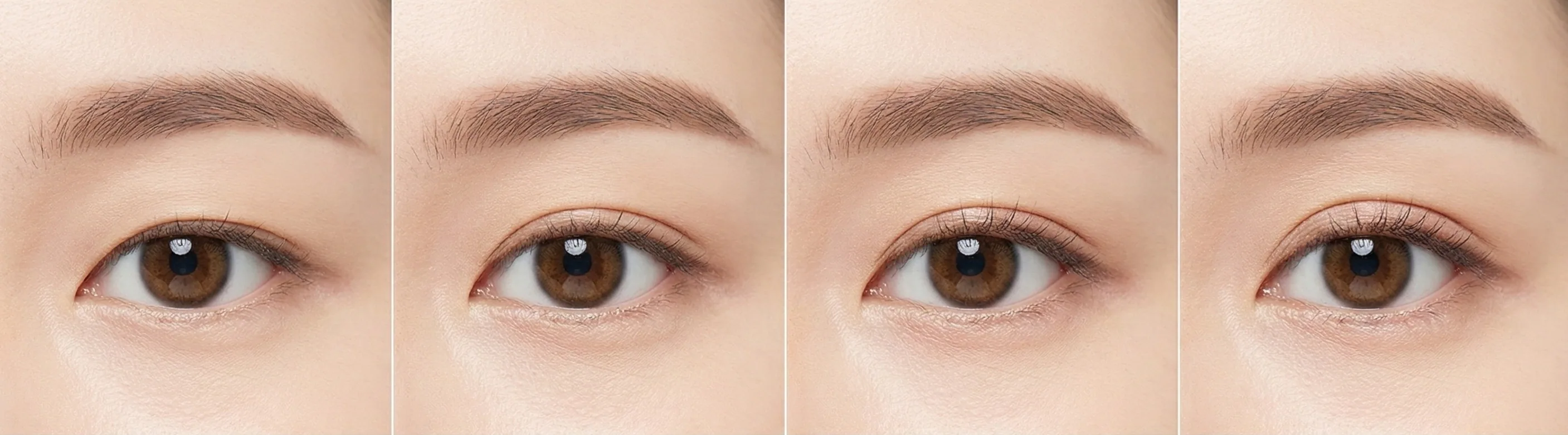
In-Line
The crease begins inside the epicanthal fold and gradually widens toward the outer corner, giving a natural, inner-fold look
In-Out Line
The crease starts just at the outer edge of the epicanthal fold and extends outward in a clean, open line — the most popular style among East Asian patients
Semi-Out Line
The starting point sits slightly higher than the In-Out Line, lending a more defined and polished look without feeling overdone
Out-Line
The crease begins outside the epicanthal fold and runs parallel to the lid margin, creating a bold, Western-inspired look
Check Point Highly Recommended For
Natural Adhesion Double Eyelid Procedure
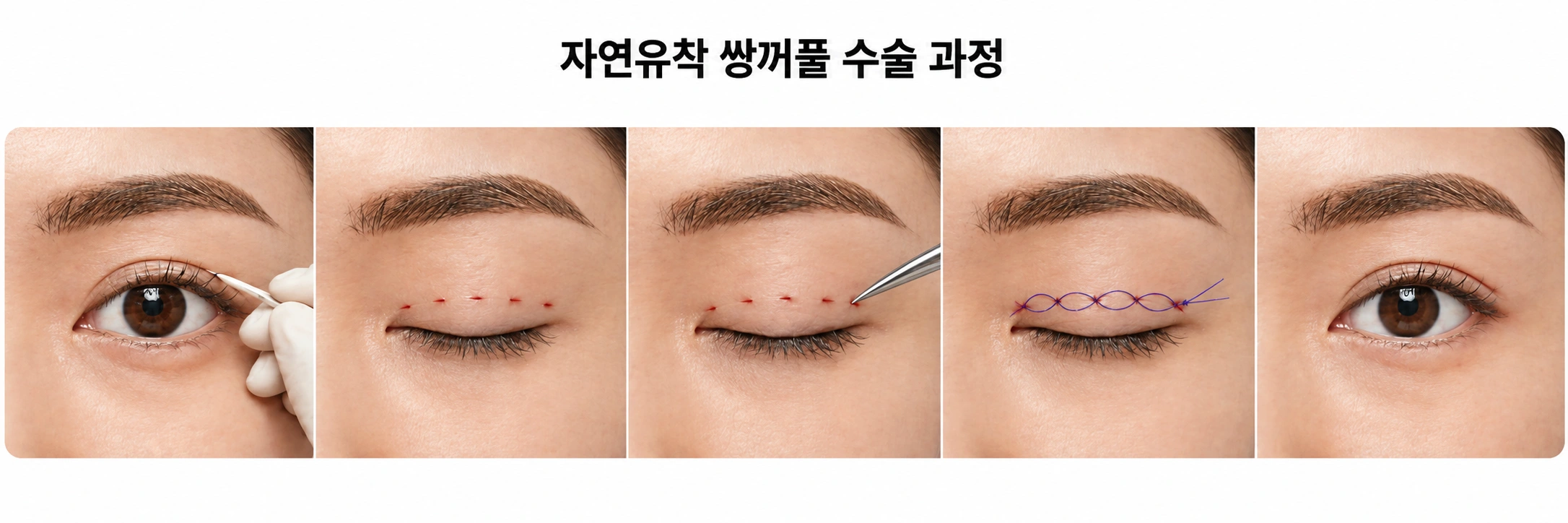
Customised Design
The most flattering crease line is designed by carefully evaluating the individual's eye shape and facial proportions.
Micro-Point Creation
Tiny micro-punctures are made along the designed crease line.
Natural Adhesion Induction
A suture connects the skin to the levator palpebrae superioris (the lid-lifting muscle), encouraging natural adhesion along the entire line.
Crease Completion
With minimal scarring concern, a crisp and natural-looking double eyelid crease is formed with a low risk of loosening.
Burial Suture vs Natural Adhesion vs Incision — Side-by-Side Comparison
Each of the three double eyelid techniques differs in its suturing principle, risk of loosening, and ideal candidate profile.
| Criteria | Burial Suture | Natural Adhesion | Incision Method |
|---|---|---|---|
| Suturing Method | 4–5 point knots along the crease line | Continuous suture along the line (passing back and forth between points) | Incision along the line followed by direct suturing and fixation |
| Adhesion Pattern | Point adhesion (4–5 points only) | Full-line adhesion (a line, not just points) | Incision-based direct and definitive adhesion |
| Risk of Loosening | Highest | Low (entire line secured) | Minimal |
| Line Precision | Moderate (only points secured) | High (desired shape reproduced accurately) | Very high |
| Combined Procedures | Not possible | Not possible | Skin excision, fat removal, and ptosis correction can be combined |
| Surgery Time | 20–30 minutes | 30 minutes | 1 hour |
| Recovery Period | 3–5 days | 3–5 days | 1 week |
| Scarring | None | None | Minimal (concealed within the crease line) |
| Ideal Candidate | Thin eyelid skin, prefers a subtle crease | Thin skin + precise crease desired + wants lower risk of loosening | Thick or sagging skin, ptosis, or revision surgery |
Eye Surgery Procedures — At a Glance
The right method depends on lid thickness, sagging, eye proportion, and revision needs.
| Procedure | Area | Time | Anesthesia | Recovery | Key Technique |
|---|---|---|---|---|---|
| Natural Adhesion Double Eyelid Natural Adhesion | Upper eyelid (double-fold line) | 30 minutes | IV Sedation / Local | From day 3–4 | Micro-tunnel + natural adhesion |
| Incision Double Eyelid Incision Method | Upper eyelid (skin/muscle/fat) | 1 hour | IV Sedation / Local | From 1 week post-op | Incision + tissue trim + line fixation |
| Canthoplasty Canthoplasty | Medial / lateral / lower canthus | 30 minutes | Local / IV Sedation | From 1 week post-op | CPF anchoring + skin redraping |
| Ptosis Correction Ptosis Correction | Upper eyelid (levator muscle) | 1 hour | IV Sedation | From 1 week post-op | Levator strengthening |
| Under-Eye Fat Repositioning Under Eye Fat Repositioning | Lower eyelid (conjunctiva/fat) | 30 minutes – 1 hour | IV Sedation | From 1 week post-op | Conjunctival fat repositioning |
| Revision Eye Surgery Revision Eye Surgery | Eye revision | 1–2 hours | IV Sedation | 2 weeks or more | Adhesion release + redesign |
Click a row to open that procedure.
The AVA Difference
Natural Adhesion Technique
Tissue is repositioned along natural planes and secured at multiple points.
Designed to reduce loosening and align with the patient's intrinsic contour.
Levator Aponeurosis Ptosis Correction
Ptosis is addressed by shortening and refixing the levator aponeurosis,
restoring natural eyelid flow.
Patient Satisfaction Defines Completion
Surgery is complete not when sutures are removed,
but when the patient smiles in front of the mirror.
Natural-adhesion double eyelid surgery creates a subtle, low-loosening crease without an incision by bonding the skin to the eyelid-opening muscle.
Answer three questions to get a first direction based on the surgeon's logic. For reference only; confirmed at consultation.
Q1.Does your eyebrow sit below the bony rim above the eye?
Q2.Is there enough eyelid skin to touch the lashes?
Q3.Do your eyes look small or sleepy unless you raise your forehead?
Start with a forehead lift
The brow, not the eyelid, has descended. Removing eyelid skin alone pulls the brow lower, so restoring brow position comes first.
Self-check is for reference. Brow position, skin excess and lid-opening strength are measured at consultation.
Ptosis correction
The lid-opening muscle is weak. Removing skin will not open the eye, so the muscle is addressed first.
Self-check is for reference. Brow position, skin excess and lid-opening strength are measured at consultation.
Upper blepharoplasty or sub-brow lift
Brow and muscle are fine; skin excess is the issue. Inner excess suits upper blepharoplasty, outer (corner) excess suits a sub-brow lift.
Self-check is for reference. Brow position, skin excess and lid-opening strength are measured at consultation.
Ptosis correction + upper blepharoplasty
Both muscle weakness and skin excess are present. Incisional ptosis repair shares the same incision as upper blepharoplasty.
Self-check is for reference. Brow position, skin excess and lid-opening strength are measured at consultation.
Surgery may not be urgent
If none apply, the concern may be the crease or the lower lid. Tell us the impression you want at consultation.
Self-check is for reference. Brow position, skin excess and lid-opening strength are measured at consultation.
Who it’s not for
Not advised when excess skin has to be removed, or when previous buried-suture procedures have come undone several times.
What we suggest instead
Thick lids and excess skin call for the incisional method, or for a sub-brow lift done at the same time; weak eye-opening strength calls for ptosis correction.
Pick a surgery date to see stitch removal, return to daily life and the earliest flight home as calendar dates. Confirmed at consultation.
- Arrive in Seoul · consultationD-1Fri, Sep 25
- SurgeryD+0Sat, Sep 26
- Stitch removalD+5Thu, Oct 1
- Back to daily lifeD+4Wed, Sep 30
- Earliest flight homeD+5Thu, Oct 1
- Major swelling settledD+30Mon, Oct 26
Individual recovery and combined procedures change the dates.
Cost depends on the extent of surgery, anesthesia and any combined procedures, and is quoted at consultation. The same criteria apply to every patient.
See current offersQ&A
Post-op Instructions
- Do not rub the surgical area strongly for about a week.
- Avoid alcohol and smoking for at least 2 weeks as they delay recovery.
- Swelling and bruising vary individually but will gradually improve.
- Light walking or stretching helps reduce swelling.
Curious About This Procedure?
Our head surgeon provides a one-on-one assessment and a tailored treatment plan just for you. Results and recovery may vary by individual.