Mini SMAS Facelift vs. Full Dual-Deep Plane Facelift — Two-Axis Anatomical Guide to Extent, Plane & Recovery
- Choosing between a Mini Facelift and a Full Facelift involves two distinct anatomical axes: extent of dissection/incision (localized lower-cheek jowl & jawline vs. combined midface, jawline, and neck platysma) and plane of dissection (true sub-SMAS & ligament release vs. skin-only tension).
- Even in a short-scar Mini SMAS Facelift, durable contour and fine retro-tragal scars require releasing lower-face retaining ligaments and anchoring tension on the deep SMAS fascia—never pulling skin alone.
- Patients in their 30s–40s with early jowling and minimal neck laxity are ideal candidates for a Mini SMAS Lift (7–8 day Seoul stay), whereas combined midface descent, deep jowls, and cervical/platysmal laxity call for a Full Dual-Deep Plane Facelift (10–14 day stay).
"Dr. Kim, my main concern is early jowling around the corners of my mouth and a softening jawline—do I really need a full facelift, or is a Mini Facelift enough? On the other hand, I have heard that mini facelifts only pull the skin and relapse quickly. How do I choose?" — The true clinical distinction between a Mini Facelift and a Full Facelift is not whether the SMAS layer is lifted, but rather (1) the anatomical extent of sagging (localized lower-cheek jowls vs. combined midface, jawline, and neck platysma) and (2) the incision and dissection range required to reach those structures.
Hello, I am Dr. Seungsoo Kim, Chief Director and Board-Certified Plastic Surgeon at AVA Plastic Surgery in Sinsa, Gangnam, Seoul.
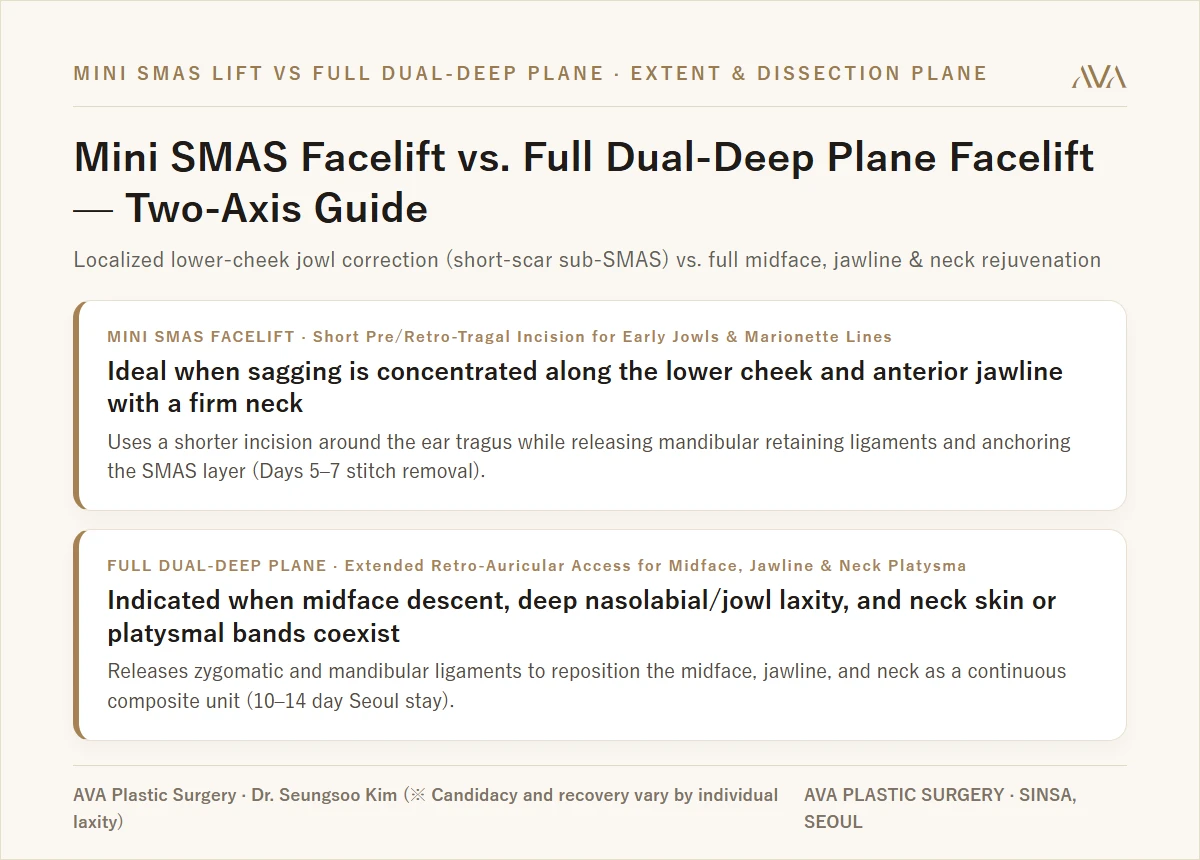
During consultations with patients in their late 30s through 50s, one of the most frequent dilemmas is choosing between a Mini SMAS Facelift and a Full Dual-Deep Plane Facelift. Non-surgical devices (Ultherapy, Thermage) or thread lifts may no longer hold back descending jowl fat and marionette lines, yet a full retro-auricular neck incision can feel excessive if the neck is still firm. In this column, I explain how we evaluate candidacy along two independent anatomical axes: plane of dissection and extent of correction.
01. Axis 1 (Plane of Dissection): Why a True Mini Facelift Is Never a "Skin-Only" Pull
The misconception that "mini facelifts relapse within a few months" comes from superficial, skin-only mini lifts. When a surgeon undermines only the subcutaneous skin, trims a strip in front of the ear, and pulls the skin tight with sutures, two problems follow: elastic skin stretches back out under gravity, and high tension along the incision causes widened scars or a pulled earlobe (pixie ear deformity).
At AVA Plastic Surgery, our Mini SMAS Facelift shortens the external incision length while adhering strictly to the same deep structural principle as our full facelift:
- Sub-SMAS Dissection & Retaining Ligament Release: Working through a concealed pre- and retro-tragal incision, we enter beneath the lower-face SMAS fascia and release the mandibular osteocutaneous and masseteric cutaneous ligaments that tether the jowl and marionette fold.
- Deep Fascial Anchoring & Tension-Offloaded Skin Closure: The primary lifting load is anchored onto the firm SMAS fascia, allowing the overlying skin to be redraped smoothly and closed without excess surface tension.
02. Axis 2 (Extent of Correction & Incision Design): Mini SMAS Lift vs. Full Dual-Deep Plane Facelift
If both procedures elevate the deep SMAS layer and release retaining ligaments, how do we decide between them? The answer lies in how far the aging cascade has progressed across the midface, lower jawline, and neck:
- When a Mini SMAS Facelift Is Ideal:
- Sagging is concentrated in the lower cheek, early jowls, marionette folds, and anterior-to-mid jawline (commonly patients in their late 30s to early 50s, or after facial bone contouring).
- The submental area and neck remain relatively firm, without prominent vertical platysmal bands or redundant cervical skin.
- Incision Design: Concealed along the lower sideburn tuft, the natural retro-tragal shadow of the ear cartilage, and wrapping just around the earlobe crease—avoiding a long retro-auricular or posterior hairline extension.
- When a Full Dual-Deep Plane Facelift Is Indicated:
- Aging spans multiple zones simultaneously: midface malar fat descent, deep nasolabial folds, heavy jowls, blunted cervicomental angle, and neck/platysmal laxity.
- Incision & Dissection Extent: Extends from the temporal/pre-auricular contour around the earlobe into the retro-auricular groove and posterior hairline, allowing release of both zygomatic and mandibular retaining ligaments and simultaneous lateral/medial platysma tightening.
03. Recovery Timeline & Recommended Stay in Seoul (7–8 Days vs. 10–14 Days)
- Mini SMAS Facelift Recovery (7–8 Day Seoul Stay): Because posterior neck dissection is minimized, early swelling and bruising resolve faster. Fine pre-auricular sutures are removed at postoperative days 5 to 7, allowing international patients to fly home comfortably around Day 7 or 8.
- Full Dual-Deep Plane Facelift Recovery (10–14 Day Seoul Stay): Because the midface, jawline, and neck are repositioned together, suture removal is staged: pre-auricular stitches at days 5 to 7, followed by retro-auricular and scalp sutures at days 10 to 12. Major social swelling settles within 2 to 3 weeks, with progressive deep tissue softening over 3 to 6 months.
※ Clinical Notice: Both Mini SMAS Facelift and Full Dual-Deep Plane Facelift require an in-person anatomical assessment of skin elasticity, retaining ligament laxity, and neck structure. Potential surgical risks include bleeding, hematoma, infection, temporary numbness, facial nerve branch injury, asymmetry, delayed wound healing or skin necrosis (especially in smokers), and scar hypertrophy. Strict smoking/nicotine cessation before and after surgery is mandatory.
Book Your 1:1 Consultation with Dr. Seungsoo Kim
Whether you are flying in from overseas or living in Korea, Dr. Seungsoo Kim personally oversees every step from initial consultation to surgery and recovery:
- 📅 Book a 1:1 Zoom Video Pre-Consultation or Seoul Clinic Visit (English Booking Hub) →
- 📖 Read Dr. Kim's Mother's Deep-Plane Facelift & Eyelid Surgery 2-Month Recovery Log →
- ✨ View Deep-Plane Facelift Guide & 1-Year Follow-Up Cases →
- 👁️ View Upper Eyelid, Sub-Brow & Forehead Lift Guide →
- 💬 Chat Directly on WhatsApp (+82 10-3705-3423) →
📍 AVA Plastic Surgery · 4F Insung Building, 603 Gangnam-daero, Seocho-gu, Seoul (1-min walk from Sinsa Station Exit 4) · TEL +82 2-545-1882
※ Surgical & Consultation Notice: 1:1 Zoom video consultations provide a preliminary educational assessment; final surgical candidacy and operative plans are confirmed through an in-person clinical examination by Dr. Seungsoo Kim in Seoul. Post-operative complications such as bleeding, infection, swelling, scarring, asymmetry, or sensory changes may occur, and results and recovery vary by individual.
Frequently Asked Clinical Questions (FAQ)
Q. What is the main anatomical difference between a Mini Facelift and a Full Deep-Plane Facelift?
The distinction lies primarily in the anatomical extent of correction and incision length rather than skipping the SMAS layer. A Mini SMAS Facelift uses a shorter incision confined around the natural pre- and retro-tragal ear creases to target localized lower-cheek jowling and marionette lines when the neck remains firm. A Full Dual-Deep Plane Facelift extends the incision behind the ear and releases both zygomatic and mandibular retaining ligaments to reposition the midface, lower jawline, and neck platysma as one continuous unit.
Q. Does a Mini Facelift only pull the skin, or does it also lift the SMAS layer?
Skin-only mini lifts stretch out quickly and risk widened scars or earlobe distortion because skin is elastic and cannot bear gravitational load. At AVA Plastic Surgery, Dr. Seungsoo Kim performs every Mini Facelift at the sub-SMAS plane—releasing the mandibular osteocutaneous ligaments, suspending the SMAS fascia securely, and redraping the skin without excess surface tension.
Q. How do recovery timelines and recommended stays in Seoul compare between a Mini and Full Facelift?
Because a Mini SMAS Facelift avoids extensive retro-auricular and posterior neck dissection, sutures are removed around postoperative days 5 to 7 and international patients typically stay in Seoul for 7 to 8 days. A Full Dual-Deep Plane Facelift involves staged suture removal—pre-auricular stitches at days 5 to 7 and retro-auricular/scalp sutures at days 10 to 12—so a 10-to-14-day stay in Seoul is recommended.
Read the original Naver blog post ·