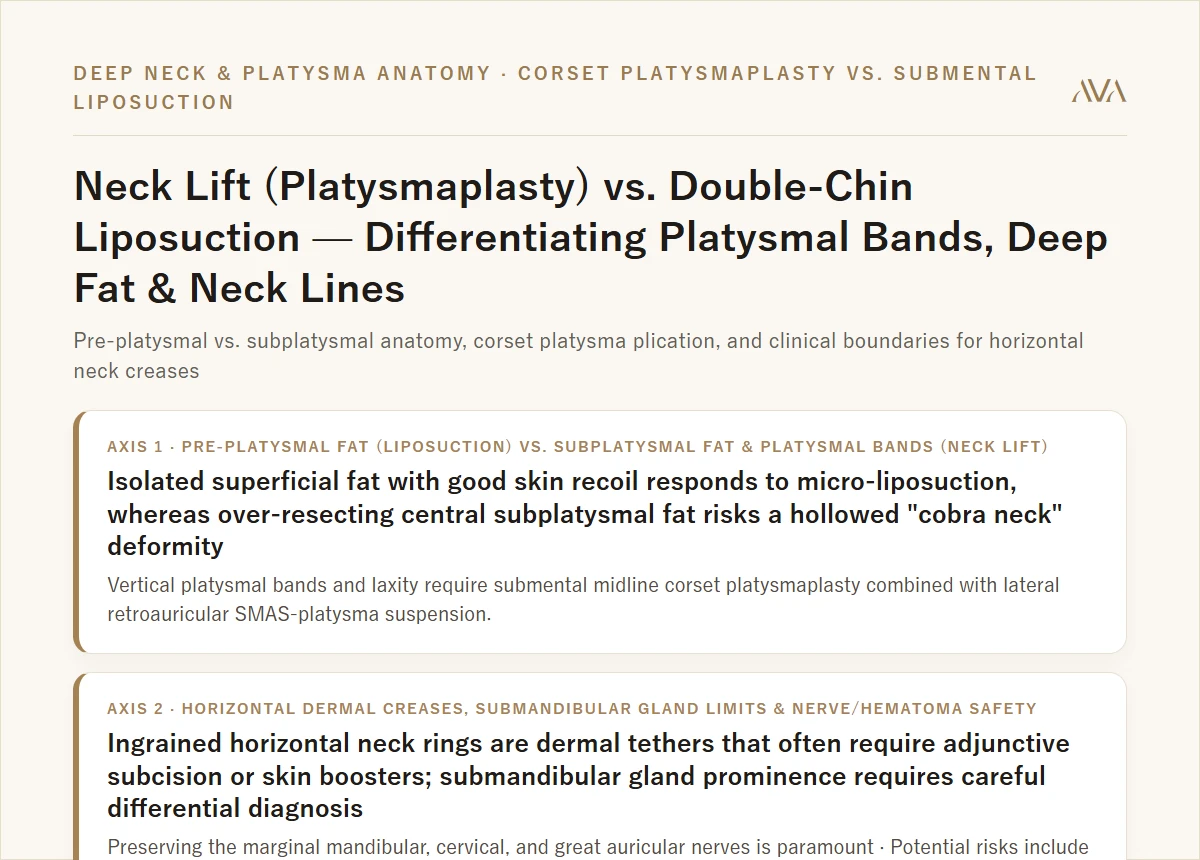
Neck Lift (Platysmaplasty) vs. Double-Chin Liposuction — Bands, Deep Fat & Neck Lines
- Blunted submental and neck contours stem from distinct anatomical layers: (1) superficial pre-platysmal fat (amenable to micro-liposuction when skin recoil is strong), (2) deep subplatysmal fat, anterior digastric muscle bulk, or submandibular gland ptosis, and (3) separated vertical platysmal bands ("turkey neck") with skin laxity requiring midline corset platysmaplasty and lateral SMAS-platysma suspension.
- Ingrained horizontal neck creases are dermal-fibrous tethers that surgical lifting softens but cannot completely erase without adjunctive dermal therapies (micro-subcision or skin/collagen boosters); likewise, over-resecting central subplatysmal fat risks a hollowed "cobra neck" deformity, demanding conservative deep-plane contouring.
- Potential side effects and surgical risks of neck lift (platysmaplasty) and submental liposuction include bleeding, hematoma, seroma, infection, delayed healing or skin-flap ischemia (markedly higher in smokers), temporary numbness or lower-lip asymmetry from great auricular or marginal mandibular/cervical nerve traction, sialocele if salivary tissues are irritated, contour irregularity, and visible scarring.
"Dr. Kim, my jawline has blended into my neck and I see vertical cords when I speak. Will double-chin liposuction tighten my neck, or do I need a surgical neck lift with muscle tightening? And can a neck lift also erase my horizontal neck rings and the small bulges under my jaw?" — Restoring a crisp cervicomental angle begins with (1) differentiating superficial pre-platysmal fat from deep subplatysmal fat, digastric bulk, submandibular gland ptosis, and separated vertical platysmal bands, and (2) understanding which structures are corrected by midline corset platysmaplasty and lateral SMAS-platysma suspension versus ingrained dermal horizontal neck creases that require adjunctive dermal care.
Hello. I am Dr. Seungsoo Kim, Chief Director and Board-Certified Plastic Surgeon at AVA Plastic Surgery in Sinsa, Gangnam, Seoul.
In our Neck Lift & Platysmaplasty Center and Facial Micro-Liposuction Clinic, we frequently meet patients who previously underwent submental liposuction or fat-dissolving injections elsewhere, yet still feel their submental profile looks heavy—or worse, noticed that vertical neck cords became more visible afterward. This happens because the neck is not a single fat pad; it is a multi-layered anatomical structure consisting of skin — superficial pre-platysmal fat — the platysma muscle — deep subplatysmal fat — and the anterior digastric muscles and submandibular glands.
01. Anatomical Decision Tree: Submental Micro-Liposuction Alone vs. Surgical Neck Lift (Platysmaplasty)
A blunted neck-to-chin contour originates from one or more of three distinct anatomical planes, each requiring a tailored surgical strategy:
- Plane 1 — Superficial Pre-Platysmal Fat Excess (Micro-Liposuction Indication):
- Clinical Profile: When a patient in their 20s or 30s has strong skin elasticity, an intact platysma muscle floor, and fullness located strictly superficial to the platysma muscle, facial micro-liposuction alone allows the skin envelope to contract smoothly against the mandible and restore a clean cervicomental angle (ideally 105°–120°).
- Why Liposuction Alone Fails in Lax Necks: If skin recoil is diminished or the underlying fullness is deep to the platysma, aggressively suctioning superficial fat leaves deflated, redundant skin and unmasks vertical platysmal cords directly beneath the dermis.
- Plane 2 — Deep Subplatysmal Fat & Preventing the "Cobra Neck" Deformity:
- Clinical Profile: A thick central fat pad lying beneath the platysma muscle cannot be safely or effectively reached by blind superficial liposuction cannulas.
- Conservative Direct Sculpting: Through a concealed 2–3 cm incision inside the natural submental crease, we elevate the medial platysmal edges and sculpt excess subplatysmal fat under direct vision. However, over-resecting central subplatysmal fat hollows out the midline while leaving the lateral digastric muscles and submandibular glands prominent—creating an unnatural "cobra neck" deformity. Preserving a smooth anatomical transition is essential.
- Plane 3 — Vertical Platysmal Bands ("Turkey Neck") & Midline Corset Platysmaplasty:
- Mechanism of Vertical Bands: With aging, the left and right medial borders of the platysma muscle separate (decussation laxity) and contract into two vertical bowstrings along the anterior neck.
- Midline Corset Plication + Lateral SMAS-Platysma Suspension: We approximate and suture the separated medial platysmal borders together in the midline like a supportive corset (Corset Platysmaplasty) to rebuild a firm muscular hammock under the chin. When lateral neck skin laxity and jowling are also present, we combine this with a retroauricular and posterior hairline incision to suspend the lateral SMAS-platysma unit upward and backward (Dual-Deep Plane Facelift & Neck Lift).
02. Clinical Boundaries: Horizontal Dermal Neck Creases & Submandibular Gland Prominence
Accurate preoperative counseling requires distinguishing what a surgical neck lift corrects from conditions that require different or adjunctive management:
- Vertical Platysmal Cords vs. Ingrained Horizontal Neck Lines: Corset platysmaplasty and lateral neck lifting are designed to correct vertical muscular bands, submental fullness, and sagging neck skin. By contrast, horizontal "necklace lines" are congenital or posture-related dermal-fibrous adhesions. While redraping the skin reduces folding tension, deeply etched dermal grooves will not vanish from pulling alone; they often require staged micro-cannula subcision, dermal skin boosters, or collagen biostimulators.
- Lateral Submandibular Fullness — Submandibular Gland Ptosis: When walnut-sized lateral bulges persist beneath the jawline even after fat contouring, the cause is often a ptotic (drooping) submandibular salivary gland or prominent anterior digastric belly rather than fat. Any asymmetric or firm mass must first be evaluated (e.g., via ultrasound) to rule out salivary gland pathology. Because direct surgical reduction of the submandibular gland carries specific deep-neck risks—including deep hemorrhage, sialocele (saliva collection), dry mouth, and proximity to the marginal mandibular, lingual, and hypoglossal nerves—we carefully evaluate whether supportive platysmal sling suspension can safely camouflage mild ptosis.
03. Concealed Incisions, Nerve Preservation & Recovery Timeline
- Concealed Incision Design & Tension-Free Closure: Isolated anterior platysmaplasty uses a 2–3 cm incision hidden inside the submental crease beneath the chin. Full neck lifting adds incisions concealed within the retroauricular sulcus behind the ear and along the posterior hairline, placing all suspensory tension on the deep fascia so the skin closes without tension.
- Protecting Key Cervical & Facial Nerves: Dissection respects the anatomical planes protecting the marginal mandibular and cervical branches of the facial nerve (which control lower-lip symmetry) and the great auricular nerve over the sternocleidomastoid muscle (which supplies earlobe and lateral neck sensation).
- Recovery Milestones: Sutures are removed between postoperative days 7 and 14. Major swelling and bruising resolve over 2 to 3 weeks, followed by a normal physiological phase of deep subcutaneous firmness between weeks 3 and 8 before the neck contour softens fully over 3 to 6 months.
※ Clinical & Regulatory Notice: Surgical neck lift (platysmaplasty) and submental liposuction outcomes and recovery timelines vary according to individual skin elasticity, platysmal laxity, deep fat volume, and submandibular anatomy. Potential risks and side effects include bleeding, acute hematoma (requiring prompt drainage), seroma, infection, delayed wound healing or skin-flap necrosis (risk is substantially higher in smokers, requiring strict smoking cessation before and after surgery), temporary or persistent numbness around the ear and neck (great auricular nerve traction), temporary lower-lip asymmetry (marginal mandibular or cervical branch irritation), sialocele if salivary tissues are irritated, central "cobra neck" hollowing from over-resection, contour irregularity, and hypertrophic or keloid scarring. Always complete a 1-on-1 in-person examination with a board-certified plastic surgeon before deciding on surgery.

Book Your 1:1 Consultation with Dr. Seungsoo Kim
Whether you are flying in from overseas or living in Korea, Dr. Seungsoo Kim personally oversees every step from initial consultation to surgery and recovery:
- 📅 Book a 1:1 Zoom Video Pre-Consultation or Seoul Clinic Visit (English Booking Hub) →
- 📖 Read Dr. Kim's Mother's Deep-Plane Facelift & Eyelid Surgery 2-Month Recovery Log →
- ✨ View Deep-Plane Facelift Guide & 1-Year Follow-Up Cases →
- 👁️ View Upper Eyelid, Sub-Brow & Forehead Lift Guide →
- 💬 Chat Directly on WhatsApp (+82 10-3705-3423) →
📍 AVA Plastic Surgery · 4F Insung Building, 603 Gangnam-daero, Seocho-gu, Seoul (1-min walk from Sinsa Station Exit 4) · TEL +82 2-545-1882
※ Surgical & Consultation Notice: 1:1 Zoom video consultations provide a preliminary educational assessment; final surgical candidacy and operative plans are confirmed through an in-person clinical examination by Dr. Seungsoo Kim in Seoul. Post-operative complications such as bleeding, infection, swelling, scarring, asymmetry, or sensory changes may occur, and results and recovery vary by individual.
Frequently Asked Clinical Questions (FAQ)
Q. When is submental liposuction alone sufficient versus a surgical neck lift with platysmaplasty?
In patients with firm skin elasticity and fullness confined to the superficial pre-platysmal fat layer, micro-cannula liposuction alone can cleanly define the cervicomental angle. However, if fullness lies deep to the platysma muscle (subplatysmal fat), if the medial edges of the platysma have separated into vertical bands ("turkey neck"), or if skin elasticity is reduced, liposuction alone will leave redundant skin or unmask deeper bands. Those cases require submental midline corset platysmaplasty and lateral retroauricular SMAS-platysma suspension.
Q. Can a surgical neck lift completely remove horizontal neck rings and prominent submandibular glands?
A surgical neck lift and corset platysmaplasty directly correct vertical platysmal bands, muscular laxity, and excess neck skin. Deeply etched horizontal neck lines, however, represent dermal adhesions; while redraping reduces skin folding, residual dermal creases often benefit from staged micro-subcision, dermal fillers, or biostimulators. Lateral submandibular fullness caused by ptotic submandibular glands must first be differentiated from pathological enlargement, and any deep-neck management must weigh platysmal sling support against risks such as bleeding, sialocele, and nerve proximity.
Q. Where are neck lift incisions placed, and what are the potential side effects and recovery milestones?
Midline platysmaplasty uses a concealed 2–3 cm incision tucked inside the natural submental crease beneath the chin; when lateral skin redraping is required, incisions are hidden within the retroauricular crease behind the ear and along the posterior hairline using tension-free closure. Sutures are typically removed between Days 7 and 14, with major swelling subsiding over 2–3 weeks. Potential side effects include hematoma, seroma, infection, skin-flap necrosis (strictly requiring smoking cessation before and after surgery), temporary ear/neck numbness or marginal mandibular nerve weakness, cobra-neck hollowing if central deep fat is over-resected, and hypertrophic scarring.