High SMAS vs Low SMAS: Midface and Nasolabial Fold Improvement
High SMAS vs Low SMAS Facelift: How the SMAS Incision Starting Point Determines Midface and Nasolabial Fold Improvement

"Why did my jawline lift while my midface and nasolabial folds stayed the same?" This is one of the most common questions patients ask when researching a facelift. Much of the answer lies in how high the surgeon starts the SMAS incision when dissecting beneath the SMAS layer [1].
In short, whereas terms like SMASectomy, SMAS plication, Deep-Plane, and Dual-Deep Plane describe the surgical method and plane of dissection, High SMAS versus Low SMAS classifies a facelift by the anatomical starting height of the SMAS incision line when entering the sub-SMAS plane [1][2]. In this column, I explain from a board-certified plastic surgeon's perspective how the starting position of the SMAS incision changes the area of improvement—and why combining a High SMAS facelift with a subciliary midface lift creates powerful synergy for nasolabial fold rejuvenation.
What Does a Low SMAS (Standard SMAS) Facelift Lift?
A conventional Low SMAS (standard SMAS) facelift places the starting point of the SMAS incision below the zygomatic arch (cheekbone arch) when dissecting beneath the SMAS, focusing lifting forces primarily on the lower face and jawline [1].
Because the SMAS incision begins below the zygomatic arch, the vector of traction is transmitted mainly to the lower facial structures:
1. Sagging tissue along the jawline (jowls)
2. Laxity of the lateral and lower cheeks
3. The contour extending just below the mandibular border
As the starting point of the SMAS incision moves lower, the anatomical area that can be improved shrinks [1]. An SMAS flap elevated below the zygomatic arch has a structural limitation: it cannot adequately release and elevate the midface, under-eye cheek transition, or nasolabial fold [1].
How Is a High SMAS Facelift Different?
A High SMAS facelift begins the SMAS incision above the zygomatic arch when dissecting beneath the SMAS, allowing sub-SMAS dissection to extend thoroughly into the midface so that a single unified flap can improve the midface, cheeks, jawline, and the lower half of the nasolabial fold together [1][3].
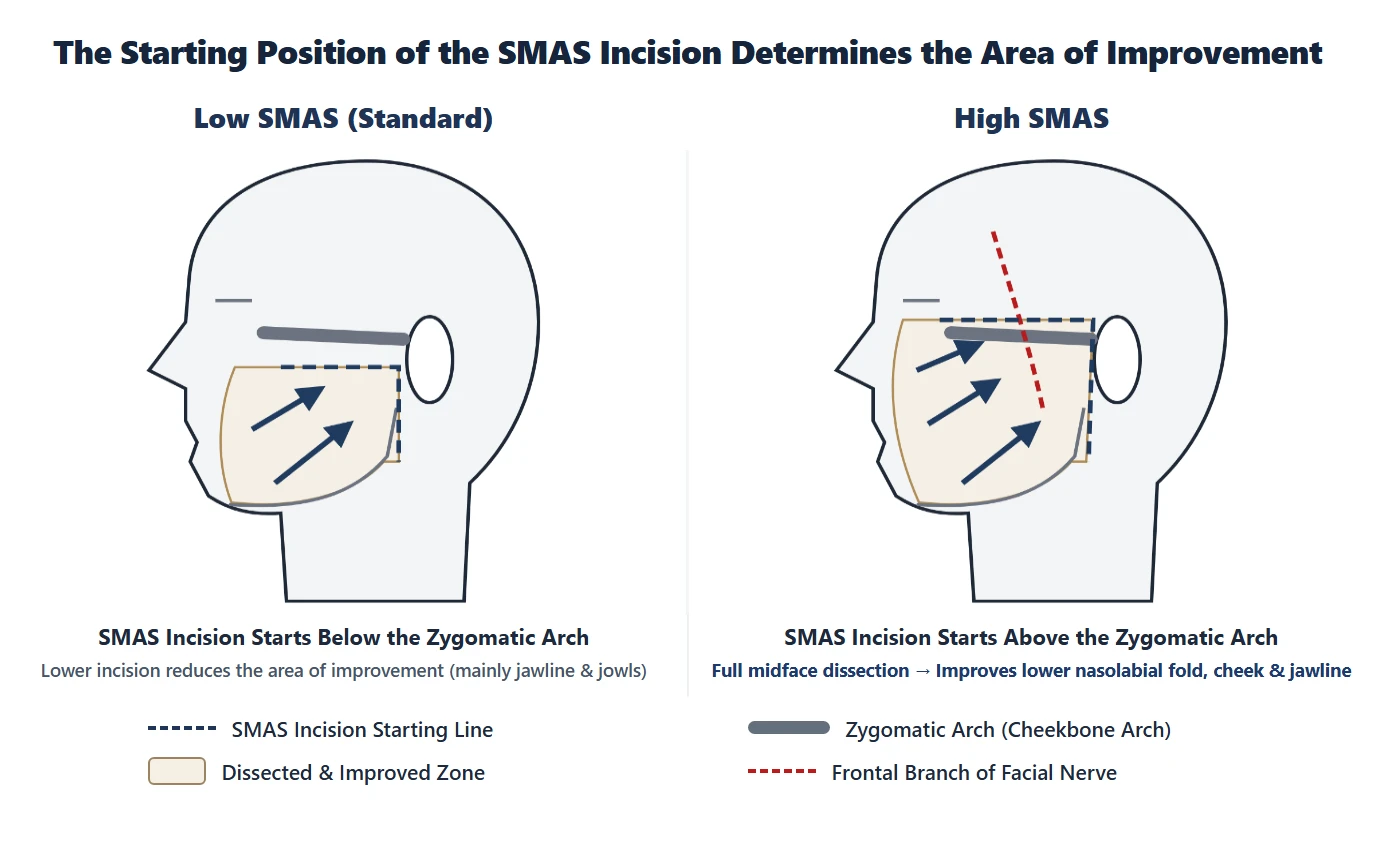
▲ Side-view anatomical diagram comparing SMAS incision starting points when dissecting beneath the SMAS: Low SMAS starts below the zygomatic arch (limiting improvement mainly to the jawline and lower cheek), whereas High SMAS starts above the zygomatic arch, extending dissection into the midface to improve the nasolabial fold (lower half), cheek, and jawline together.
An intraoperative clinical study compared standard (Low) versus High-SMAS entry points in 14 deep-plane facelift patients and found that the High-SMAS entry point achieved approximately 77% greater vertical tissue movement and 61% greater horizontal movement at the jawline [4]. While this study measured intraoperative displacement in a small cohort rather than long-term outcomes, it illustrates the mechanical advantage of a higher entry point.
How Far Can a High SMAS Facelift Improve the Nasolabial Folds? (Synergy with Subciliary Midface Lift)
Because a High SMAS facelift starts above the zygomatic arch and dissects thoroughly into the midface, it delivers substantial improvement to the lower half of the nasolabial fold (from the nasal tip to the lip), while the upper half of the nasolabial fold achieves dramatic synergy when combined with a vertical midface lift through a lower-eyelid subciliary incision [1][2][3]. Because a facelift pulls laterally toward the ear, the degree of improvement along the nasolabial fold differs between its upper and lower segments [5].
Specifically, patients can expect strong improvement in the lower half of the nasolabial fold (spanning from the level of the nasal tip down to the corner of the mouth) from the High SMAS flap itself [1][3], whereas the upper half of the nasolabial fold near the alar base is much more effectively elevated when a subciliary-incision midface lift is performed simultaneously to add a direct vertical vector [2].
What Is the Key Anatomical Precaution in a High SMAS Facelift?
Because the frontal branch of the facial nerve (which elevates the eyebrow and forehead) crosses the zygomatic arch, a High SMAS facelift requires precise mastery of fascial depth to protect the nerve while dividing and elevating the SMAS above the arch [6].
Cadaver dissection studies demonstrate that across the zygomatic arch, the frontal branch travels deeper than the SMAS beneath a distinct fascial layer, meaning the nerve can be safely protected when the surgeon stays strictly within the correct anatomical plane [6]. Nerve safety in facelift surgery is covered in greater detail in a separate column.
Comparison at a Glance: Low SMAS vs. High SMAS Facelift
Feature | Low SMAS (Standard SMAS) | High SMAS Facelift |
|---|---|---|
SMAS Incision Starting Point | Starts below the zygomatic arch (cheekbone arch) [1] | Starts above the zygomatic arch [1] |
Dissection & Area Improved | As the incision moves lower, the area improved shrinks—mainly limited to the jawline, jowls, and lower cheek [1] | Dissection extends thoroughly into the midface, improving the midface, nasolabial fold (lower half), cheek, and jawline [1][3] |
Nasolabial Fold Synergy & Precaution | Limited effect on the midface and nasolabial fold [1] | Strong improvement in the lower half of the nasolabial fold (nasal tip to lip), with high synergy in the upper half when combined with a subciliary midface lift [2][3] / Requires precise plane control near the frontal nerve branch [6] |
Why Should a Facelift Naturally Be Performed as a High SMAS for Optimal Results?
Rather than viewing High SMAS and Low SMAS as two equal options to choose between, a facelift should naturally be performed as a High SMAS to achieve superior, more comprehensive rejuvenation [1][3]. The lower the SMAS incision starts when dissecting beneath the SMAS, the smaller the area of the face that can be improved [1]. Because facial aging does not occur in the jawline alone—it descends continuously across the midface, nasolabial area, cheek, and jawline—starting the SMAS incision above the zygomatic arch and dissecting fully into the midface is essential for balanced improvement across a wider area [1][3].
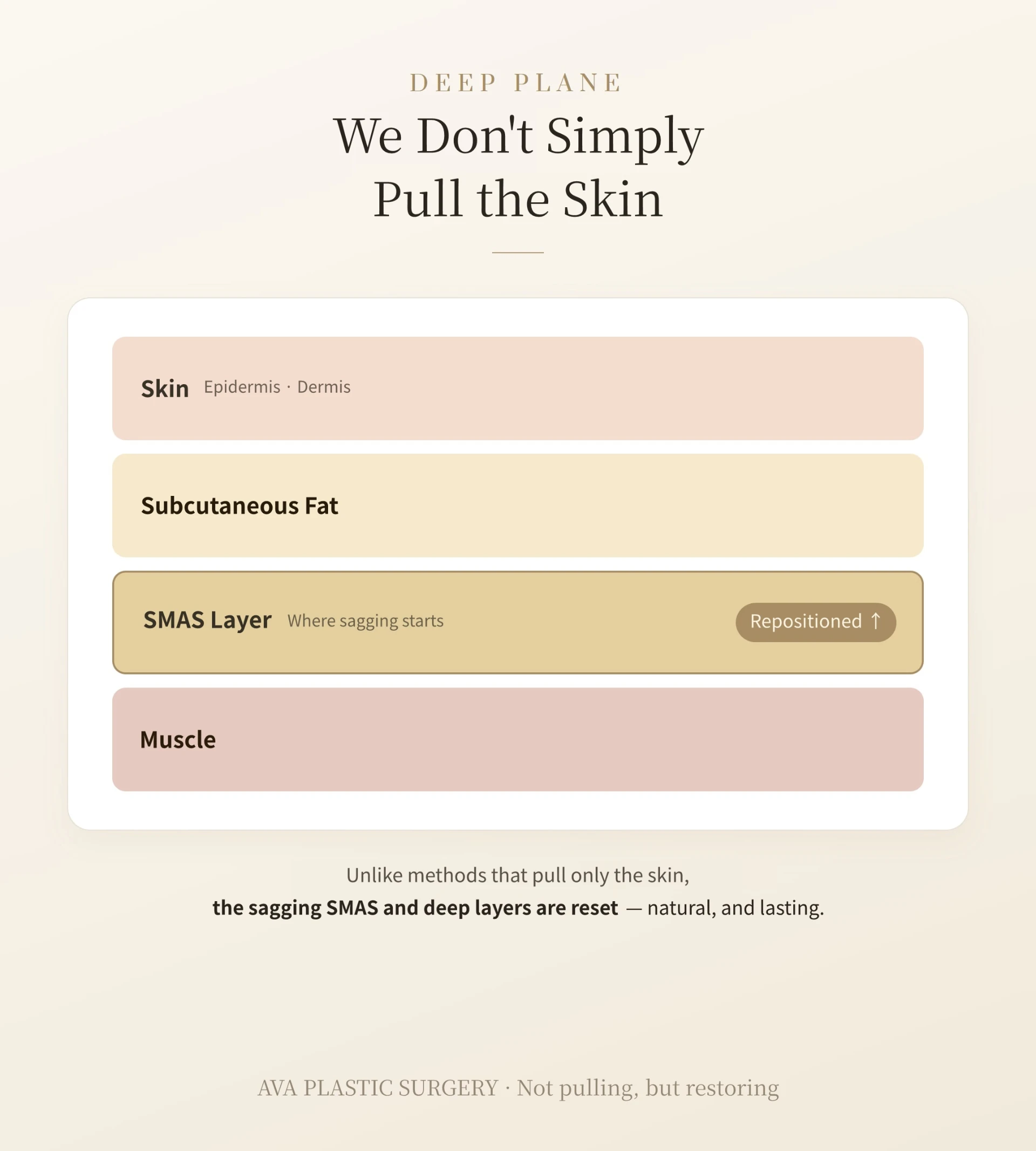
AVA Plastic Surgery's Dual-Deep Plane Facelift combines a two-plane dissection (between the subcutaneous fat layers and beneath the SMAS to create three anatomical layers, anchoring the SMAS flap to deep tissue) with a High SMAS incision starting above the zygomatic arch to dissect thoroughly into the midface. This enables powerful improvement across the cheeks, jawline, and the lower half of the nasolabial fold (from the nasal tip to the lip), and when paired with a subciliary-incision midface lift, delivers even greater synergy for the upper half of the nasolabial fold.
Key Takeaways: High SMAS vs. Low SMAS Facelift
Here is a summary of how the SMAS incision starting position affects midface and nasolabial fold rejuvenation.
Topic | Key Point |
|---|---|
Anatomical Classification | While SMASectomy, SMAS plication, Deep-Plane, and Dual-Deep Plane describe the surgical method and dissection plane, High SMAS vs. Low SMAS is defined by the starting position of the SMAS incision when dissecting beneath the SMAS [1][2]. |
Low SMAS (Standard) | The SMAS incision begins below the zygomatic arch; as the incision moves lower, the area of improvement shrinks and traction is limited mainly to the jawline, jowls, and lower cheek [1]. |
High SMAS | The SMAS incision begins above the zygomatic arch and dissects thoroughly into the midface, improving the cheeks, jawline, and nasolabial fold in a single flap [1][3]. |
Nasolabial Fold & Midface Synergy | Because a facelift pulls laterally, High SMAS produces strong improvement in the lower half of the nasolabial fold (nasal tip to lip) [1][3], while the upper half achieves much greater synergy when combined with a subciliary-incision midface lift [2]. |
Nerve Safety Precaution | Maintaining the exact fascial depth across the zygomatic arch is critical to protect the frontal branch of the facial nerve [6]. |
Core Surgical Principle | Rather than choosing between the two as equals, a facelift should naturally be performed as a High SMAS for better results, because a lower incision starting point reduces the area that can be improved [1][3]. |
At AVA Plastic Surgery, Dr. Seungsoo Kim personally oversees every case from consultation through surgery and recovery.
※ This article provides general medical information for educational purposes. Results, recovery and scarring vary between individuals, and every surgery carries risks such as bleeding, infection, swelling and asymmetry. Diagnosis and treatment decisions are made only through an in-person consultation.
References
2. Warren RJ, Aston SJ, Mendelson BC. Face lift. Plast Reconstr Surg. 2011;128(6):747e-764e.
5. Barton FE. The SMAS and the nasolabial fold. Plast Reconstr Surg. 1992;89(6):1054-1059.
Related Procedures
• Facelift
• Fat Grafting

Dr. Seungsoo Kim · Board-Certified Plastic Surgeon, AVA Plastic Surgery (Seoul)
Facelift consultation in Seoul, Korea
Visit AVA Plastic Surgery near Exit 4 of Sinsa Station, on Gangnam-daero in Seoul. Our clinic is on the 4th floor of Inseong Building, 603 Gangnam-daero, Seocho-gu. A facelift consultation covers your concerns, previous treatments and recovery plans, including arrangements for your stay in Korea.
Facelift surgery in KoreaMeet Dr. KimDirections to Sinsa Station clinicRequest a facelift consultation
Read the original Naver blog post
Recommended Related Columns by Dr. Seungsoo Kim
Dr. Seungsoo Kim’s Facelift 101: SMAS Deep-Plane Method, Recovery & vs. Thread Lifting
Read article →
Mini Facelift vs Full Facelift: Who Is a Short-Scar Lift Enough For?
Read article →
Dual-Deep Plane Facelift: Skin Tension, SMAS Fixation, Scars and Pixie Ear
Read article →