Facelift and Neck Wrinkles: Platysma, Submentoplasty and Liposuction
Does a Facelift Fix a Sagging Neck? Synergy of the Platysma Hammock Effect, Submentoplasty, and Neck Liposuction

"What if my face is lifted, but my neck bands and double chin stay the same?" During facelift consultations, many patients run a hand beneath their chin and ask this exact question. In fact, many people notice aging in their vertical neck cords and blunted jawline even before they notice it in their cheeks.
In short, because a facelift pulls and tightens the platysma muscle from both sides—much like tightening a hanging hammock from both ends—it sharpens the jawline and upper neck, but eliminating prominent vertical neck cords (platysmal bands) and sculpting the full neck contour requires combining the facelift with submentoplasty (connecting the skin dissection across the entire neck via tunneling for complete skin redraping) and neck liposuction [1][3]. In this column, I explain from a board-certified plastic surgeon's perspective how a facelift, submentoplasty, and liposuction work in synergy to rejuvenate the neck.
What Does a Facelift Do for the Neck? (The Hammock Principle)
Because the facial SMAS layer continues downward into the neck as the broad, thin platysma muscle, lifting the SMAS and pulling the platysma laterally from both sides through the retroauricular incision acts like tightening a hanging hammock from both ends—sharpening the jawline and smoothing the upper neck skin [1].
The American Society of Plastic Surgeons (ASPS) likewise includes loose neck skin and jawline definition within the scope of a comprehensive facelift [2], and AVA Plastic Surgery treats the face, jawline, and upper neck as a single continuous anatomical unit.
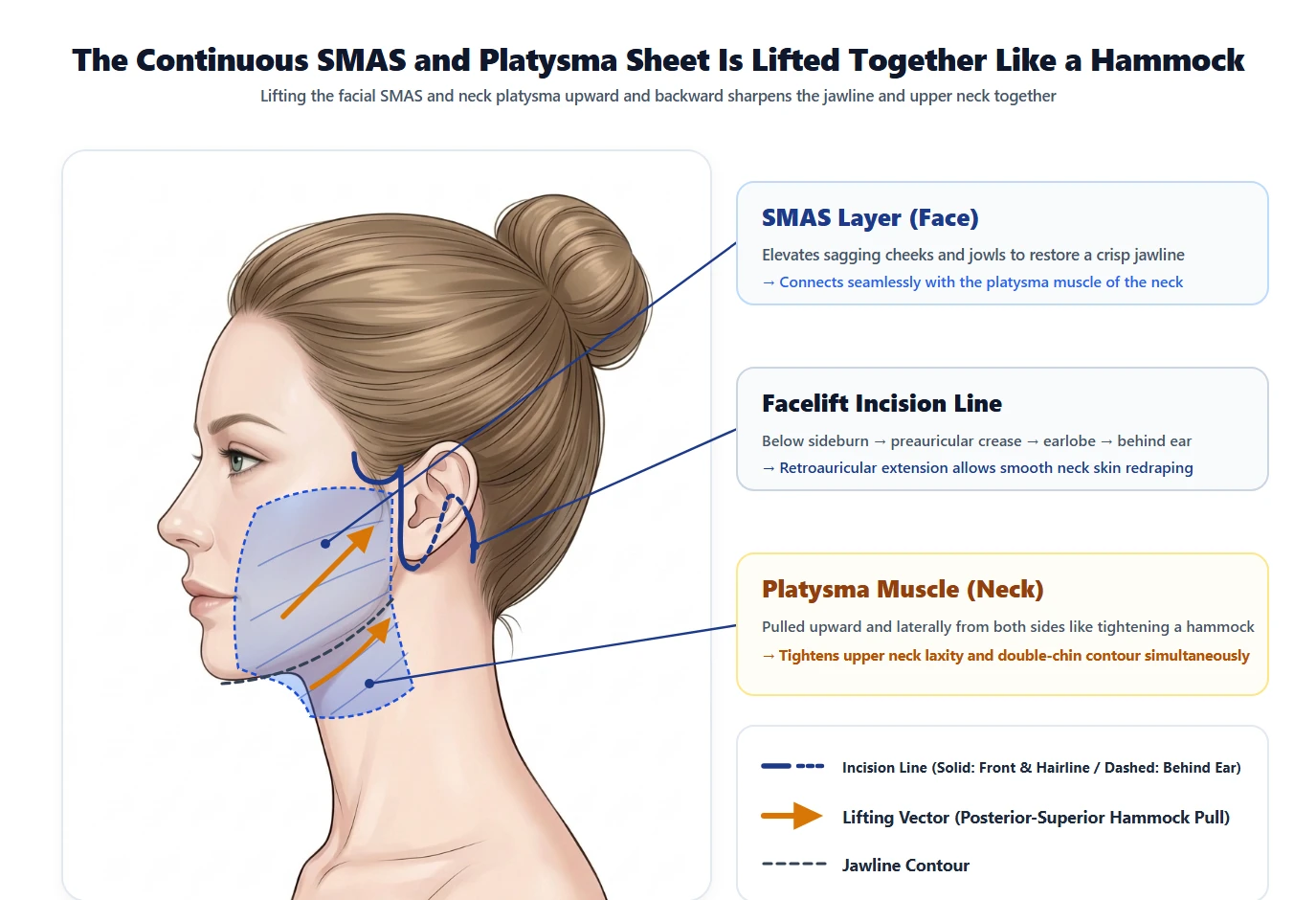
▲ Because the SMAS of the face and the platysma muscle of the neck form one continuous layer, a facelift pulls and tightens the platysma from both sides like tightening a hammock through incisions running from below the sideburn, in front of the ear, around the earlobe, and behind the ear.
What Are the Three Anatomical Causes of an Aging Neck?
An aging neck is caused by three distinct anatomical factors—skin laxity, submental/neck fat accumulation, and vertical platysmal bands—that combine in different proportions in each patient [1][3].
1. Neck Skin Laxity: The thin skin of the neck loses elasticity, developing horizontal creases and blurring the border between the jaw and neck.
2. Submental & Neck Fat (Double Chin): Fat accumulating beneath the chin and along the neck creates a heavy double chin and blunts the neck shape. This fat can lie superficial to the platysma (subcutaneous fat) or deep beneath the muscle (subplatysmal fat) [3].
3. Vertical Platysmal Bands: Cord-like vertical lines that stand out along the center of the front of the neck [1][3].
Because these three elements coexist in varying proportions from person to person, two patients with a "sagging neck" may require very different surgical combinations [3].
What Are Vertical Platysmal Bands (Neck Cords)?
The platysma is a thin sheet of muscle draping the front of the neck; as the medial edges of the left and right platysma muscle loosen and separate with age, two vertical cords (platysmal bands) protrude along the front of the neck [1][3]. They become especially prominent when speaking, swallowing, or tensing the neck.
Plastic surgery literature attributes platysmal banding both to the anatomical dehiscence (separation) of the medial muscle borders and to persistent neuromuscular activity of the platysma, which has led to refined surgical techniques to prevent band recurrence [3][4].
Why Does the Cervicomental Angle Matter for Neck Shape?
Viewed in profile, the angle where the underside of the chin meets the vertical line of the neck is called the cervicomental angle, and a crisp, well-defined cervicomental angle is the hallmark of a youthful jawline and neck shape [3]. Skin laxity, submental fat, and vertical platysmal bands all make this angle look heavy and obtuse [3].
At the same time, the cervicomental angle is influenced by underlying skeletal anatomy, such as chin projection and the position of the hyoid bone [3]. During your consultation, we examine your side profile together to explain the exact contour improvement you can expect.
When a Facelift Alone Is Not Enough: The Synergy of Submentoplasty, Tunneling, and Liposuction
Because a facelift pulls and tightens the platysma muscle from both sides—like tightening a hanging hammock—lateral traction alone has limits when vertical neck bands or global neck laxity are severe; combining the facelift with submentoplasty connects the dissection planes across the entire neck via tunneling, enabling complete neck skin redraping and high synergy in eliminating vertical neck bands, while simultaneous liposuction sculpts a sleek neck shape [1][3].
1. Vertical neck bands (platysmal bands) on the front of the neck remain clearly visible even at rest [1][3]
2. Excess fat beneath the chin and neck creates a prominent double chin and a blunted neck shape [3]
3. Generalized laxity across the entire neck skin cannot be fully redraped by pulling from the sides alone [1][3]
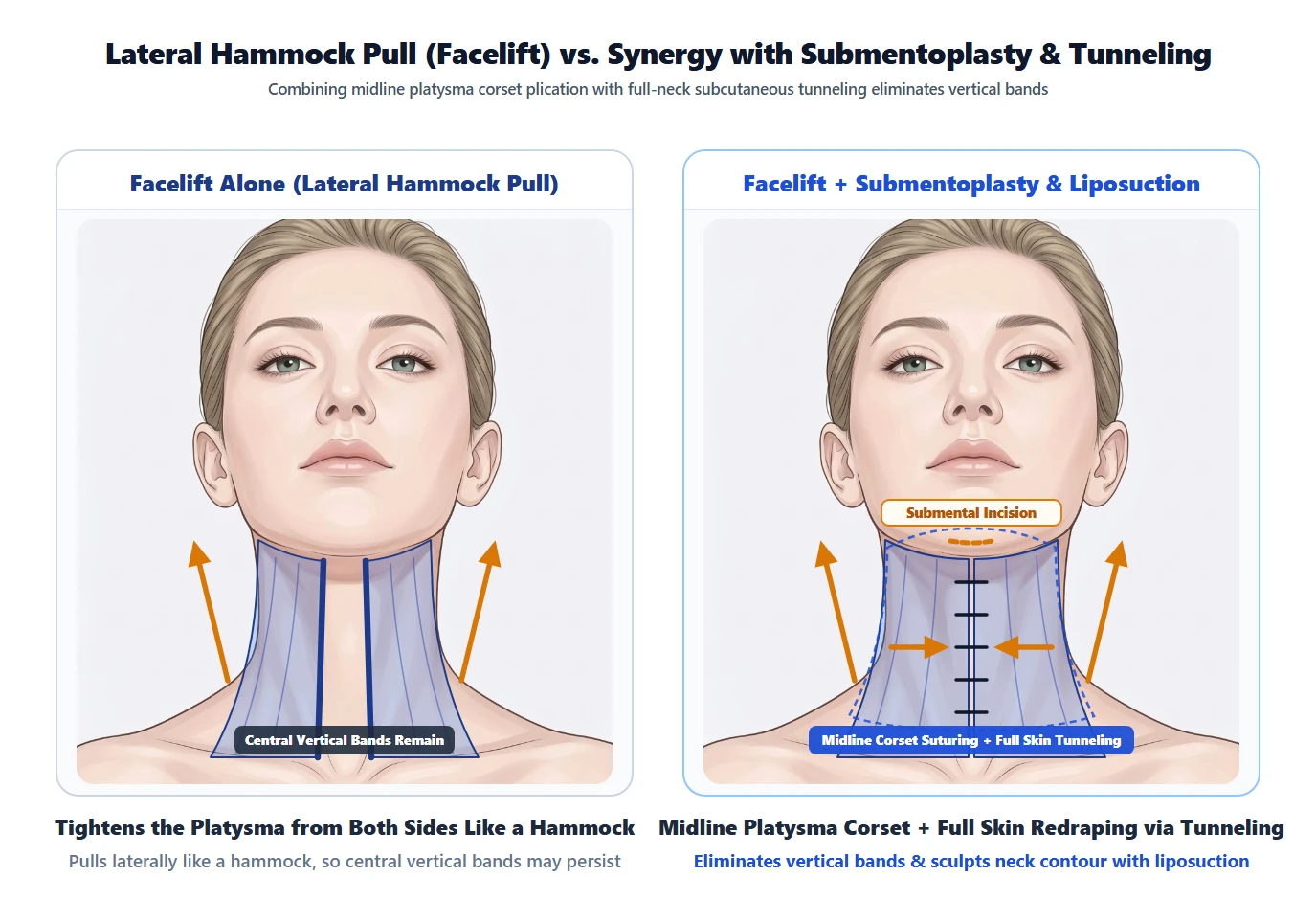
▲ While a facelift pulls and tightens the platysma laterally from both sides like tightening a hammock, combining it with submentoplasty sutures the medial platysma borders together at the midline AND connects the skin dissection across the entire neck via tunneling—achieving complete skin redraping to eliminate vertical neck bands while simultaneous liposuction sculpts a sharp neck shape.
In a clinical study of 80 patients who underwent full horizontal transection of the platysma with up to 5 years of follow-up, no recurrence of vertical platysmal bands was observed [4]. Because each technique carries specific operative demands, selecting the right platysmal procedure for each patient's anatomy is essential.
Furthermore, in the identical-twin study comparing facelift incision lengths, the full incision extending behind the ear scored significantly higher in the neck at the 5-year long-term follow-up than the short-scar incision [5], underscoring how important posterior dissection is for redraping neck skin.
At AVA Plastic Surgery, when vertical neck bands, a double chin, or full neck laxity are present, we combine the facelift with submentoplasty (medial platysmaplasty / double-chin muscle tightening) through a small, hidden incision beneath the chin. Performing submentoplasty alongside the facelift not only corsets the left and right platysma borders tightly at the midline, but also connects the lateral facelift dissection pockets with the central submental dissection pocket across the entire neck via tunneling—allowing complete neck skin redraping and powerful synergy in erasing vertical neck bands [1][3]. Simultaneously, we perform submental and neck liposuction to remove unwanted fat and sculpt a crisp, sleek neck shape [3].
What About Non-Surgical Treatments Like Botulinum Toxin for Neck Bands?
The American Society of Plastic Surgeons (ASPS) notes that botulinum toxin (Botox) injections can serve as a non-surgical option to temporarily soften vertical neck bands by relaxing platysma muscle contraction [6]. However, injections cannot remove submental fat or redrape loose neck skin, and their effect is temporary. Depending on whether your concern is dynamic muscle banding alone or combined skin, fat, and muscle laxity, we guide you toward the right surgical or non-surgical plan.
Final Thoughts: Combining the Lateral Hammock Lift with Full-Neck Tunneling & Sculpting
Because neck skin is thin and constantly in motion, accurate diagnosis is essential to determine whether tightening the platysma hammock from both sides with a facelift is sufficient, or whether combining submentoplasty (with full-neck tunneling and skin redraping) and neck liposuction is needed to eliminate vertical bands and refine the neck shape. Potential facelift complications are covered in a separate column.
Key Takeaways: Facelift, Submentoplasty & Neck Liposuction Synergy
Here is a summary of the causes of neck aging and the synergy of combining a facelift with submentoplasty and liposuction.
Topic | Key Point |
|---|---|
Role of a Facelift (Hammock Principle) | Pulls and tightens the platysma muscle (continuous with the SMAS) from both sides, acting like tightening a hanging hammock to sharpen the jawline and upper neck [1]. |
Three Causes of Neck Aging | Neck skin laxity, submental/neck fat (double chin), and vertical platysmal bands combine in different proportions in each person [1][3]. |
Vertical Platysmal Bands | Formed when the medial borders of the left and right platysma muscle loosen and separate; lateral pulling alone has limits for deep central cords [1][3]. |
Cervicomental Angle & Neck Shape | The angle where the underside of the jaw meets the neck; submental and neck liposuction is performed simultaneously to sculpt a sharp, sleek neck shape [3]. |
Submentoplasty & Tunneling Synergy | Combining submentoplasty brings the left and right platysma together at the midline AND connects skin dissection across the entire neck via tunneling—enabling complete skin redraping and high synergy in eliminating vertical neck bands [1][3]. |
Non-Surgical Options | Botulinum toxin temporarily softens dynamic bands but cannot remove fat or redrape loose skin [6]. |
At AVA Plastic Surgery, Dr. Seungsoo Kim personally oversees every case from consultation through surgery and recovery.
※ This article provides general medical information for educational purposes. Results, recovery and scarring vary between individuals, and every surgery carries risks such as bleeding, infection, swelling and asymmetry. Diagnosis and treatment decisions are made only through an in-person consultation.
References
1. Warren RJ, Aston SJ, Mendelson BC. Face lift. Plast Reconstr Surg. 2011;128(6):747e-764e.
2. American Society of Plastic Surgeons. Facelift.
6. American Society of Plastic Surgeons. Neck Lift.
Related procedures
• Facelift
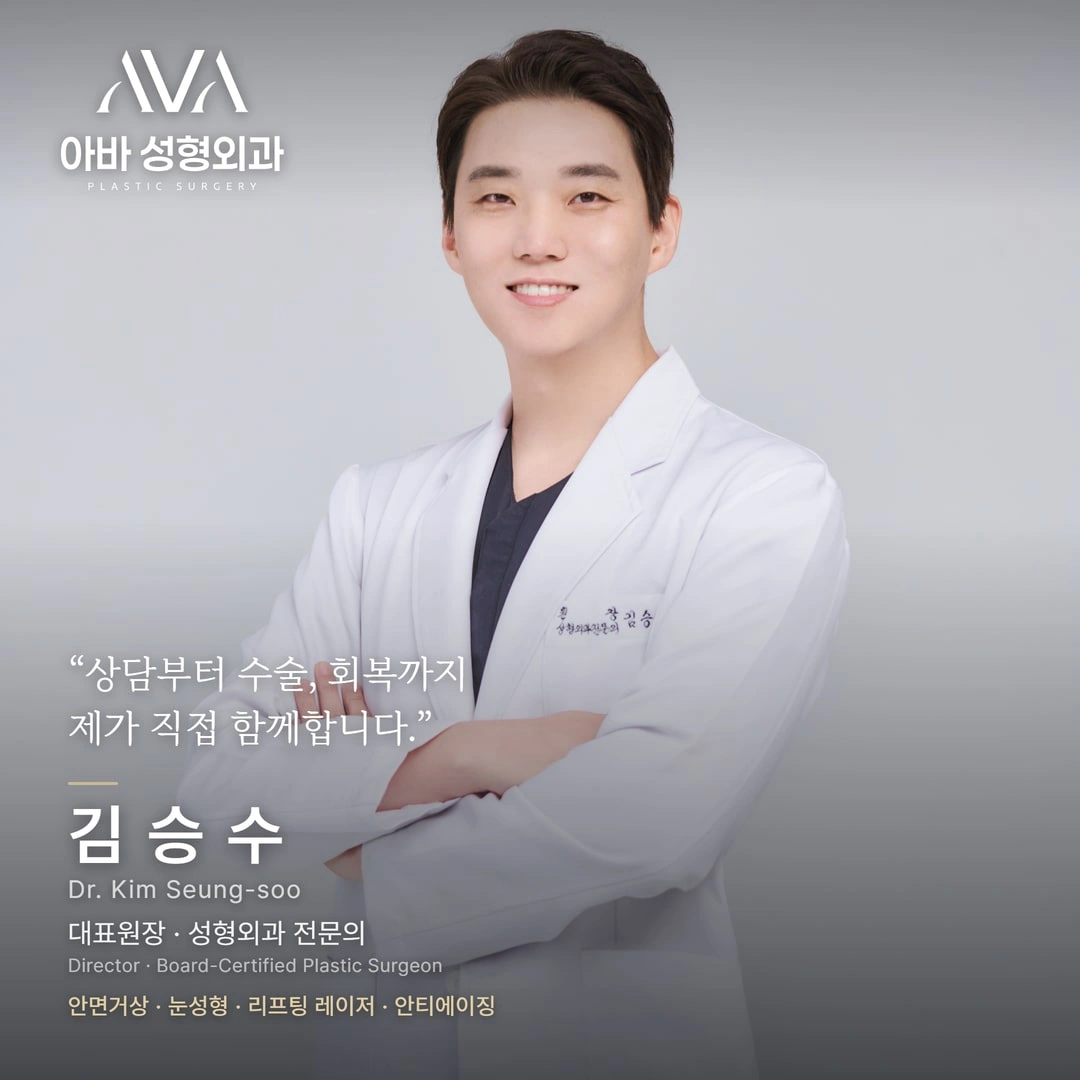
Dr. Seungsoo Kim · Board-Certified Plastic Surgeon, AVA Plastic Surgery (Seoul)

Facelift consultation in Seoul, Korea
Visit AVA Plastic Surgery near Exit 4 of Sinsa Station, on Gangnam-daero in Seoul. Our clinic is on the 4th floor of Inseong Building, 603 Gangnam-daero, Seocho-gu. A facelift consultation covers your concerns, previous treatments and recovery plans, including arrangements for your stay in Korea.
Facelift surgery in KoreaMeet Dr. KimDirections to Sinsa Station clinicRequest a facelift consultation
Recommended Related Columns by Dr. Seungsoo Kim
Nasolabial Folds: Should You Fill with Filler or Lift Back into Place? (3-Stage Guide)
Read article →
Dr. Seungsoo Kim’s Facelift 101: SMAS Deep-Plane Method, Recovery & vs. Thread Lifting
Read article →
Mini Facelift vs Full Facelift: Who Is a Short-Scar Lift Enough For?
Read article →