Dual-Deep Plane Facelift: Skin Tension, SMAS Fixation, Scars and Pixie Ear
Dual-Deep Plane Facelift: Why Separating Skin Tension from SMAS Tension Minimizes Facelift Scars and Pixie Ear

"It is the same facelift, so why do some patients heal with fine, nearly invisible lines while others develop wide scars or a pulled earlobe?" For patients researching a facelift in Korea, potential facelift scars around the ears and hairline—and earlobe distortion known as pixie ear—are just as important as the lifting result itself.
In short, preventing wide facelift scars and pixie ear deformity depends on shifting the mechanical lifting tension onto the deeper SMAS flap and deep fascia so the skin can be closed with minimal tension [1][2]. While individual genetics and postoperative care play a role, the surgical architecture chosen before the first incision is made determines how much force the healing skin edge must bear. In this article, I explain from a board-certified plastic surgeon's perspective how wound tension drives scarring and why force separation is the core principle behind AVA Plastic Surgery's Dual-Deep Plane Facelift.
How Does Mechanical Tension on a Wound Affect Facelift Scars?
When a healing skin incision is subjected to high mechanical pulling force (tension), skin cells trigger a biological process called mechanotransduction that stimulates excess collagen production, prolongs inflammation, and increases the risk of a wide or hypertrophic scar [1].
Wound-healing research consistently demonstrates a direct link between mechanical tension across an incision line and scar hypertrophy [1]:
1. Wounds in high-tension anatomical zones—such as the center of the chest or over joints—frequently heal with wider, thicker scars [1].
2. Incisions aligned parallel to natural skin tension lines (Langer's lines) experience far less cross-incisional pull and heal as finer lines [1].
3. Clinical studies show that tension-offloading tapes and mechanical devices around a healing incision significantly reduce scar formation [1].
Of course, much of the foundational cellular data comes from laboratory and animal models, and real-world scarring is also shaped by patient genetics, skin thickness, and anatomical site in addition to tension [1].
What Happens When the Skin Bears the Lifting Force in a Facelift?
Because a facelift elevates sagging facial tissue upward and backward, some anatomical layer must bear the mechanical load; if the skin itself is used to pull and hold the face up, the incision heals under constant tension, leading to widened scars, a pulled-down earlobe (pixie ear deformity), and early relapse [2][3].
Specifically, when the skin directly carries the lifting force, three problems commonly occur:
1. Widened or Thickened Scars: Constant pulling across the suture line stretches the immature scar tissue as it heals, causing the scar to widen or thicken [1][2].
2. Pixie Ear Deformity: As the cheek skin pulls downward against the lower attachment of the ear, the earlobe is dragged inferiorly and loses its natural rounded contour, creating a tethered "pixie ear" appearance [2][3].
3. Early Loss of Lifting Effect: Skin is a viscoelastic tissue that gradually stretches under sustained load, meaning skin-only tension tends to relax and loosen over time [4][5].
Conversely, clinical studies of deep-layer facelifts report that when lifting forces are anchored in the deeper layers and the skin is redraped without tension, facelift scars are overwhelmingly inconspicuous [2]. By transferring the traction load to the deep tissue planes to relieve skin tension [3] and designing the SMAS incision line at a safe distance from the earlobe so that almost no downward pull reaches the lobe, pixie ear deformity is effectively prevented. Pixie ear revision surgery is covered in a separate column.
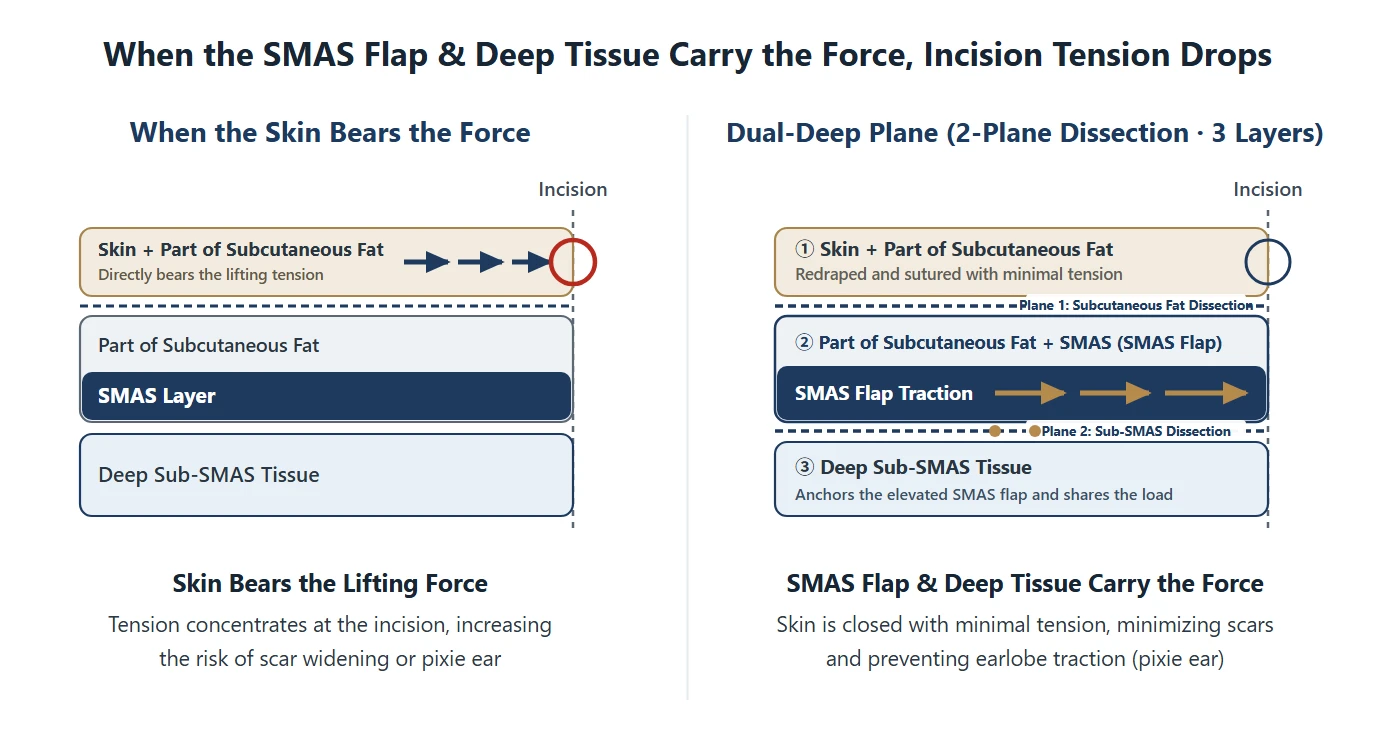
▲ Cross-sectional diagram comparing a skin-tension facelift (left), where pulling force concentrates at the suture line, versus AVA Plastic Surgery's Dual-Deep Plane Facelift (right), where two-plane dissection (between the subcutaneous fat layers and beneath the SMAS) creates an SMAS flap (partial subcutaneous fat + SMAS) that is anchored to the deep sub-SMAS tissue while the skin is closed with minimal tension.
How Does the Dual-Deep Plane Facelift Separate Force Across Three Layers?
AVA Plastic Surgery's Dual-Deep Plane Facelift performs a precise two-plane dissection—between the subcutaneous fat layers and beneath the SMAS layer—to establish three distinct anatomical layers, assigning the lifting and tension-bearing role to the SMAS flap and deep tissue while closing the skin tension-free [4][5].
1. Two-Plane Dissection Creating Three Anatomical Layers: By dissecting along two planes—within the subcutaneous fat layer (Plane 1) and beneath the SMAS layer (Plane 2)—the surgery separates three layers: (1) skin + partial subcutaneous fat, (2) the SMAS flap (partial subcutaneous fat + SMAS layer), and (3) the deep sub-SMAS tissue [4][5].
2. Load Sharing Between the SMAS Flap and Deep Tissue: Because the SMAS-containing flap (SMAS flap) is advanced and securely anchored to the immobile deep sub-SMAS tissue, the lifting force is carried by the SMAS flap and shared by the deep anchoring tissue [4][5].
3. Minimal-Tension Skin Closure: Tension that would otherwise pull on the skin incision is transferred to the SMAS flap and deep plane, allowing the skin flap to be trimmed of excess and sutured with minimal tension [4][6].
4. Inconspicuous Incision Concealment: Incisions are meticulously tailored along the natural creases in front of and behind the ear (trifurcation and retroauricular sulcus) and along the temporal and occipital hairline [6].
A traditional deep-plane facelift, which elevates the skin and SMAS together as a single composite flap, shares the same fundamental philosophy of placing the lifting force on the deeper layers [2][3][5]. The Dual-Deep Plane technique refines this further by dissecting along two planes (within the subcutaneous fat and beneath the SMAS) to create three layers—allowing the SMAS flap to be anchored to the deep tissue to handle the structural lift and tension while the skin is redraped and trimmed along its own optimal vector [4][5]. Neither technique has been proven universally superior for every patient in head-to-head trials; what matters most is customizing the surgical plane to each individual's facial anatomy.
Does a Tension-Free Facelift Leave Zero Scars?
When tension across the skin suture line is minimized, scar widening is dramatically reduced, and because the fine healing line is tucked into the hairline and the natural creases in front of and behind the ear, the scar becomes nearly invisible in the vast majority of patients [2][6].
However, in a very small percentage of patients with a strong genetic predisposition to keloids or hypertrophic scarring, localized scar thickening can still occur and is managed proactively with targeted steroid injections or laser therapy as needed [2][3]. Postoperative scar care protocols are discussed in detail in a separate column.
Specific details regarding layered suturing techniques and stitch removal timelines are tailored to your skin condition and explained during your in-person consultation.
Inconspicuous Facelift Scars Begin at the Surgical Planning Stage
An inconspicuous facelift scar is not achieved merely by neat stitching at the end of the operation. It begins during preoperative surgical planning by deciding which anatomical layer will carry the lifting load and how little tension will remain on the skin [1][4][6]. If you are concerned about facelift scars or pixie ear, I encourage you to ask during your consultation how the deep planes are dissected and which layer bears the lifting force.
Key Takeaways: Skin-Tension Design vs. Dual-Deep Plane (SMAS & Deep-Layer) Design
Here is a side-by-side summary of how scar quality, earlobe contour, and longevity change depending on which anatomical layer carries the lifting force.
Feature | Skin-Tension Facelift Design | Dual-Deep Plane Design (SMAS Flap & Deep Layer Bear Force) |
|---|---|---|
Layer Bearing the Lifting Force | Skin layer directly bears traction | SMAS flap (partial subcutaneous fat + SMAS) created by 2-plane dissection and anchored to deep sub-SMAS tissue [4][5] |
Tension at the Incision Line | Incision heals under continuous mechanical pull [1]. | Tension is shifted to the SMAS flap and deep tissue; skin is sutured with minimal tension [4][6]. |
Facelift Scar Appearance | Higher risk of widening or thickening over time [1]. | Scars are minimized and concealed within the hairline and natural ear creases, becoming nearly invisible in most patients (rare hypertrophic scarring only in strongly predisposed skin) [2][6]. |
Earlobe Contour (Pixie Ear) | Downward skin pull can drag the earlobe into a pixie ear deformity. | SMAS dissection relieves skin tension and the SMAS incision is kept at a safe distance from the earlobe, preventing pixie ear [2][3]. |
Longevity of Lifting Effect | Skin stretches over time, causing the lift to loosen early. | The SMAS flap is anchored to deep tissue to sustain the lift and tension, while only excess skin is trimmed [4][5]. |
At AVA Plastic Surgery, Dr. Seungsoo Kim personally oversees every case from consultation through surgery and recovery.
※ This article provides general medical information for educational purposes. Results, recovery and scarring vary between individuals, and every surgery carries risks such as bleeding, infection, swelling and asymmetry. Diagnosis and treatment decisions are made only through an in-person consultation.
References
5. Warren RJ, Aston SJ, Mendelson BC. Face lift. Plast Reconstr Surg. 2011;128(6):747e-764e.
Related Procedures
• Facelift
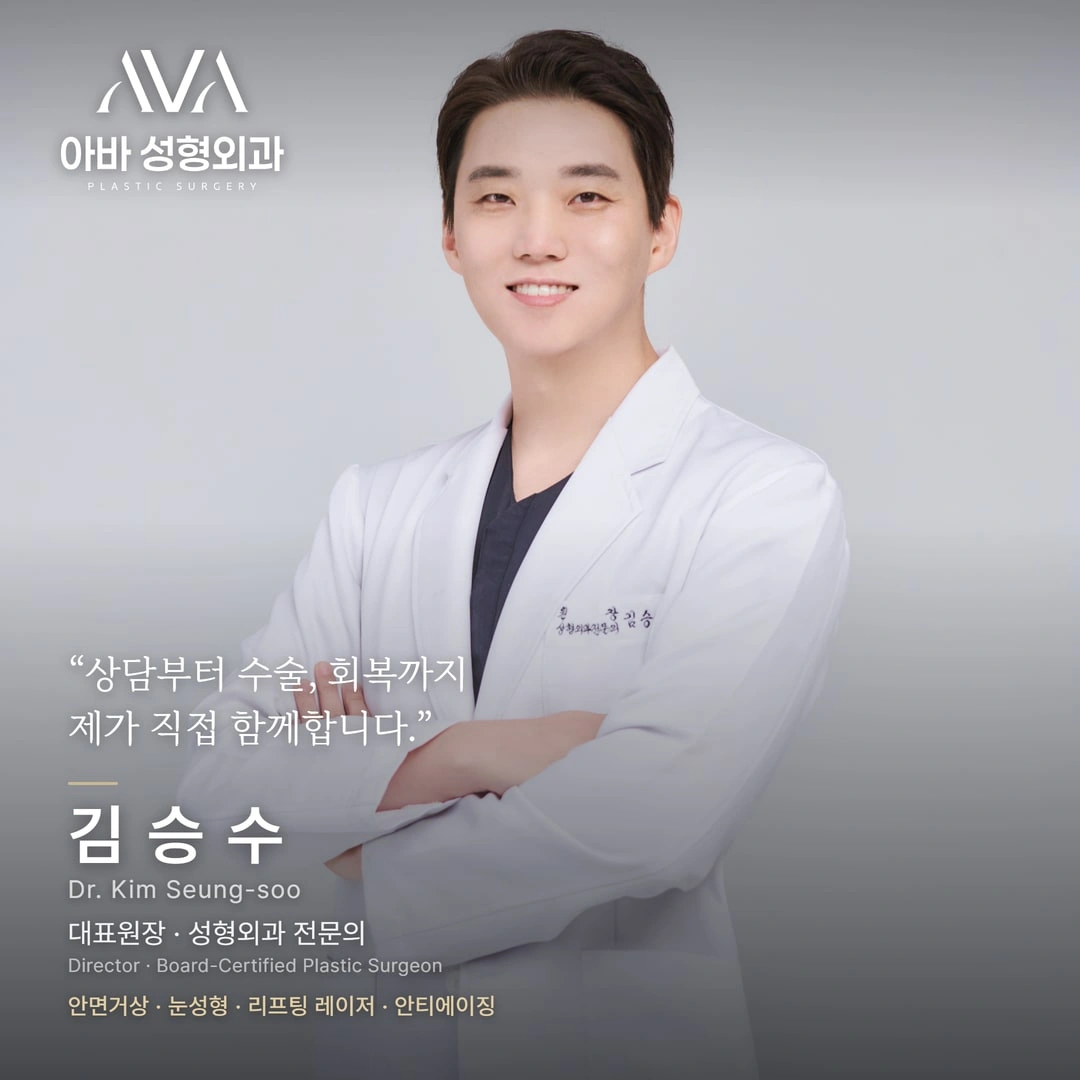
Dr. Seungsoo Kim · Board-Certified Plastic Surgeon, AVA Plastic Surgery (Seoul)
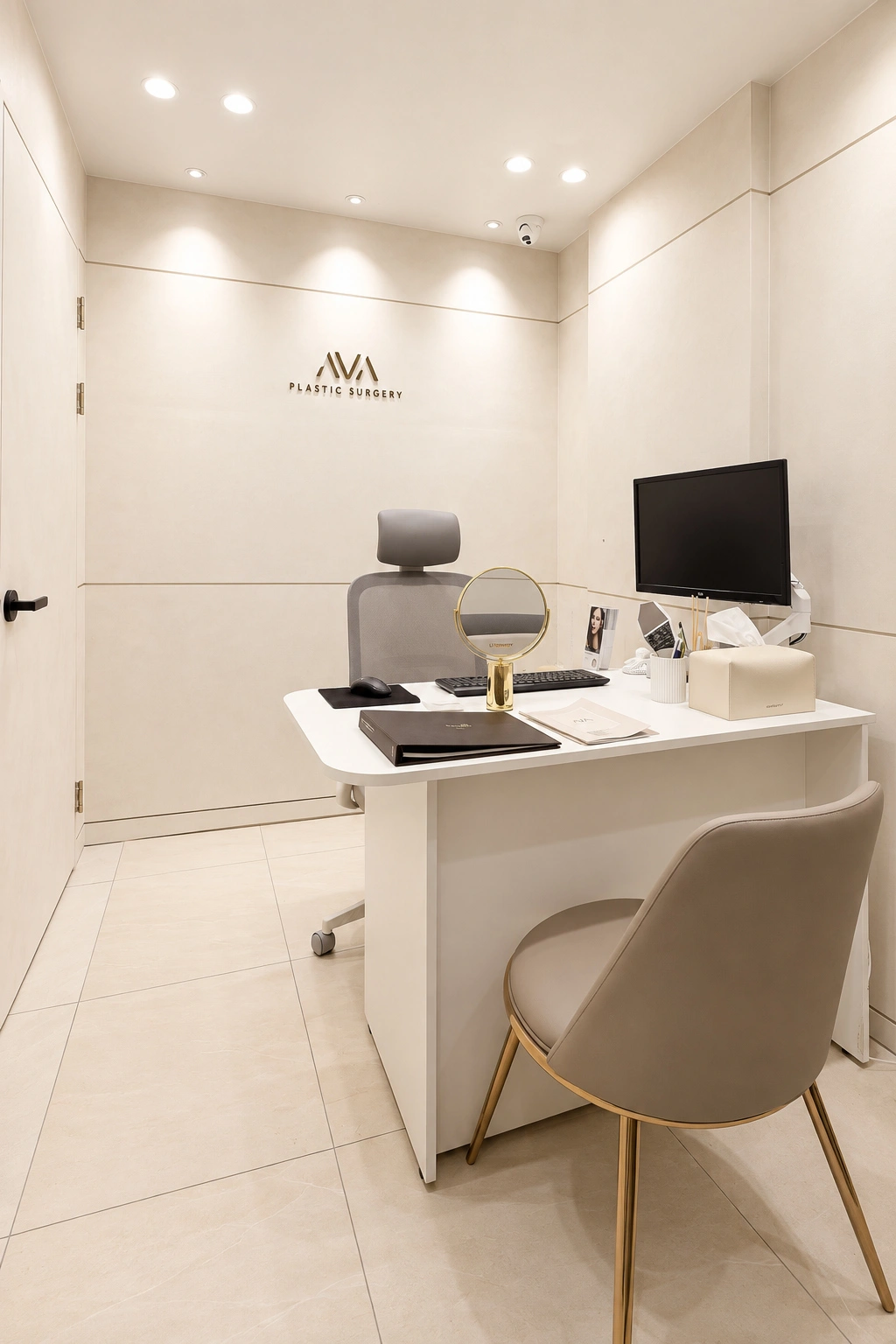
Facelift consultation in Seoul, Korea
Visit AVA Plastic Surgery near Exit 4 of Sinsa Station, on Gangnam-daero in Seoul. Our clinic is on the 4th floor of Inseong Building, 603 Gangnam-daero, Seocho-gu. A facelift consultation covers your concerns, previous treatments and recovery plans, including arrangements for your stay in Korea.
Facelift surgery in KoreaMeet Dr. KimDirections to Sinsa Station clinicRequest a facelift consultation
Read the original Naver blog post
Recommended Related Columns by Dr. Seungsoo Kim
Facelift Scars: Where the Incision Goes Makes the Difference | AVA Plastic Surgery, Sinsa Station
Read article →
Why I Performed a Deep-Plane Facelift & Eyelid Surgery on My Own Mother — 2-Month Recovery Log
Read article →
Facelift Revision ① Pixie Ear. Why It Happens, and How to Correct It (Explained by a Plastic Surgeon)
Read article →