Facelift with Forehead and Eyelid Surgery: Planning Combined Procedures
Combining a Facelift with Blepharoplasty and Forehead Lift: Clinical Criteria and Why Single-Session Combination Surgery Is Advantageous

"Since I am having a facelift anyway, can I have my eyelids or forehead lifted at the same time?" We hear this question constantly in the consultation room. Wanting to go through recovery just once—and worrying that the lower face will look rejuvenated while the eyes still look tired—are both completely natural concerns.
In short, because the eyes, forehead, and mid-to-lower face form one interconnected aesthetic unit, we evaluate brow position, lateral hooding, eyelid skin and fat, uneven (asymmetrical) double eyelids, and blepharoptosis together—and rather than splitting 3 procedures into separate stages that drag out recovery and lower patient satisfaction, having all 3 harmoniously combined in one session under IV sedation in under 3 hours by a highly experienced surgeon with complete confidence in the design is far more advantageous [1][2][3]. Here are the clinical criteria and benefits of simultaneous facelift, brow, and eyelid surgery.
Why Are Eye and Forehead Procedures Planned Together with a Facelift?
Because a facelift treats the mid-to-lower face and jawline while the forehead, eyebrows, and eyelids belong to separate anatomical zones, achieving balanced full-face rejuvenation often requires addressing the upper and lower face together [1]. Aging rarely happens in isolation: brow descent, upper eyelid hooding or crease asymmetry, and under-eye bags typically progress alongside cheek sagging and jowls.
If only the lower face is lifted with a facelift, sagging around the eyes and forehead can look relatively more pronounced by contrast, which is why patients frequently consider combined surgery. The American Society of Plastic Surgeons (ASPS) likewise highlights forehead (brow) lifts and eyelid surgery (blepharoplasty) as key procedures commonly paired with a facelift for comprehensive harmony [1].
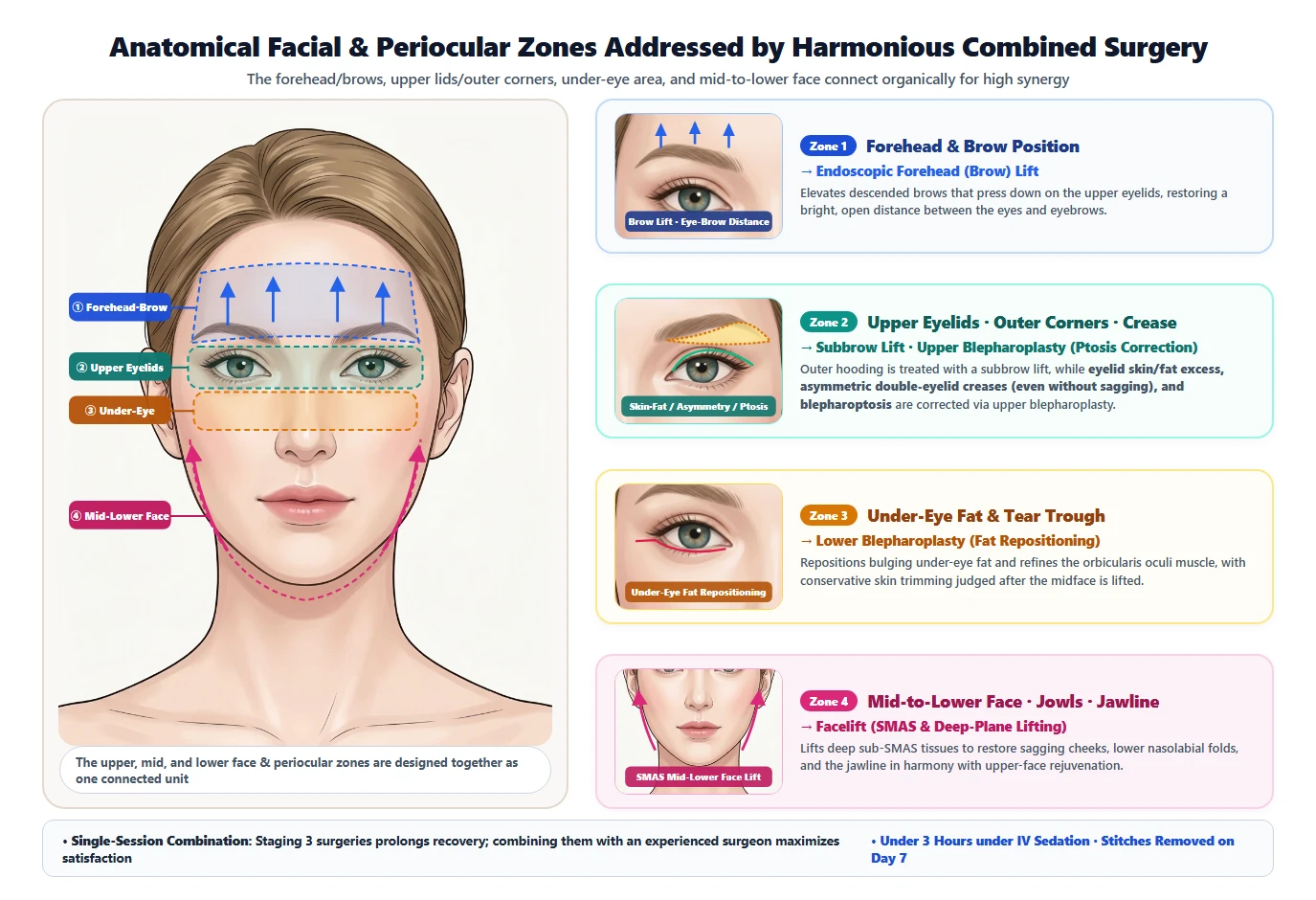
▲ Zone 1 (forehead & brows) is treated with an endoscopic forehead lift, Zone 2 (upper eyelids, lateral hooding & double-eyelid crease) with a subbrow lift and upper blepharoplasty, Zone 3 (under-eye area) with lower blepharoplasty, and Zone 4 (mid-to-lower face & jawline) with a facelift.
First Criterion: Evaluating Brow Position, Uneven Double Eyelids, and Blepharoptosis Together
When planning upper periorbital rejuvenation, we first check eyebrow position (for an endoscopic forehead lift), evaluate lateral hooding (for a subbrow lift), and determine whether upper blepharoplasty is needed based on three criteria: (1) excess skin and bulging fat of the eyelid itself, (2) asymmetrical (uneven) double eyelids even without severe sagging, and (3) the presence of blepharoptosis (eyelid ptosis) [2][3].
When the eyebrows descend with age, they push the skin beneath them downward onto the upper eyelids, making it appear as though there is more excess eyelid skin than there actually is. Excising a large amount of upper eyelid skin while ignoring a low brow narrows the brow-to-eye distance and can make the expression look heavy or harsh. In a clinical study of 70 upper blepharoplasty patients, postoperative brow descent was observed in 34.2% of cases, prompting the authors to recommend careful preoperative brow evaluation and concurrent brow lifting when indicated [2].
Therefore, we combine the three upper-periorbital procedures—endoscopic forehead lift, subbrow lift, and upper blepharoplasty—by evaluating the following criteria together [2][3]:
1. 1) If the eyebrows themselves have descended — Endoscopic Forehead Lift: Restores the brows to their natural youthful height first, opening up a refreshed space between the eyes and eyebrows [2][3]. At AVA Plastic Surgery, the forehead lift is performed meticulously using an endoscope through small incisions hidden within the scalp.
2. 2) If brow height is adequate but the outer eyelid skin droops — Subbrow Lift: Excises thick, sagging lateral skin along the lower border of the eyebrow, extending to the outer tail of the brow for a clean lateral lift.
3. 3) Three Indications for Upper Blepharoplasty: Upper blepharoplasty (with ptosis repair when needed) is performed not only (1) when excess skin and bulging fat of the upper eyelid itself are the problem, but also (2) when the left and right double-eyelid creases are asymmetrical (uneven) even without severe sagging—incising along the double-eyelid crease line to restore symmetry—and (3) depending on whether blepharoptosis (weak levator muscle function) is present [3]. Skin excision is kept conservative to preserve a natural crease [2][3].
Rather than relying on a single procedure for every eye, harmoniously combining an endoscopic forehead lift, subbrow lift, and upper blepharoplasty according to brow height, lateral hooding, eyelid skin/fat, crease symmetry, and ptosis creates the most natural and defined eye contour [3].
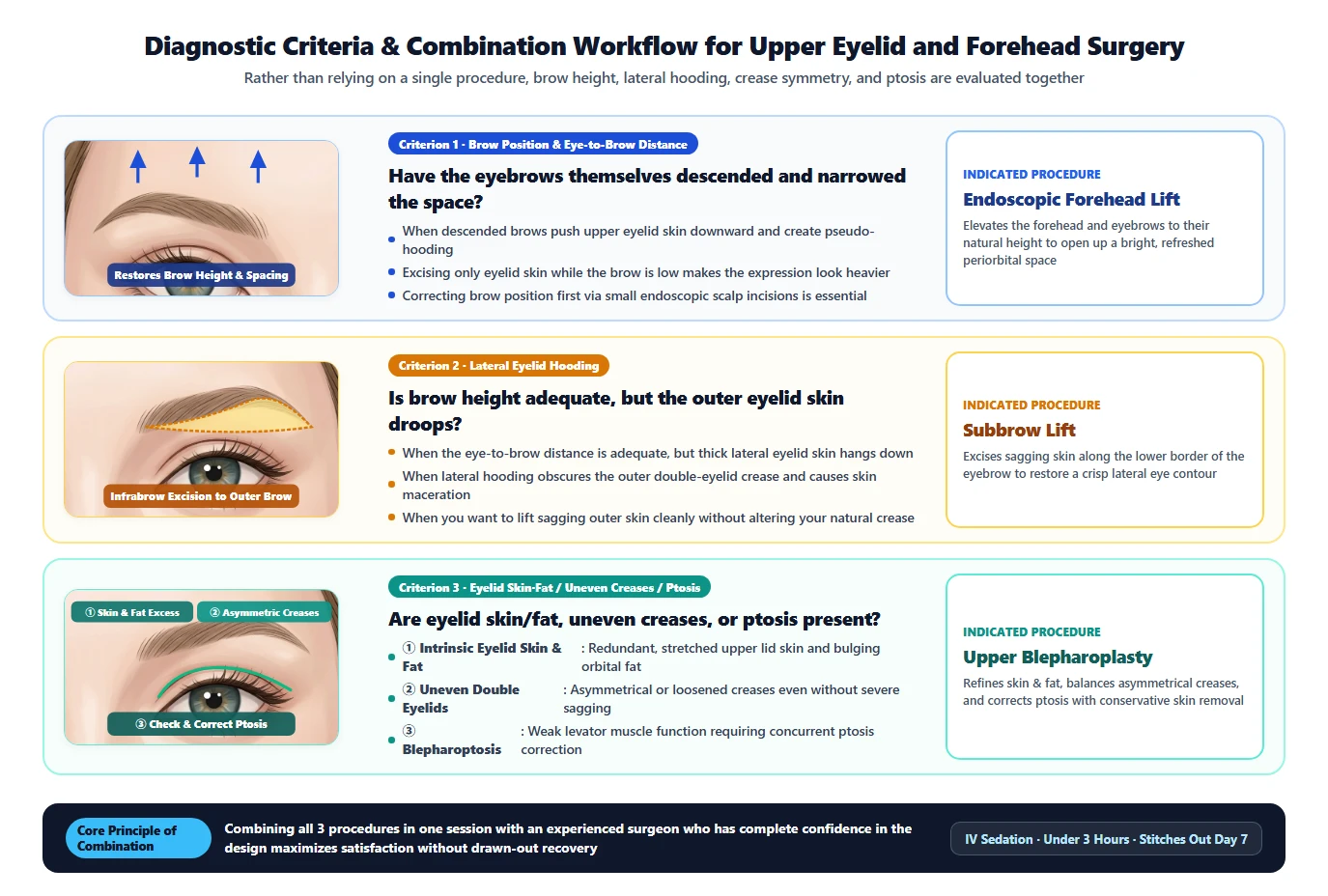
▲ Diagnostic workflow combining endoscopic forehead lift (brow descent), subbrow lift (lateral hooding), and upper blepharoplasty based on (1) intrinsic eyelid skin and fat excess, (2) uneven (asymmetrical) double eyelids even without sagging, and (3) presence of blepharoptosis.
How Is Lower Blepharoplasty Connected to a Facelift?
Because the under-eye area and the midface form one continuous anatomical transition, lower blepharoplasty must be designed around how the midface will sit after it is elevated by the facelift, using fat repositioning and conservative skin trimming [4]. When the midface descends, the tear trough and lid-cheek junction lengthen and deepen, making under-eye fat pads appear more prominent [4].
At AVA Plastic Surgery, the facelift elevates the sagging mid-to-lower face beneath the SMAS layer, while lower blepharoplasty repositions or refines bulging orbital fat and tightens the orbicularis oculi muscle to blend the lid-cheek junction seamlessly [4].
When performing both procedures together, we judge how much lower eyelid skin to trim based on the elevated position of the midface. Because over-resecting lower eyelid skin can pull the lower lid downward (ectropion or scleral show), conservative skin excision is our strict principle [4].
All at Once or in Stages? Why Simultaneous Combination by an Experienced Surgeon Is Far More Advantageous
Patients planning a facelift alongside forehead and eyelid surgery often ask whether doing the 3 procedures one by one is more accurate: while splitting 3 surgeries into separate stages can slightly increase micro-precision, the total recovery period becomes far too drawn out and lowers patient satisfaction—making it much more advantageous for satisfaction to have all 3 procedures harmoniously combined in a single session by an extensively experienced surgeon who has complete confidence in the surgical design.
An analysis of 11,300 facelift patients in the US CosmetAssure database noted a 30-day major complication rate of 1.5% for facelift alone and up to 3.7% when combined with additional procedures, largely associated with prolonged operating and anesthesia times [5].
To achieve both high patient satisfaction and safety in simultaneous combination surgery, four clinical pillars are essential:
1. Preoperative Medical Assessment: Thorough evaluation of blood pressure, medications, and overall health status
2. Harmonious 3-Procedure Combination & Design Confidence: Extensive surgical experience to accurately predict how simultaneous lifting vectors interact across the brow, eyelids, and face
3. Minimizing Operating Time and Anesthesia Burden: Surgical mastery that completes the combined procedures smoothly without prolonged anesthesia
4. Single Unified Recovery Period: Healing all treated zones together in one recovery window rather than enduring months of repeated downtime
At AVA Plastic Surgery, performing all 3 procedures simultaneously under IV sedation takes under 3 hours, placing minimal strain on the body, and Dr. Kim's extensive clinical experience allows patients to undergo combined surgery with confidence and peace of mind.
Anesthesia methods for facelift surgery are discussed in detail in a separate column.
How Does Recovery Work, and When Are Stitches Removed?
Because the skin around the eyes is thin, early swelling and bruising around the eyelids overlap with facelift swelling during the first few days, but total downtime is dramatically shorter than recovering from three separate operations—and stitches are removed on postoperative day 7.
Final Thoughts: Harmonious Full-Face Rejuvenation in a Single Under-3-Hour Session
Eye and forehead surgery and a facelift are not isolated procedures—they are connected steps that complete a person's overall expression. Accurately diagnosing brow height, lateral hooding, eyelid skin and fat, uneven double eyelids, and ptosis, and having all 3 procedures harmoniously combined in under 3 hours under IV sedation by a surgeon with complete design confidence, is the most effective path to a natural result and a single streamlined recovery.
Key Takeaways: Combining a Facelift with Eye and Forehead Surgery
Here is a summary of the clinical criteria and principles for combining a facelift with eyelid and forehead surgery.
Topic | Key Point |
|---|---|
Why Plan Them Together | The forehead, eyebrows, and eyelids are anatomically separate from the mid/lower-face facelift zone, so combining them creates harmonious full-face rejuvenation [1]. |
Brow & Lateral Hooding Criteria | An endoscopic forehead lift is chosen if the brows have descended, while a subbrow lift is chosen if brow height is adequate but outer eyelid skin droops [2][3]. |
Upper Blepharoplasty Criteria | Performed not only (1) for excess eyelid skin and fat, but also (2) when double eyelids are uneven (asymmetrical) even without sagging, and (3) when blepharoptosis is present [3]. |
Connection with Lower Blepharoplasty | Under-eye fat repositioning and conservative skin trimming are calibrated to the lifted position of the midface [4]. |
Single Session vs. Staged Surgery | Staging 3 surgeries may slightly aid micro-precision but drags out recovery and lowers satisfaction; having all 3 combined at once by an experienced surgeon with design confidence is far more advantageous. |
Anesthesia, Operating Time & Stitches | At AVA Plastic Surgery, combining all 3 procedures under IV sedation takes under 3 hours with minimal physical strain, and stitches are removed on day 7. |
At AVA Plastic Surgery, Dr. Seungsoo Kim personally oversees every case from consultation through surgery and recovery.
※ This article provides general medical information for educational purposes. Results, recovery and scarring vary between individuals, and every surgery carries risks such as bleeding, infection, swelling and asymmetry. Diagnosis and treatment decisions are made only through an in-person consultation.
References
1. American Society of Plastic Surgeons. Facelift.
4. Warren RJ, Aston SJ, Mendelson BC. Face lift. Plast Reconstr Surg. 2011;128(6):747e-764e.
Related procedures
• Facelift
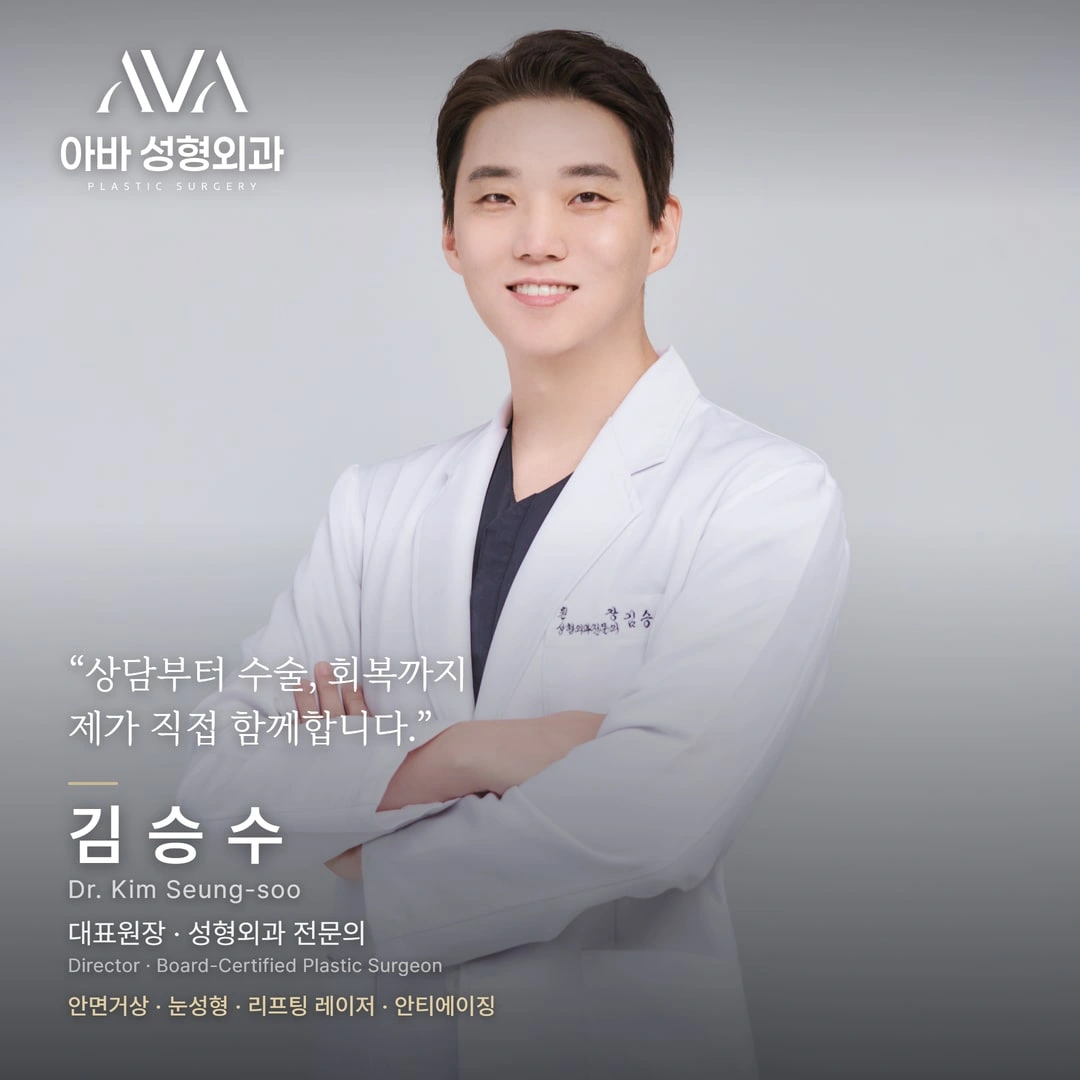
Dr. Seungsoo Kim · Board-Certified Plastic Surgeon, AVA Plastic Surgery (Seoul)
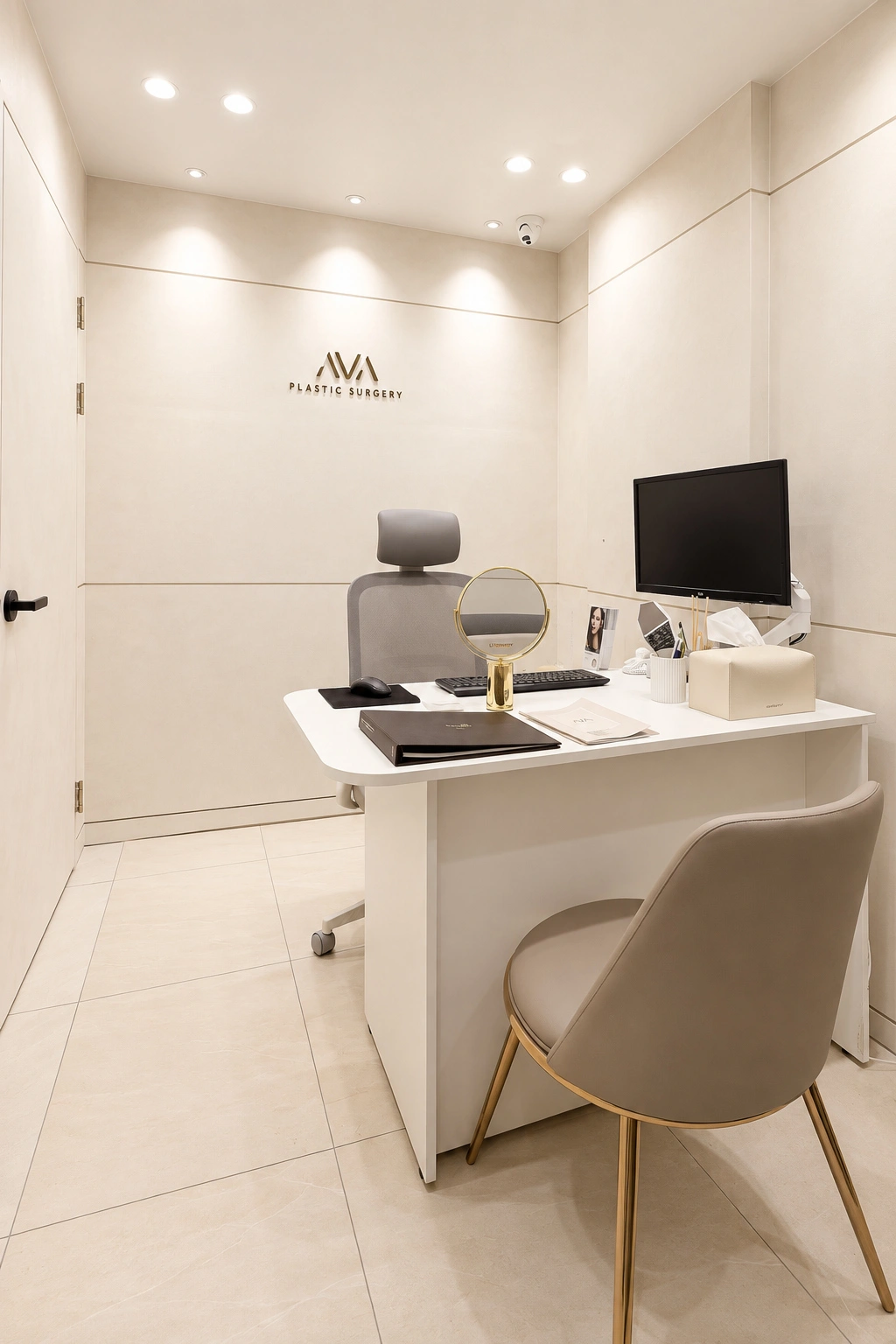
Facelift consultation in Seoul, Korea
Visit AVA Plastic Surgery near Exit 4 of Sinsa Station, on Gangnam-daero in Seoul. Our clinic is on the 4th floor of Inseong Building, 603 Gangnam-daero, Seocho-gu. A facelift consultation covers your concerns, previous treatments and recovery plans, including arrangements for your stay in Korea.
Facelift surgery in KoreaMeet Dr. KimDirections to Sinsa Station clinicRequest a facelift consultation
Recommended Related Columns by Dr. Seungsoo Kim