Ethnic Deep Plane Facelift: Skin Thickness, Tissue Structure and Surgical Design
Ethnic Deep Plane Facelift: Why 'Dual-Deep Plane' Ultimately Delivers Better Results — Analyzing Caucasian, Black, Southeast Asian, East Asian, and Middle Eastern Faces

When international patients fly to Korea—or when patients thoroughly research facial rejuvenation—the procedure they search for and ask about most often is the 'Deep Plane Facelift.' Because releasing the deep retaining ligaments allows the midface and jawline to be elevated together, the Deep Plane facelift is undeniably built on a sound anatomical principle.
However, as a board-certified plastic surgeon who operates on patients of diverse backgrounds—including East Asian, Caucasian, Black, Southeast Asian, and Middle Eastern faces—my clinical conviction is clear: across every ethnicity, stepping beyond a standard Deep Plane lift to perform a 'Dual-Deep Plane' facelift produces superior results. By performing a 2-plane dissection in both the subcutaneous fat layer beneath the dermis and the sub-SMAS plane, pulling and anchoring the SMAS layer first, and then redraping a wider area of skin to match, we significantly reduce surface unevenness or bunching and pull the skin much tighter and smoother. Moreover, because tension on the skin itself is reduced, it is far more favorable for scar healing. Today, I will share my intraoperative observations across different ethnicities and explain why Dual-Deep Plane is ultimately the better answer for patients seeking a Deep Plane facelift.
First: What Tissue Actually Feels Like on the Operating Table & How Dual-Deep Plane Works
Dermatology textbooks commonly classify skin using the Fitzpatrick scale based on melanin and UV response, noting that Asian and Black patients have a thicker dermis and develop fine wrinkles later than Caucasians, but carry a higher risk of hypertrophic scarring and post-inflammatory hyperpigmentation[1]. Plastic surgery anatomy studies on Asian facelifts further report that Asian skin is thicker and has denser fibrous attachments and retaining ligaments between the subcutaneous tissue and SMAS compared with Caucasian faces[3][4].
Yet when you actually dissect faces of different ethnicities in the operating room, you feel striking tactile differences that go beyond textbook generalizations. For instance, many assume Black skin must be the toughest and densest to dissect. In reality, when elevating facial flaps with a scalpel, East Asian (Korean, Chinese, and Japanese) patients frequently have much denser, tighter fibrous septa and retaining ligaments tethering the dermis, subcutaneous fat, and SMAS together than either Caucasian or Black patients. By contrast, while Black patients have highly reactive scar healing (such as keloid tendency) at the skin incision[1], their deeper sagging midface tissue often feels less fibrotic than East Asian tissue and glides upward quite smoothly once released.
Even though skin thickness, tissue density, and soft-tissue weight vary by ethnicity, why does 'Dual-Deep Plane' outperform a standard Deep Plane facelift across all of them? A standard Deep Plane facelift dissects briefly in the subcutaneous fat and steps directly into the sub-SMAS plane, pulling the skin and SMAS together as a single attached block and closing at the skin[3][7]. By contrast, a Dual-Deep Plane facelift uses a 2-plane (bilamellar) dissection—separately dissecting both the subcutaneous fat layer beneath the dermis and the sub-SMAS plane—so we can first pull and anchor the SMAS layer between the two planes, and then independently redrape a wider area of skin in its own optimal direction with zero tension[7][8]. First, redraping a wider area of skin eliminates surface unevenness or puckering and allows a much tighter, smoother finish[7][8]. Second, because the deep SMAS layer bears the lifting load first, tension at the skin edges is minimized, resulting in much cleaner scars[6][8].
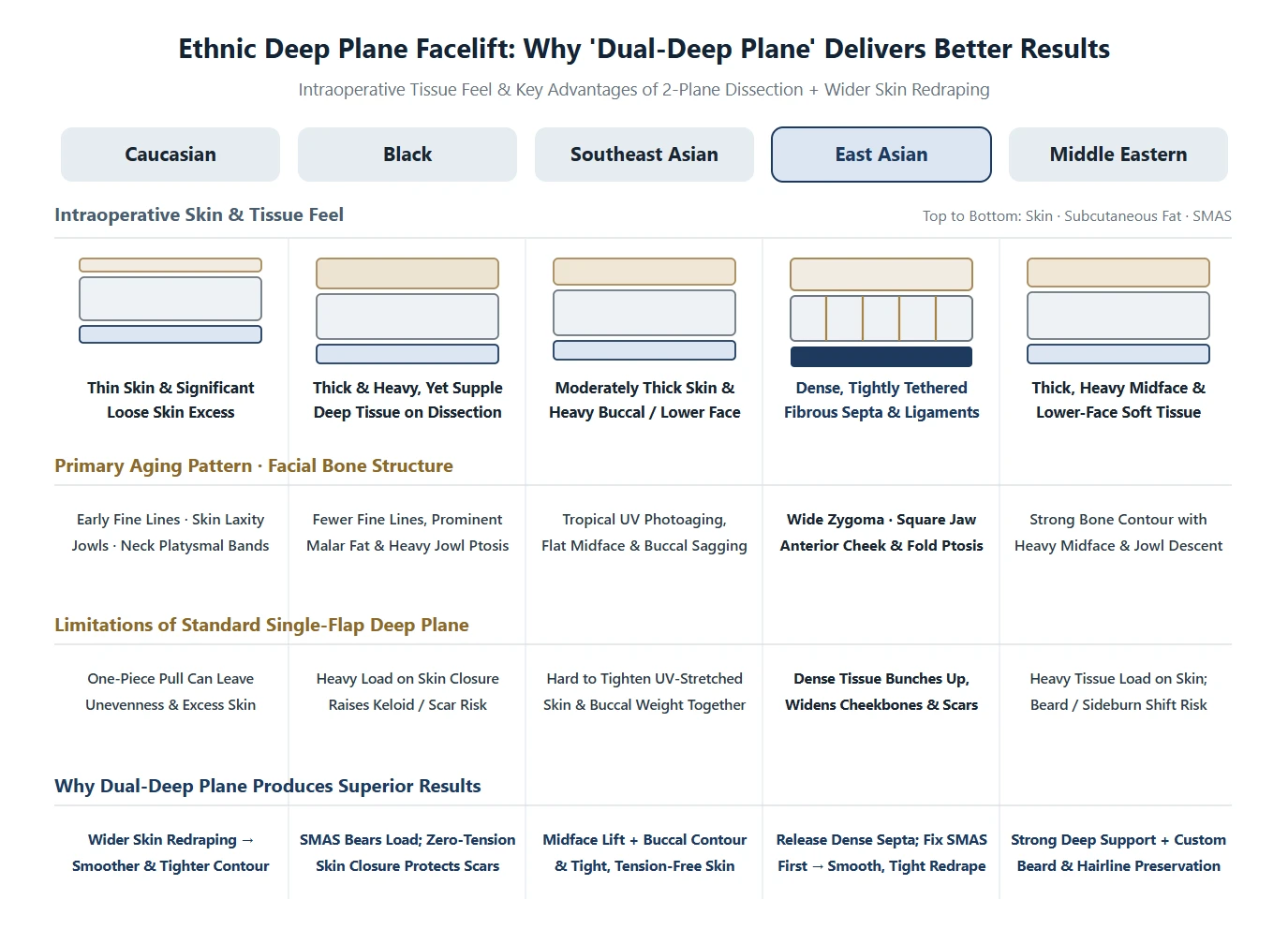
▲ Summary diagram comparing actual intraoperative tissue characteristics across ethnicities, the limitations of a standard single-flap Deep Plane lift, and why Dual-Deep Plane delivers superior results.
Caucasian Faces: Standard Deep Plane Works Well, Yet Dual-Deep Plane Is Smoother and Tighter
Caucasian patients—whom we see most frequently among our international consultations—often come in specifically asking for a Deep Plane facelift because of its popularity in the West. On physical examination and intraoperative dissection, Caucasian faces typically show the following traits:
1. The skin (dermis) is very thin with less melanin protection, so fine lines and loss of elasticity appear earlier in life, leaving a large amount of loose, redundant skin as tissues sag[1].
2. Fibrous septa in the subcutaneous fat layer are relatively loose compared with East Asian tissue, making plane dissection straightforward, and the risk of hypertrophic scarring or keloids is comparatively low[1].
3. Because the facial skeleton is narrower with stronger anterior-posterior projection, descending tissue deepens hollow shadows beneath the cheekbones and creates pronounced jowls along the jawline[1][2].
4. Because the skin is thin, vertical neck bands (platysmal bands) and loose neck skin show through clearly alongside facial aging[4].
To be fair, because Caucasian patients have thin skin and a low tendency toward keloid scarring, a standard Deep Plane facelift can certainly achieve good results. Even so, there is a clear reason why I recommend Dual-Deep Plane to Caucasian patients for a superior outcome:
1. Redraping a wider area of skin eliminates unevenness and pulls the face much tighter
Aging Caucasian faces have a large amount of redundant, stretched skin that is very thin[1]. When you step straight under the SMAS and pull the skin and SMAS together as a single block in a standard Deep Plane lift, subtle tethering around ligament release points or along the dissection transition can show through thin skin as slight unevenness or dimpling, and there is a limit to how smoothly all that excess skin can be flattened[7]. With Dual-Deep Plane, dissecting both the subcutaneous fat layer and the sub-SMAS plane allows us to anchor the SMAS firmly first and then redrape a much wider area of skin independently—eliminating surface unevenness and achieving a noticeably tighter, smoother contour[7][8].
2. Treating neck bands (platysma) together with the face as one unit
If the jawline is lifted while vertical neck bands and loose neck skin are left behind, the neck looks out of sync with the rejuvenated face. When neck laxity or platysmal banding is prominent, we combine the facelift with a submental incision and platysmaplasty (corset tightening of the platysma) to create a continuous, crisp jawline and neck profile.
3. Reducing skin tension prevents pixie ear and scar widening
Even though keloids are uncommon in Caucasians[1], placing pulling tension on thin skin easily leads to lateral sweep lines, widened pale scars, or a downward-pulled earlobe ('pixie ear')[6][7]. Having the deep SMAS layer carry the load first while closing the skin without tension keeps the preauricular contour and earlobe completely natural[6][8].
4. Preserving fine, light hairlines and sideburns
Blonde or light-brown fine hair offers less coverage over incision lines[6]. Because Dual-Deep Plane allows us to adjust the skin redraping angle independently from the deep SMAS pull, we can redrape the skin without displacing the sideburn or temporal hairline and use trichophytic (hair-follicle-sparing) incisions to keep scars invisible.
5. Balancing brow and eyelid aging with the midface
Once the midface and jawline are tightened, a heavy brow or hooded upper eyelids can stand out by contrast. When periorbital aging is present, we position the brow first (via an endoscopic forehead lift or subbrow lift) and address the upper/lower eyelids or under-eye fat so the overall expression looks rested rather than pulled.
6. Seamless deep fixation that never shows through thin skin
Because Caucasian skin is thin, when we pull and fix the SMAS layer first, we bevel and secure the deep fixation smoothly so no suture knots or step-offs are palpable or visible beneath the redraped skin.
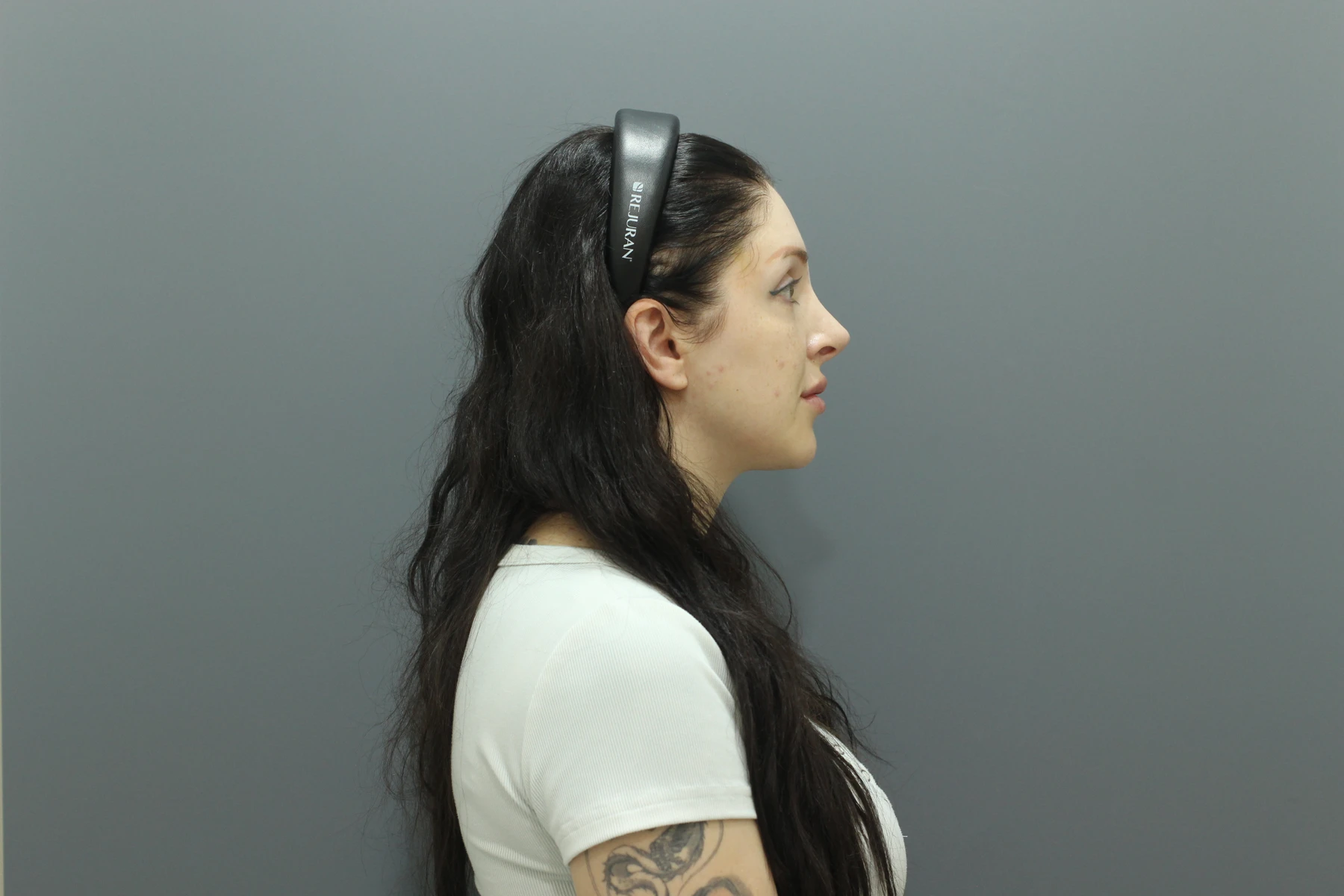
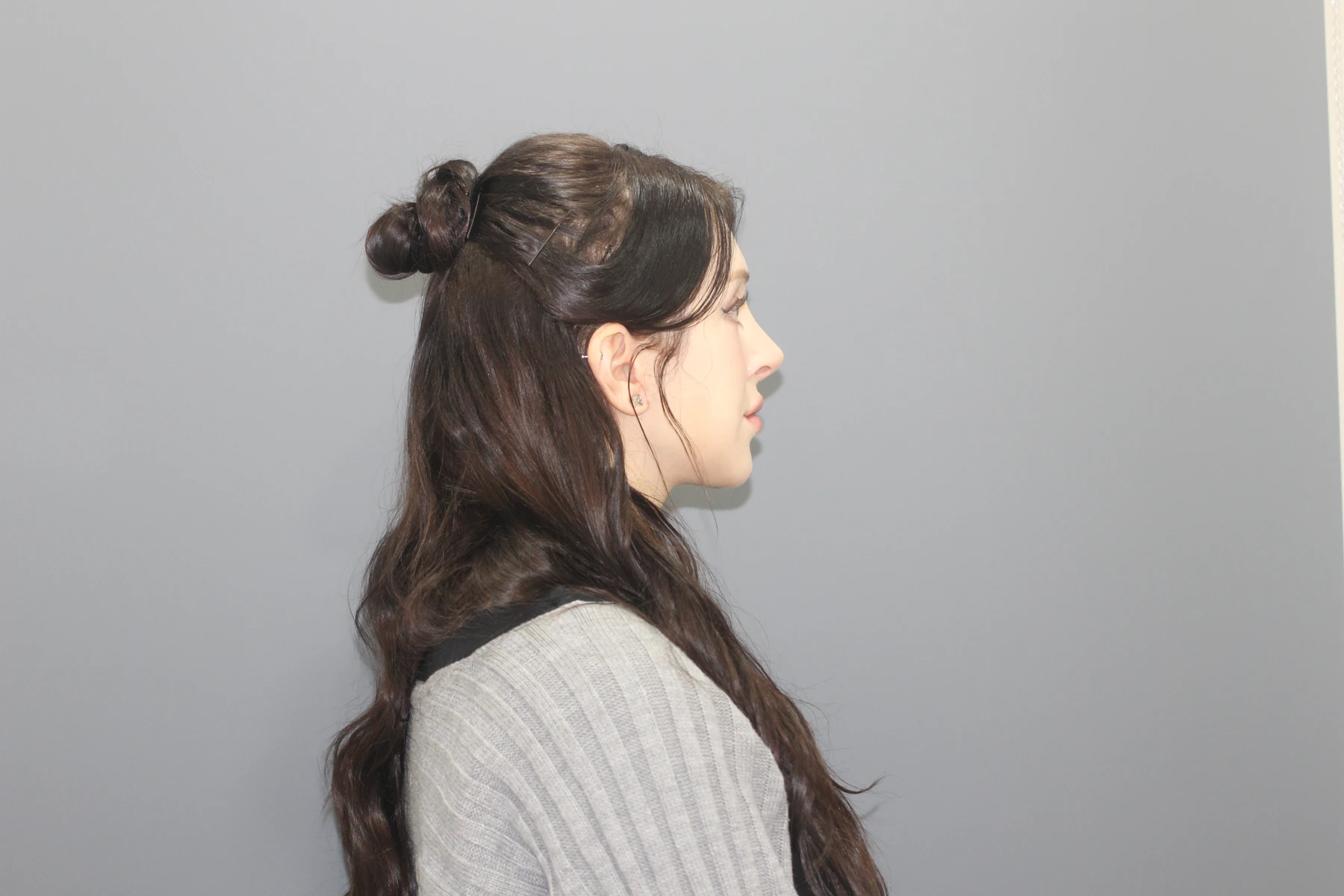
Clinical photographs before surgery and at 5 weeks
Frontal | Before | Frontal | After 5 weeks |
|---|---|
|
|
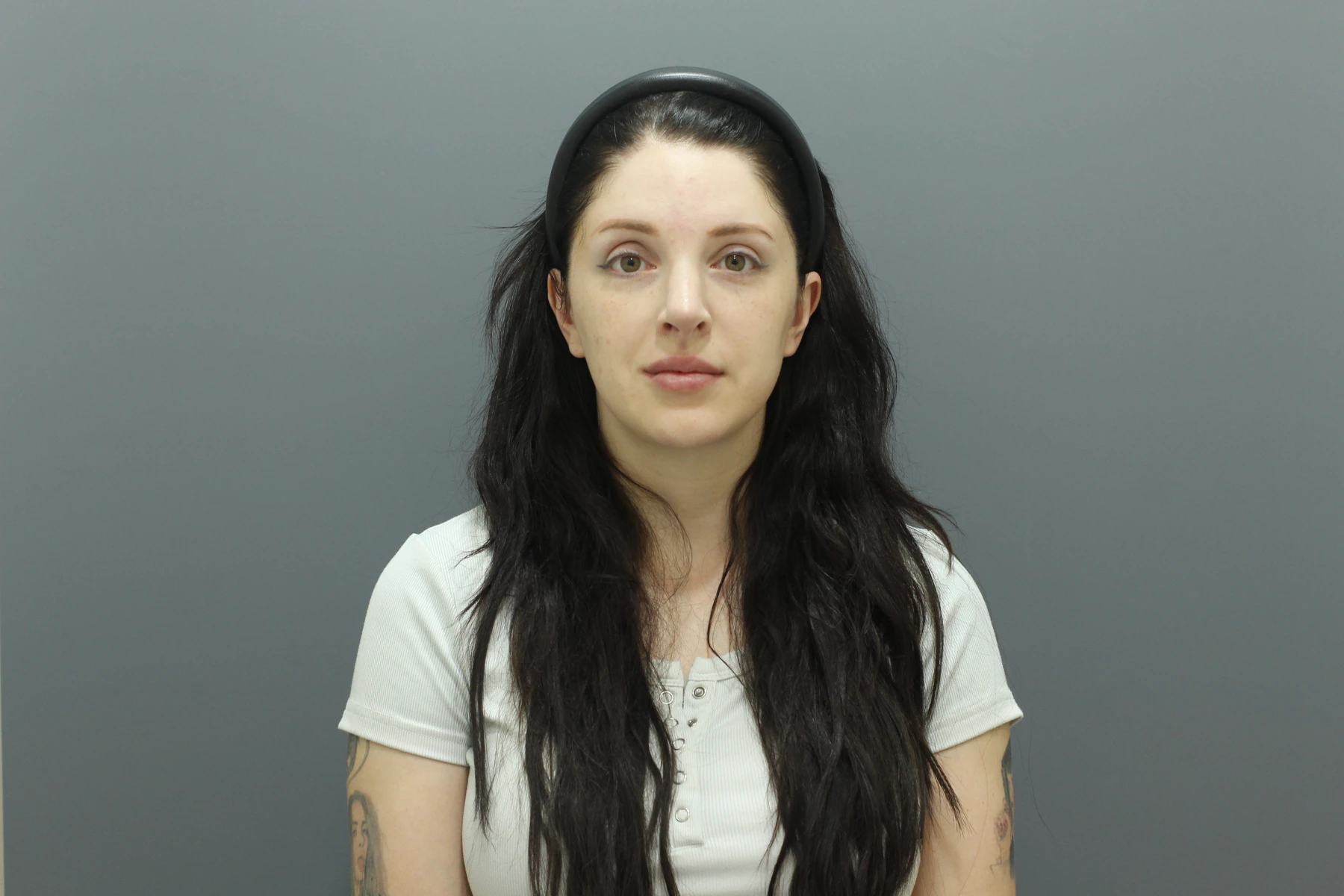

Oblique | Before | Oblique | After 5 weeks |
|---|---|
|
|
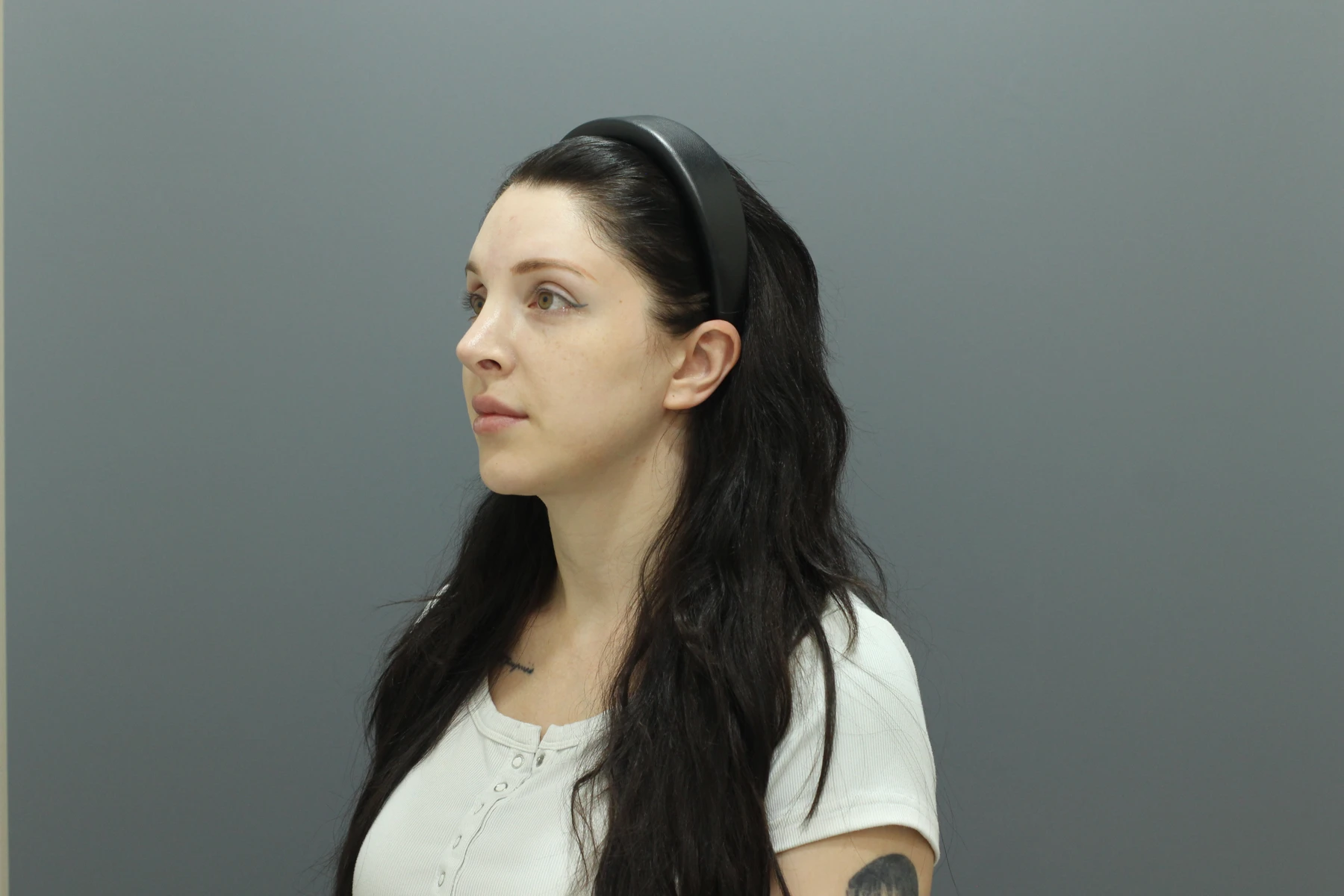

Lateral | Before | Lateral | After 5 weeks |
|---|---|
|
|
Black (African-Descent) Faces: Lifting Heavy Deep Tissue Tightly While Protecting Against Keloids
Although dermatology literature notes that Black skin has a compact stratum corneum and highly active fibroblasts[1], actual intraoperative dissection reveals a surprising contrast: unlike East Asian faces—where dermis, subcutaneous fat, and SMAS are bound together by dense, tough fibrous septa—the deeper midface tissues in Black patients often dissect smoothly and glide upward quite flexibly when pulled. Fine surface wrinkles appear late, but thick malar fat pads and heavy cheek soft tissues descend under gravity to form deep nasolabial folds and prominent jowls[1].
When Black patients inquire about a Deep Plane facelift, Dual-Deep Plane offers a decisive advantage: it holds up heavy cheek sagging more tightly while dramatically reducing tension on the skin incision—the single biggest trigger for hypertrophic scars and keloids[1].
1. Before surgery, we carefully check previous ear piercings or old scars for any history of hypertrophic scarring or keloids.
2. If you pull the heavy cheek tissue as a single composite block and rely on the skin closure to hold it, the weight of the flap pulls on the incision line and stimulates thick scarring.
3. With Dual-Deep Plane's 2-plane dissection, we pull and anchor the SMAS layer between the two planes first so the strong deep fascia bears the full weight of the heavy cheek tissue[7][8].
4. We then redrape a wider area of skin smoothly over the SMAS contour and close the skin edges with zero tension—giving a tighter lift while protecting against keloids and post-inflammatory hyperpigmentation[1][6].
5. Postoperatively, we follow a structured scar-care protocol including silicone sheeting/gel, strict UV protection, and early targeted steroid injections if needed.
Southeast Asian (Thai, Indonesian, Filipino, Vietnamese) Faces: Addressing UV-Stretched Skin and Heavy Buccal Fat Together
Southeast Asian patients frequently present with two simultaneous concerns: early loss of skin elasticity and photoaging from intense tropical UV exposure[2], combined with a relatively flat anterior midface and heavy sagging of the deep buccal fat and lower face[2][3].
1. A standard single-flap Deep Plane lift can fall short when trying to simultaneously sculpt heavy deep buccal fullness and tightly smooth out sun-stretched surface skin. In our Dual-Deep Plane approach, sub-SMAS dissection releases the retaining ligaments to elevate the flat anterior cheek while Conservative buccal fat contouring slims the lower face when needed[3][4].
2. Next, because we redrape a wider area of UV-loosened skin over the anchored SMAS layer, the skin settles tightly and smoothly from the lower jawline up to the cheek without bunching.
3. In patients with deeper skin tones, tension along the suture line easily triggers hyperpigmentation or thickened scars[1]; letting the SMAS bear the tension while closing the skin without tension is far safer for scar quality.
East Asian (Korean, Chinese, Japanese) Faces: Where Dense, Tightly Tethered Tissue Makes Dual-Deep Plane Essential
Anatomical studies confirm that East Asian patients have thicker dermis and denser fibrous attachments and retaining ligaments than Caucasians[3][4]. In the operating room, East Asian skin and subcutaneous tissue frequently feel even denser, tougher, and more tightly tethered than both Caucasian and Black tissue.
1. Not only is the dermis thick, but the fibrous septa linking the dermis, subcutaneous fat, and SMAS form a tight, dense web that creates substantial tactile resistance during dissection.
2. The retaining ligaments anchoring soft tissue to bone (zygomatic and masseteric cutaneous ligaments) are thick and fibrous, and the anterior malar fat pad is heavy[3].
3. Skeletally, wider cheekbones (especially the lateral zygomatic arch) and a fuller mandibular angle create a broader facial width that turns sharply toward a flatter anterior midface[3][4].
4. When tension is placed on the incision line, hypertrophic scars develop easily; and if dense tissue is not separated cleanly, swelling lasts longer or visible traction lines can remain[4].
In East Asian faces with such densely tethered tissues and wide cheekbones, performing a standard Deep Plane facelift—stepping quickly from a short subcutaneous flap into the sub-SMAS space and pulling everything as one attached block—commonly runs into two limitations. First, because the densely adherent skin and subcutaneous fat are not separated widely enough to redrape independently, pulling the composite block can cause the cheek or temple skin to bunch up unevenly or feel less taut. Second, advancing a thick composite flap en bloc over a prominent lateral cheekbone can make the face look even wider, while transferring heavy tissue load to the skin suture line increases scar tension[3][4].
That is why the advantages of Dual-Deep Plane stand out most dramatically in East Asian faces. By performing a 2-plane dissection in both the subcutaneous fat layer beneath the dermis and the sub-SMAS plane, we safely release the dense fibrous septa and tough zygomatic and masseteric ligaments, then pull and anchor the SMAS layer first in a superior-posterior vector that avoids widening the lateral cheekbone[3][4][8]. We then redrape a much wider area of skin over the new SMAS contour and close it without tension[6][7]. This 2-step sequence is what allows dense East Asian skin to lie completely smooth and tight—without uneven bunching—while keeping preauricular and postauricular scars fine and inconspicuous.
Middle Eastern (Arab, Persian) Faces: Supporting Heavy Soft Tissue While Preserving Beard and Hairlines
Middle Eastern patients typically combine strong, well-defined bone structure with thick dermis, substantial subcutaneous fat, and heavy overall soft-tissue weight[5]. With age, this heavy midface and cheek tissue descends to form deep nasolabial folds, heavy jowls, and submental fullness[5].
1. The heavier the soft tissue, the greater the advantage of Dual-Deep Plane over a standard Deep Plane lift. Releasing the ligaments in the sub-SMAS plane and anchoring the thick SMAS layer firmly to deep fascia first provides the structural strength needed to hold up heavy cheeks and jowls without early relapse.
2. Redraping the thick skin more widely over that anchored SMAS foundation eliminates heavy, bunched folds and creates a much tighter jawline—often paired with submental platysmaplasty when double-chin fullness is present[5].
3. In Middle Eastern men with dense beard and sideburn hair, separating the SMAS lifting vector from the skin redraping vector in a Dual-Deep Plane lift allows us to prevent beard-bearing skin from being pulled onto the tragus or earlobe[6].
4. Because an open, well-defined arched brow is often desired[5], we also evaluate brow position and combine an endoscopic forehead lift when upper-face heaviness accompanies midface descent.
5. In olive to deeper skin tones, tension-free skin closure minimizes both hypertrophic scarring and post-inflammatory pigment changes[1][5].
Comparing Ethnic Tissue Characteristics and Dual-Deep Plane Advantages in One Table
The table below summarizes actual intraoperative tissue characteristics across ethnicities and why Dual-Deep Plane produces superior results in each group.
Group | Intraoperative Skin & Tissue Feel | Primary Aging Pattern & Bone Structure | Limitations of Standard Single-Flap Deep Plane | Why Dual-Deep Plane Delivers Better Results |
|---|---|---|---|---|
Caucasian | Thin dermis, relatively loose fibrous septa, and abundant loose skin excess | Early fine lines and skin laxity, jowls, and vertical neck (platysmal) bands | Low keloid risk, but pulling as one block can leave thin skin uneven or limit excess skin tightening | Redrapes a wider area of skin for a much tighter, smoother finish while preventing pixie ear and scar widening |
Black (African Descent) | Thick, heavy skin, yet deep midface tissue feels relatively supple and mobile during dissection | Fewer fine lines, but pronounced descent of heavy malar fat, cheeks, and jowls | Transferring heavy composite flap load to the skin closure increases hypertrophic scar and keloid risk | SMAS bears the heavy load first while skin is redraped widely and closed without tension to protect scars |
Southeast Asian | Moderately thick skin with heavy deep buccal fat and lower-face soft tissue | Tropical UV photoaging combined with a flatter anterior cheek and heavy buccal sagging | Hard to tighten sun-stretched surface skin and heavy deep buccal fullness simultaneously in one block | Lifts anterior cheek SMAS and contours buccal weight first, then tightly redrapes UV-loosened skin without tension |
East Asian (KR·CN·JP) | Fibrous septa and retaining ligaments linking skin, fat, and SMAS often feel denser and tighter than in Black or Caucasian faces | Wide lateral cheekbones, strong jaw angle, flatter midface, and heavy anterior cheek/fold descent | Dense tissue pulled as one block can bunch unevenly, widen the cheekbones, and place tension on scars | 2-plane dissection releases dense adhesions and ligaments; SMAS is fixed first and skin is redraped smoothly without bunching |
Middle Eastern | Thick skin and subcutaneous fat with substantial overall soft-tissue weight | Strong skeletal contours with heavy midface descent, jowls, and submental fullness | Heavy tissue load on skin closure; risk of pulling male beard or sideburn skin toward the ear | Strong SMAS-first fixation holds heavy tissue while independent skin redraping preserves beard and hairlines |
Why We Recommend 'Dual-Deep Plane' to Patients Seeking a Deep Plane Facelift
In summary, the standard Deep Plane facelift is undeniably a good procedure that releases retaining ligaments to elevate deep facial tissues[3][7]. However, the reason AVA Plastic Surgery goes one step further—insisting on a 'Dual-Deep Plane' facelift that dissects both the subcutaneous fat layer beneath the dermis and the sub-SMAS plane—is that it consistently produces superior results across all ethnicities[7][8].
1. First, because we can redrape a wider area of skin independently, surface unevenness or bunching is minimized and the skin can be pulled much tighter and smoother. Anchoring the SMAS layer firmly first creates a stable, lifted foundation over which the skin is smoothly draped.
2. Second, reducing tension on the skin itself is far better for scars. Because the deep SMAS layer absorbs the lifting force and the skin edges are brought together without tension, we simultaneously reduce pixie-ear distortion in thin Caucasian skin and hypertrophic or keloid scar risk in East Asian, Black, Southeast Asian, and Middle Eastern skin.
3. Third, separating the SMAS lifting direction from the skin redraping direction allows us to tailor each vector to the patient's bone structure and hairline—preventing lateral cheekbone widening in East Asian faces and preserving sideburns and beard lines in men.
4. All incisions are designed inconspicuously along the natural creases in front of and behind the ear and along the hairline.
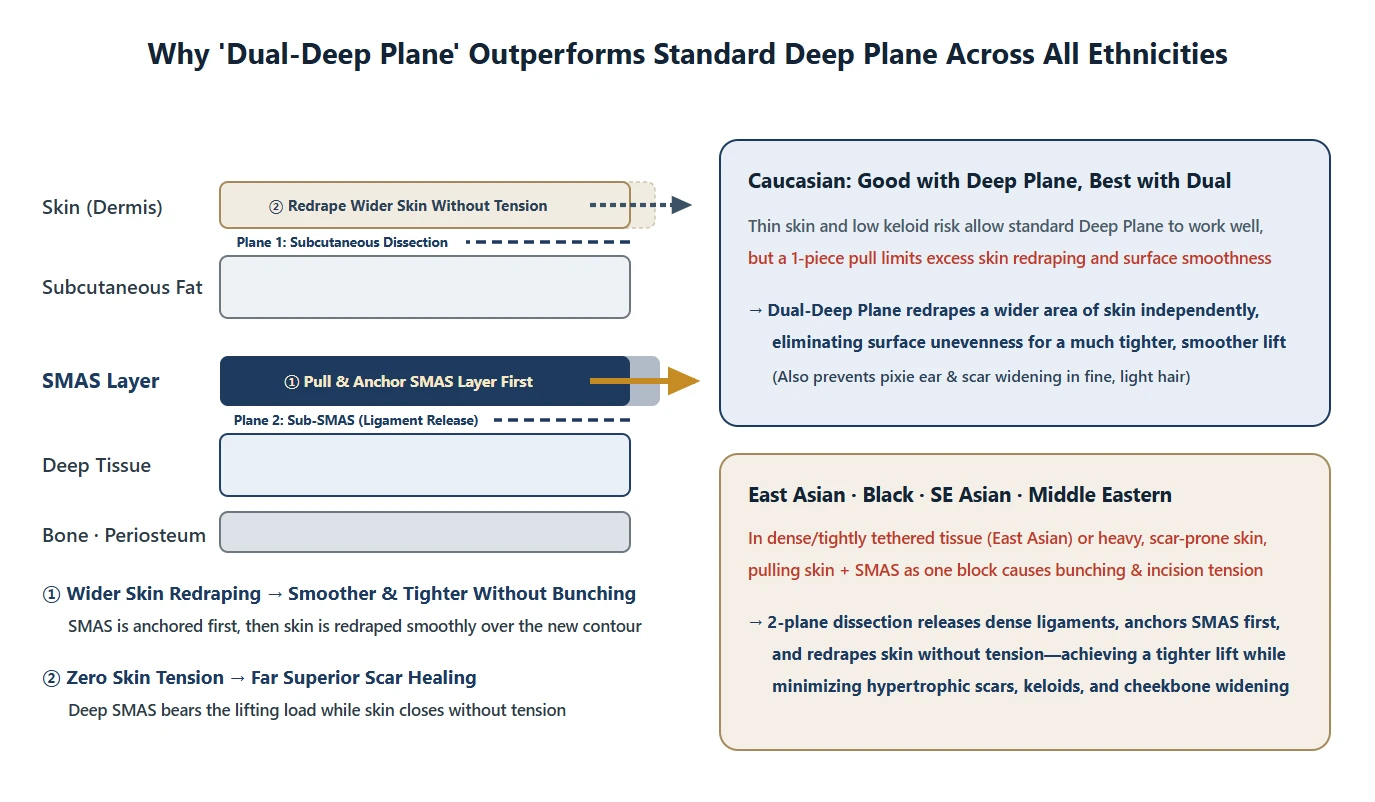
▲ Diagram illustrating why Dual-Deep Plane (2-plane dissection with SMAS-first fixation and wider tension-free skin redraping) outperforms a standard single-flap Deep Plane lift across all ethnicities—reducing unevenness, tightening more effectively, and protecting scars.
Built on Ethnic Anatomy, Tailored to Your Individual Face
If you found us while searching for a Deep Plane facelift, I encourage you to first examine how your specific skin thickness, tissue density, and bone structure require the deep SMAS layer and surface skin to be handled for the smoothest, tightest result. Ethnic tendencies provide a vital starting point, but the final surgical plan is always completed after palpating and examining your individual tissues in person.
Summary at a Glance
Key differences between ethnic Deep Plane facelifts and the Dual-Deep Plane approach, organized by question.
Question | Key Takeaway |
|---|---|
Why does Dual-Deep Plane produce better results than a standard Deep Plane lift? | By dissecting in 2 planes (subcutaneous fat beneath the dermis + sub-SMAS), pulling SMAS first, and redraping a wider area of skin, it reduces surface unevenness, pulls the face tighter, and relieves skin tension for much better scars. |
Don't Caucasian patients already get good results with a standard Deep Plane lift? | Thin skin and low keloid risk allow standard Deep Plane to work well, but because Caucasians have abundant, thin lax skin, redraping a wider skin area via Dual-Deep Plane achieves a much tighter, smoother finish without unevenness or pixie ear. |
How do East Asian and Black tissues compare on the operating table? | Many assume Black skin is the toughest, but during actual dissection East Asian skin, fibrous septa, and retaining ligaments frequently feel denser and more tightly tethered, whereas Black deep tissue glides relatively smoothly while requiring strict keloid prevention at the skin closure. |
What about East Asian faces with dense tissue and wide cheekbones? | 2-plane dissection releases dense fibrous adhesions and zygomatic ligaments, anchors the SMAS first without widening the lateral cheekbones, and redrapes skin widely without bunching or tension. |
How does Dual-Deep Plane benefit Black, Southeast Asian, and Middle Eastern faces? | The deep SMAS layer firmly supports heavy cheek and buccal tissues for a tighter lift, while zero-tension skin closure minimizes hypertrophic scars, keloids, hyperpigmentation, and beard/sideburn shift. |
What is the universal core principle across all faces? | Dual-Deep Plane: 2-plane dissection, pulling and anchoring the SMAS layer between the planes first, and redraping a wider area of skin smoothly without tension. |
At AVA Plastic Surgery, Chief Director Dr. Seung-Soo Kim personally handles every step from consultation and surgery to recovery.
※ This article provides general medical information for educational purposes. Surgical results, recovery timelines, and scar appearance vary by individual, and all surgeries carry potential risks including bleeding, infection, swelling, and asymmetry. An in-person consultation is required for an accurate diagnosis and treatment plan.
References
7. Warren RJ, Aston SJ, Mendelson BC. Face lift. Plast Reconstr Surg. 2011;128(6):747e-764e.
8. Stuzin JM, Baker TJ, Gordon HL, Baker TM. Extended SMAS dissection as an approach to midface rejuvenation. Clin Plast Surg. 1995;22(2):295-311.
Related Procedures
• Facelift
• Transconjunctival Fat Repositioning

Seung-Soo Kim, MD · Board-Certified Plastic Surgeon, Chief Director
Facelift consultation in Seoul, Korea
Visit AVA Plastic Surgery near Exit 4 of Sinsa Station, on Gangnam-daero in Seoul. Our clinic is on the 4th floor of Inseong Building, 603 Gangnam-daero, Seocho-gu. A facelift consultation covers your concerns, previous treatments and recovery plans, including arrangements for your stay in Korea.
Facelift surgery in KoreaMeet Dr. KimDirections to Sinsa Station clinicRequest a facelift consultation
Read the original Naver blog post
Recommended Related Columns by Dr. Seungsoo Kim

Mini Facelift vs Full Facelift: Who Is a Short-Scar Lift Enough For?
Read article →
Dual-Deep Plane Facelift: Skin Tension, SMAS Fixation, Scars and Pixie Ear
Read article →
Facelift with Forehead and Eyelid Surgery: Planning Combined Procedures
Read article →