Male Facelift Scars and Changes in Sideburns and Beard
“I want a more defined jawline, but will I look as though I have had surgery?” In consultations for a male facelift, we discuss not only facial contours but also scars around the ears and the position of the sideburns and beard. If you wear your hair short or shave every day, the appearance of the skin around your ears is an important part of the plan.
The fundamental principles of the facelift I perform are the same for men and women. I release and lift descended tissues, then trim excess tissue and skin to improve the contour. For men, I also consider changes in the sideburns and beard, shaving habits, and selective hair removal where needed.
“Preserve your familiar appearance while creating a younger, more defined contour.”
This is the approach I value in male facelift surgery. Improving the facial contour and making sure the result works naturally with your shaving routine and hairstyle are parts of the same plan.
01 The basic surgical principles are the same for men and women
A facelift raises descended tissues of the cheeks and jawline to a more appropriate position. I dissect and mobilize the superficial musculoaponeurotic system, or SMAS, lift it, and trim excess SMAS and skin as needed. Being male does not change this fundamental principle.
The extent of surgery and method of fixation depend on where the tissues have descended, the condition of the skin and deeper tissues, and any associated neck laxity. Supporting the deeper tissues and redraping the skin naturally is important, rather than relying on excessive skin tension. The literature also describes similar fundamental facelift techniques in men and women, with additional considerations for facial hair and the hairline in men.[1]
02 How can a male facelift change the sideburns and beard?
During a facelift, loose skin is redraped to fit the improved contour. Hair follicles move with the skin, so the boundaries of the sideburns and beard can change.[1, 3]
Beard-bearing skin on the cheek and jaw may move closer to the ear, and the position or shape of the sideburns may change. Surgery does not create new hairs; it changes the position of skin that already contains hair follicles.
Before surgery, I assess the distribution of the sideburns and beard as well as the degree of sagging. We consider their anticipated position in relation to your usual hairstyle and shaving habits and plan selective hair removal if needed.
When planning the anterior incision, I consider how much hair-bearing skin to retain so that the sideburns are not raised excessively or shortened. Preserving sideburn position and width is also an important planning consideration in the male facelift literature.[5]
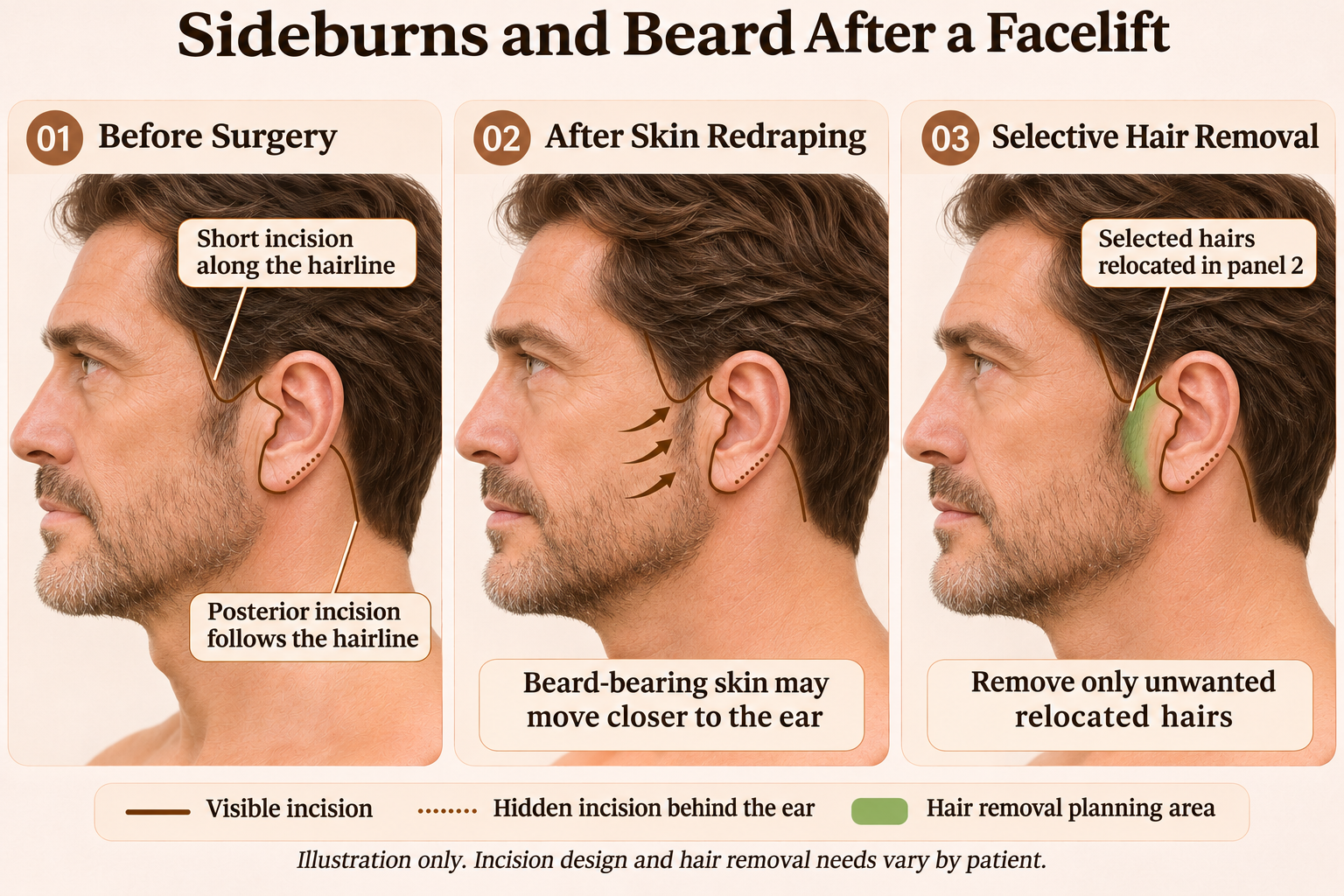
A conceptual illustration of sideburn and beard movement and selective hair removal planning. Solid brown lines indicate visible incision paths; brown dots represent paths hidden behind the ear. Green indicates relocated hairs that may be considered for selective removal. Actual incision design, skin movement, and hair removal needs are individualized.
03 Male facelift scars and the appearance after shaving
One approach to reducing the movement of beard-bearing skin toward the ear is to preserve a strip of hairless skin in front of it. However, when an incision is placed farther forward, its visibility after a close shave also needs to be considered.
I do not choose the incision position solely to preserve this hairless strip. I consider the shape of the ear, its natural boundaries, scar visibility, and postoperative beard management together. A preauricular crease can conceal an incision well in some patients, so no single position is right for every man.
Published approaches include using a retrotragal incision in men while separately managing hairs that move close to the ear. Earlier reports describe direct removal of follicles; later publications discuss laser hair removal or electrolysis.[2, 3, 4] In my consultations, I explain the anticipated beard position, ask about the patient's preferences regarding hair removal, and recommend treatment of the areas that need it.
04 Hair removal after a facelift and how to plan its timing
Because sideburn and beard positions can change, selective hair removal may be needed to create a natural boundary. This does not mean removing the entire beard. The aim is to preserve the sideburns and beard you want while addressing hairs that have moved close to the ear and may look out of place or be difficult to shave.[3, 4]
Start with your usual beard and shaving routine
If you wear a beard, we discuss your preferred beard line and sideburn shape. If you normally shave, we consider both hair distribution and how the skin and scars around the ear will look when clean-shaven. If you are already having hair removal, please tell us which areas are being treated and how far treatment has progressed.
Coordinate the treatment area and timing with the surgical plan
Hair removal is planned around your hair distribution and anticipated skin movement. Whether to prepare before surgery or refine the result once the tissues have settled and the wounds have healed depends on your circumstances. After surgery, coordinate the timing with your surgeon rather than arranging treatment over a fresh incision on your own.
The response to laser hair removal varies with hair color, thickness, and skin characteristics. Rather than assuming that one session will be enough, treatment is planned to refine the boundary naturally. A high proportion of white beard hairs or a long history of previous hair removal should also be discussed during consultation.
05 A younger and more defined contour that still looks like you
The aim of a male facelift is not automatically to produce a more angular face or a predetermined jawline. I plan the correction of descended cheek and jawline tissues around your existing features and the appearance you would like to achieve.
The goal is to preserve your familiar appearance while creating a younger, more defined contour. I aim to reduce a heavy or tired appearance and reveal the contours you recognize from earlier years, without making your face look unfamiliar.
Your beard and hairstyle are also part of your appearance. That is why facial contour improvement and sideburn and beard management need to work together.
06 What to discuss at your consultation
Tell us which areas of your cheeks, jawline, or neck concern you most and how you usually manage your facial hair. Photographs can help if there is a particular sideburn or beard shape you want to keep.
Discuss previous hair removal, any future treatment plans, your usual hair length, and concerns about scars when clean-shaven. These details help us plan the postoperative appearance more specifically. We also review your health, medications, smoking status, previous surgery and treatments, and recovery schedule.
07 Frequently asked questions
Is a male facelift completely different from a female facelift?
The basic principles of the surgery I perform are the same. I tailor the operation to the degree of sagging and tissue condition. In men, I also consider sideburn and beard movement, shaving habits, and hair removal plans.
Will I need to remove my entire beard after surgery?
No. We assess hairs that move close to the ear and changes in the sideburn boundary to identify any areas that need treatment. Selective hair removal can be planned around the beard shape you want to maintain.
Do I need to grow a beard to hide the scars?
I do not plan surgery on the assumption that a beard will conceal the scars. Incision placement and care are planned with your usual shaved appearance and hair length in mind. Scar maturation is monitored during recovery.
When can I start hair removal?
Depending on the surgical plan and the condition of your skin and hair, treatment may be planned before surgery or as part of postoperative care. After surgery, the timing is decided once wound healing has been assessed.
A male facelift combines facial contour improvement with a plan for changes in the sideburns and beard. Planning selective hair removal when needed helps support the goal of a younger, more defined contour that still looks like you.
For an overview of the procedure, visit the AVA facelift surgery guide.
The extent of surgery, hair removal, and recovery plan depend on the individual. Consultation includes discussion of scarring, bleeding or hematoma, infection, wound-healing problems, altered sensation, facial nerve injury, asymmetry, and potential skin irritation or pigmentation changes from hair removal.
References
- Daraei PP, Marshall RV, Adams AS, Rousso DE. The Male Facelift. Facial Plast Surg. 2020;36(4):404–415. doi:10.1055/s-0040-1713827. View paper | Back to text
- Cremone J, Courtiss EH, Baker JL Jr. Male rhytidectomy incisions. Plast Reconstr Surg. 1983;71(3):423–426. doi:10.1097/00006534-198303000-00027. View paper | Back to text
- Pascali M, Botti C, Botti G. Face Lifting in Bald Male Patients: New Trends and Specific Needs. Plast Reconstr Surg. 2020;145(1):60–69. doi:10.1097/PRS.0000000000006397. View paper | Back to text
- Bloom JD, Immerman SB, Rosenberg DB. Face-lift complications. Facial Plast Surg. 2012;28(3):260–272. doi:10.1055/s-0032-1312703. View paper | Back to text
- Muller PM, Nogueira ALC, Moraes E, Estrela D. Facelift: Personal Approach to the Sideburn Region in Men. Aesthetic Plast Surg. 2026;50(12):4649–4655. doi:10.1007/s00266-026-05855-7. View paper | Back to text
Facelift consultation in Seoul, Korea
Visit AVA Plastic Surgery near Exit 4 of Sinsa Station, on Gangnam-daero in Seoul. Our clinic is on the 4th floor of Inseong Building, 603 Gangnam-daero, Seocho-gu. A facelift consultation covers your concerns, previous treatments and recovery plans, including arrangements for your stay in Korea.
Facelift surgery in KoreaMeet Dr. KimDirections to Sinsa Station clinicRequest a facelift consultation
Recommended Related Columns by Dr. Seungsoo Kim
Neck Lift (Platysmaplasty) vs. Double-Chin Liposuction — Bands, Deep Fat & Neck Lines
Read article →
SMAS, Deep Plane and Dual-Deep Plane: What Surgical Planes Mean
Read article →
Facelift Scars: Where the Incision Goes Makes the Difference | AVA Plastic Surgery, Sinsa Station
Read article →