A Facelift in Your 40s: Is It Too Early?
Why tissue elasticity matters — timing, longevity, and choosing between a facelift, mini facelift, and nonsurgical treatments
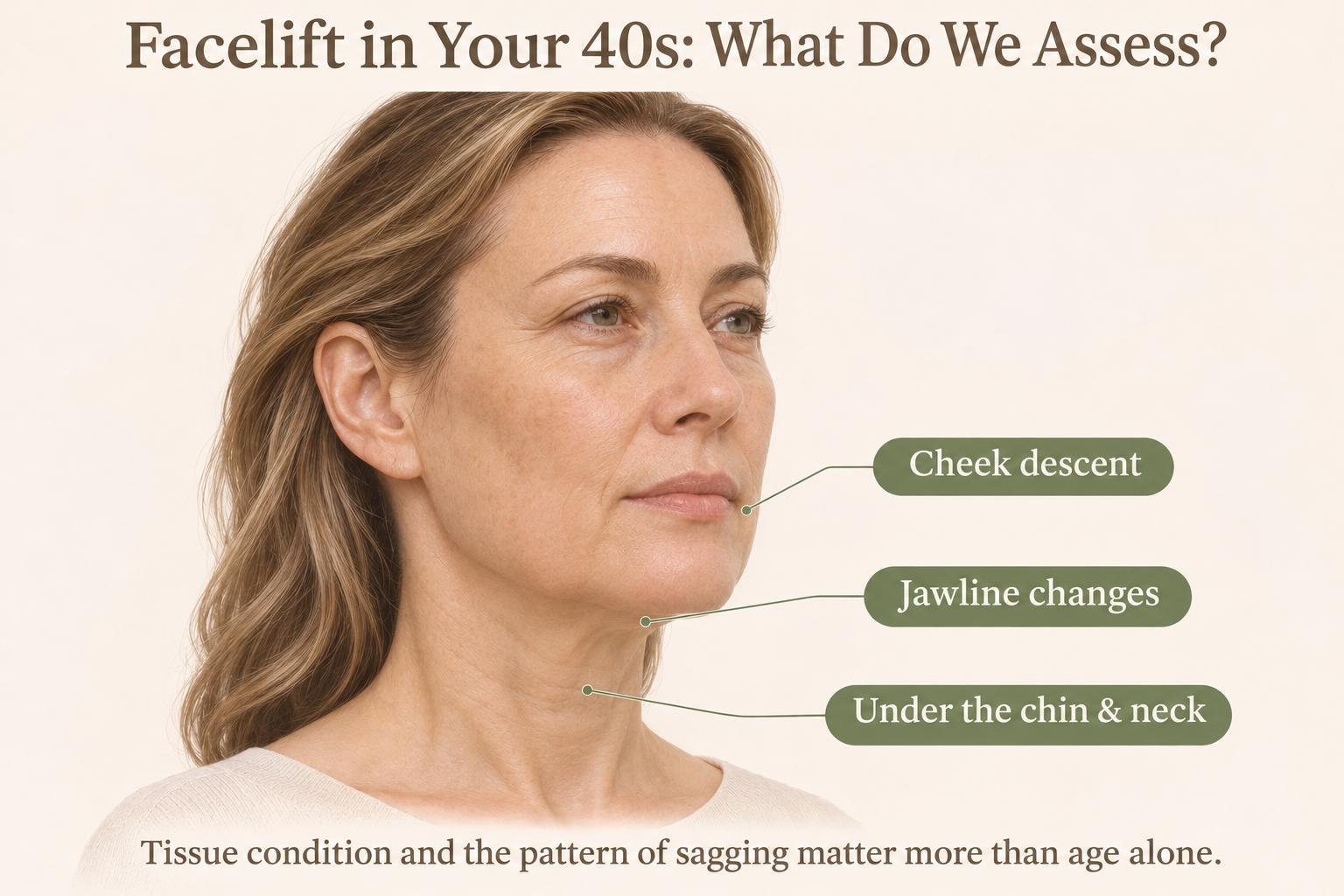
Cheeks, jawline, and neck are assessed together when planning treatment. This AI-generated fictional person is an educational illustration, not a patient or a surgical result.
A facelift can be considered in your 40s when cheek and jawline tissues have descended. Surgery lifts the SMAS and skin and removes excess tissue. When skin laxity or volume loss is the main concern, energy-based treatments or volume restoration may be the starting point.
In your 40s, you may notice that your jawline looks different in photographs. Jowls develop beside the mouth, and descending cheek tissue can make the lower face look heavier or more tired. Yet a facelift may still seem like something to consider much later.
You do not have to reach an advanced age to consider a facelift. If sagging is already a concern, correcting it while the tissues retain elasticity can be a worthwhile choice. Timing depends on your current tissue condition as well as your age—and on when you would like to begin enjoying the improvement.
“Wouldn't it be better to wait until I am older and the sagging is more pronounced?”
This is a common question. My perspective is a little different: if there is already sagging that surgery can meaningfully improve, there is no need to wait simply for it to become worse. Understanding how tissues change and what surgery actually does helps explain why.
01 Why does the face begin to sag?
Over time, the skin and underlying tissues lose elasticity and become looser. Their supporting structures also change, allowing cheek and jawline tissues to descend. Gravity continues to act on these tissues, making the sagging more noticeable.
Jowls beside the mouth, a less defined jawline, and heaviness in the lower cheeks reflect these changes. Unlike fine surface wrinkles, these contour changes involve a shift in tissue position.
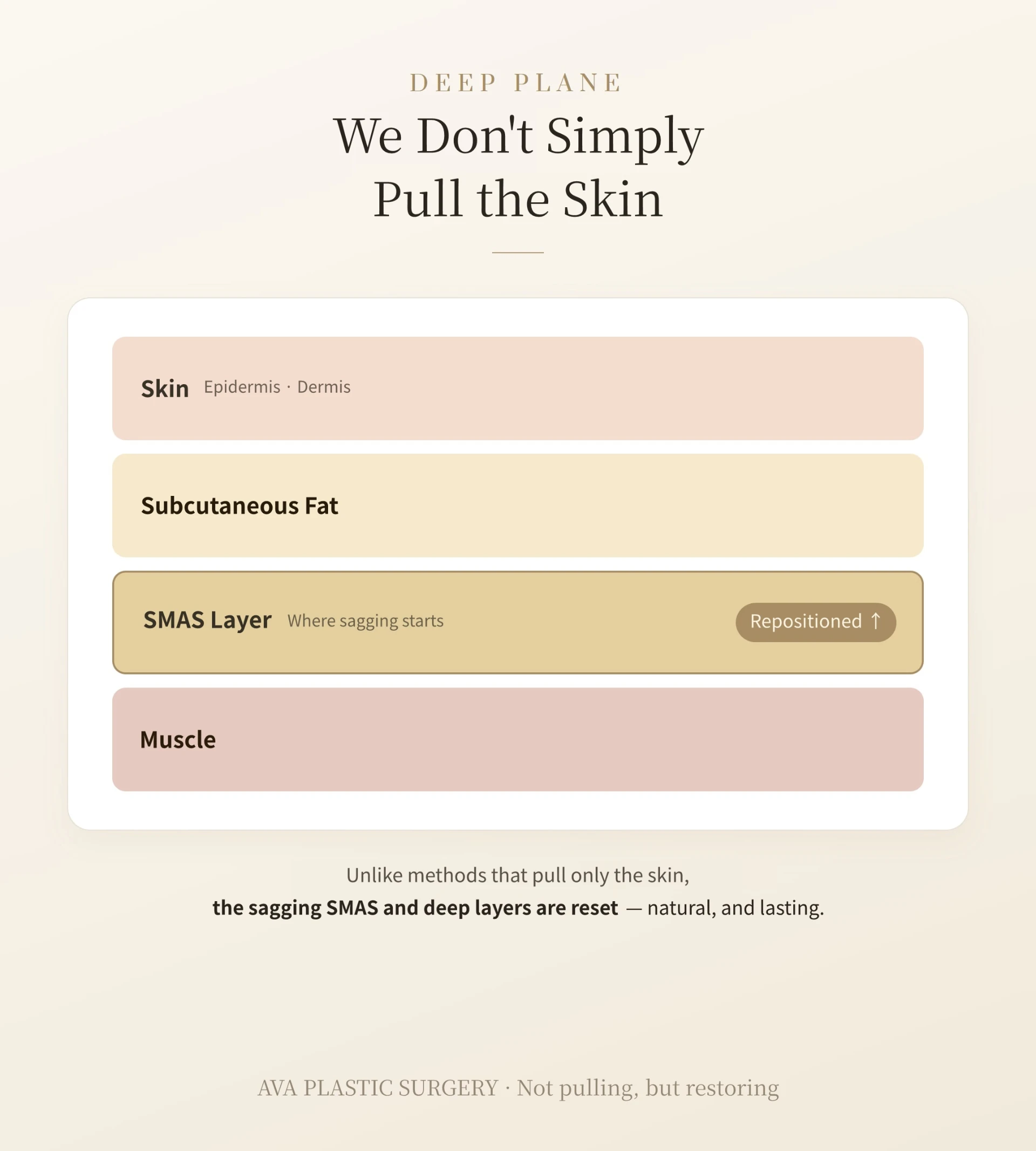
An assessment therefore goes beyond the amount of loose skin. We also examine which tissues have descended, in what direction, and how facial fat is distributed—including the supporting layer beneath the skin known as the superficial musculoaponeurotic system, or SMAS.
02 A facelift both lifts and removes excess tissue
A facelift is sometimes described as simply pulling the skin upward. The operation I perform involves lifting descended tissues and removing excess SMAS and skin.
First, I dissect and mobilize the SMAS so that it can move adequately, then lift the descended tissue into the planned position. Excess SMAS is trimmed as appropriate and the tissue is secured. The skin is then redraped over the restored contours, excess skin is removed, and the incisions are closed.
01Mobilize the SMAS → 02Lift descended tissues → 03Trim and secure the SMAS → 04Trim and close the skin
Two changes therefore occur together: descended tissues are repositioned, and removing excess tissue also reduces tissue mass. This is different from simply pulling on loose tissues without removing the excess.
Imagine carrying a heavy object in a thin plastic bag. When the handles stretch, the bag hangs low and its weight can feel less stable in your hand. Wrapping the stretched handles around your hand to shorten your grip can make the same load feel more secure and easier to carry. The contents have not become lighter; the hanging length and the way the load is handled have changed.
That is why I use this analogy when explaining a facelift. In addition to restoring support, removing excess SMAS and skin reduces the amount of tissue. In the bag analogy, shortening the grip and taking out some of the contents happen together.
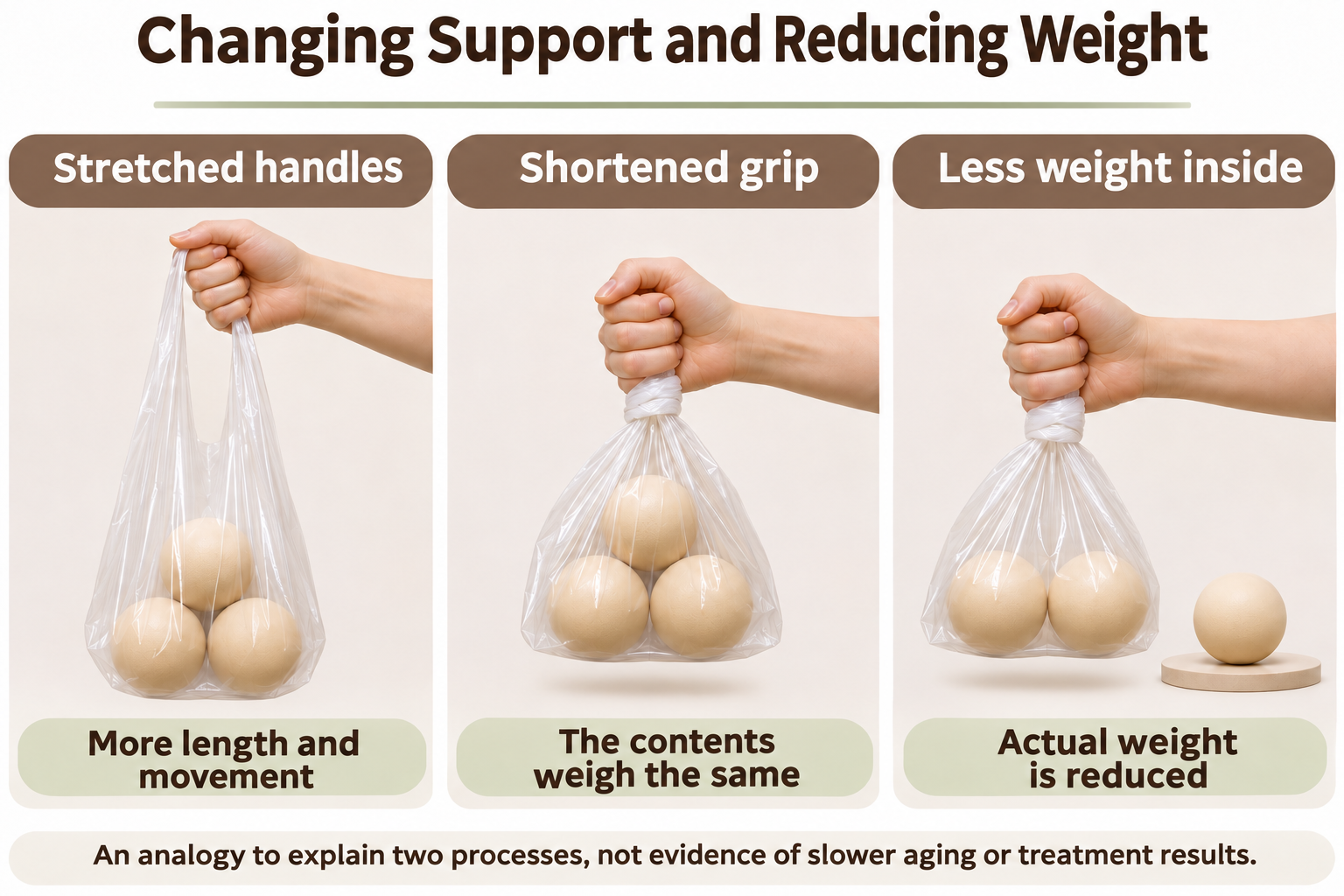
An analogy distinguishing a change in support from a reduction in tissue mass. This AI-generated illustration is not a surgical photograph or a measurement of treatment effects.
Excision reduces tissue mass by the amount removed. The forces acting on the remaining tissues also depend on the direction and location of fixation and the tissues' properties. I plan surgery with the view that improved support and reduced excess tissue may also influence how sagging develops afterward.
This does not mean that removing more is always better. Natural facial volume and necessary tissues must be preserved. The goal is to retain what the face needs, remove the appropriate amount of excess, and provide stable support.
03 What affects how long a facelift lasts?
One of the things I look for in patients in their 40s is remaining tissue elasticity. When sagging has begun but tissue quality is still relatively good, there can be advantages to correcting the descent at that stage.
Repositioning tissues that retain elasticity is a different starting point from correcting tissues that have already stretched considerably. In my clinical experience, better tissue condition can be favorable as the contours settle and are maintained. A facelift in your 40s can therefore address sagging while preserving your familiar appearance.
Research has also examined longer-term results in younger patients. Liu and Owsley reported higher long-term satisfaction in patients under 50. A 2026 deep-plane facelift study found a longer interval before a second operation among patients who were relatively younger at their first procedure.[1, 2]
Sundine and colleagues also discussed skin elasticity in their study of long-term SMAS facelift outcomes. Among 42 patients undergoing repeat surgery, loss of skin elasticity was one reason for an early repeat procedure. This supports looking at tissue condition alongside chronological age.[4]
Figure 3 in Sundine and colleagues' paper shows one patient before surgery at 40, one year after surgery, and at 57 before a second facelift. It offers a view of the face over time, rather than only shortly after surgery. It is an individual case, not a representation of every patient's outcome.
View Figure 3 on PDF page 4 — an external research caseThese studies offer context for considering surgery while tissue condition is favorable. They do not set an individual expiration date for the result. During consultation, we examine skin and SMAS condition, the extent of sagging, and overall health rather than relying on age alone.
04 Why does some tightness ease during recovery?
Immediately after surgery, the face can look quite tight and the jawline particularly defined. As swelling subsides and tension eases, the tissues settle into a more natural position. This can feel like some loosening or a partial return from the initial appearance.
This is what I mean when I explain that some of the initial tightness settles during recovery. In describing my clinical observations, I sometimes say that the initial tightness can feel as though it has eased by about 30%. That figure is an experiential description of the change, not a measured percentage of surgical benefit lost.
Long-term changes also differ by region. Jones and Lo evaluated 50 patients an average of 5.5 years after surgery and reported different patterns in the jawline and neck. This highlights the importance of distinguishing early changes as swelling resolves from changes in contour over several years.[6]
I therefore plan the lift and support with the settling process in mind, rather than designing surgery only around the immediate postoperative appearance.
In my practice, this process also varies with tissue quality. The easing of initial tightness can be more noticeable in tissues with substantial loss of elasticity. When elasticity is better preserved, I often find that this change is less pronounced. This is another reason tissue condition matters when discussing earlier surgery.
05 When would you like to enjoy the improvement?
“If I wait until there is more sagging, could one operation make me look much younger?” That can seem logical if we consider only the size of the change. But how much younger someone looks and how youthful their resulting appearance is are two different questions.
In my clinical experience, some patients in their 60s or 70s appear around 15 years younger after surgery. That can be a substantial improvement, but achieving the appearance of someone in their 30s remains difficult. In contrast, an improvement that feels like seven or eight years in a patient in their 40s can bring their appearance closer to their 30s. These ages describe my clinical impression, not objectively measured averages.
Separately, a survey study by Jacono and colleagues involving 157 facelift patients under 50 reported that respondents felt they looked an average of eight years younger after surgery. This patient-reported perception provides useful context when discussing perceived age.[5]
A substantial 15-year improvement in your 60s or 70s is therefore not equivalent to achieving an appearance closer to your 30s through surgery in your 40s. The later operation may create a larger change, while the earlier operation may achieve a more youthful starting point.
The distinction becomes clearer over a longer period. Someone who corrects meaningful sagging in their 40s can already enjoy that improvement in daily and social life throughout the years they might otherwise have spent waiting. A major improvement later cannot bring back the earlier years that could have been spent with the improved appearance.
For that reason, when sagging already warrants surgery, I do not believe that the prospect of a larger change later is, by itself, a reason to wait. Restoring a more youthful appearance while tissue condition is favorable, and enjoying it through the years ahead, is an important long-term value I see in a facelift in your 40s.
A more youthful starting point and the subsequent course of sagging
My interest extends beyond the initial improvement. If excess SMAS and skin are reduced and support is restored while tissue elasticity remains, I believe there may also be advantages in how sagging progresses afterward.
If surgery first restores a more youthful appearance, and the altered support also helps with subsequent sagging, the difference compared with not having surgery could widen over time. This is a hypothesis arising from my clinical experience. It has not been established by long-term comparisons of the same person with and without surgery, and it should not be interpreted as a reduction in the overall biological rate of aging.
From this perspective, I encourage patients to consider their current sagging, tissue condition, and future goals rather than automatically postponing surgery until they are older.
06 Choosing the right time for your face
Being in your 40s does not, by itself, determine whether surgery is appropriate. During consultation, I focus on the following points.
Have cheek and jawline tissues actually descended?
When jowls and cheek descent are evident, I explain what repositioning the tissues can achieve. If the neck is also affected, we consider the area beneath the chin and the neck together.
Sagging after facial bone contouring, or more pronounced sagging for your age
After facial bone contouring surgery, the underlying bony outline may be smaller, yet soft tissues around the cheeks and jawline may descend and make the lower face look heavy. When this is the problem, a facelift can reposition those tissues and refine the contour.
When descended tissue and excess skin are clearly present, there is a more distinct target for correction. In my clinical experience, patients with pronounced sagging for their age, or cheek and jawline sagging after facial bone contouring, can achieve noticeable improvement with a facelift. For these patients, I base timing on the actual sagging rather than advising them to wait simply because they are young.
Is the main concern sagging or hollowing?
Areas lacking volume need to be distinguished from descended tissues. We consider restoring volume where needed and repositioning tissues that have moved downward, rather than simply reducing or filling the entire face.
What would you like to preserve about your appearance?
Earlier photographs can be helpful. Looking together at the jawline, cheek shape, eyes, and expressions you would like to preserve helps us define a specific surgical goal.
Can you prepare for surgery and recovery?
We review your health, medications, smoking history, and prior treatments, and plan your recovery schedule. Mild skin laxity may be approached with nonsurgical treatment, while localized sagging may call for a more limited procedure. The key question is whether the expected change is meaningful for your current situation.
07 Mini facelift, threads, Ultherapy, Thermage, or Onda?
Some people are concerned about sagging but are not ready for surgery or cannot arrange the recovery time. We start by identifying the main concern: skin laxity, hollowing, or tissue descent. Each calls for a different approach.
| Main concern | Options to compare | What to assess |
|---|---|---|
| Reduced elasticity and mild laxity | Ultherapy, Thermage, Onda | Skin thickness, fat volume, and each device's mechanism |
| Hollow cheeks or temples | Fillers or fat grafting | Volume loss versus tissue descent |
| Sagging with a preference to avoid incisions | Thread lifting | Tissue weight, correction range, and expectations for longevity |
| Localized sagging | Mini facelift or another limited procedure | The actual dissection, fixation, and excision rather than the name |
| Clear cheek and jawline descent with excess skin | Facelift | SMAS and skin repositioning and excision; whether the neck also needs treatment |
When skin laxity is the main concern
Energy-based treatments such as Ultherapy, Thermage, and Onda may be considered. These devices differ in how energy is delivered and which tissues they target, so selection depends on skin thickness, fat volume, and the desired change. Choosing what your face needs matters more than simply combining multiple devices.
Related guide: Choosing between Ultherapy, Thermage, and Onda
When hollow cheeks or temples create a tired appearance
Fillers or fat grafting can restore missing volume and improve the transitions between facial regions. Treatment planning distinguishes these hollow areas from areas that appear heavy because tissues have descended.
When you want improvement without incisional surgery
We can assess whether thread lifting is suitable. Skin thickness, tissue weight, and the extent of sagging guide the discussion about improvement and longevity. See our article on what affects how long a thread lift lasts.
When surgery is an option but the sagging is localized
A mini facelift or another appropriately limited operation may be considered. Rather than choosing by incision length alone, we first determine which areas need correction to achieve the desired contour.
Related guide: Mini facelift treatment areas and planning
When cheek and jawline tissues have descended substantially and excess skin is evident, a facelift that repositions tissues and removes the excess may address the goal more directly than repeated nonsurgical treatments.
You do not need to decide between surgery and nonsurgical treatment in advance. Tell us what you most want to improve and how much recovery time you can arrange, and we can explore the appropriate options together.
08 Frequently asked questions
Is a facelift too early in your 40s?
The cause of sagging and tissue condition matter more than age alone. When cheek and jawline descent is clear and surgery offers meaningful improvement, a facelift can be considered in your 40s.
How long does a facelift in your 40s last?
Longevity varies with skin elasticity, surgical extent, weight changes, and other factors. Long-term studies assess contours years later or the interval to repeat surgery. During consultation, these findings are considered alongside your individual tissue condition.
How do I choose between Ultherapy, Thermage, Onda, and a facelift?
We first distinguish mild skin laxity from descended cheek and jawline tissues with excess skin. We then compare what the devices target with what surgery would reposition and remove, taking your goals and recovery schedule into account.
Is a mini facelift enough if I am in my 40s?
Age alone does not determine the scope of surgery. We examine whether sagging is localized or extends across the cheeks, jawline, and neck. Procedures described as a mini facelift can differ in their actual extent, so this is important to clarify during consultation.
How should I plan time off work and recovery?
We plan separately for swelling and bruising, incision care, and returning to exercise. Tell us whether your work is face-to-face and about upcoming events so we can discuss a schedule appropriate to your surgery. Ask about washing your face, makeup, suture removal, and resuming exercise.[3]
09 Key takeaways
A facelift in your 40s is a decision based on current sagging and tissue condition, rather than waiting to reach a particular age.
Lifting the SMAS and skin and removing excess tissue improves facial contours. Correcting meaningful sagging while elasticity remains—and enjoying the improvement earlier—are reasons to consider surgery at a younger age.
Instead of asking only, “How old should I be before surgery?”, start with, “What can be improved in my face now?”
The surgical plan and recovery depend on individual circumstances. Consultation includes discussion of expected improvement and risks such as scarring, bleeding or hematoma, infection, wound-healing problems, altered sensation, facial nerve injury, and asymmetry.
References
- Liu TS, Owsley JQ. Long-term results of face lift surgery: patient photographs compared with patient satisfaction ratings. Plast Reconstr Surg. 2012;129(1):253–262. View paper
- Levin M, Frankel A. Thirty Years of Deep Plane Facelifts: Characterizing Outcomes and Longevity. Facial Plast Surg Aesthet Med. 2026;28(5):482–487. View paper
- American Society of Plastic Surgeons. Facelift surgery. Patient guide · Recovery guide
- Sundine MJ, Kretsis V, Connell BF. Longevity of SMAS facial rejuvenation and support. Plast Reconstr Surg. 2010;126(1):229–237. doi:10.1097/PRS.0b013e3181ce1806. View paper
- Jacono AA, Malone MH, Lavin TJ. Nonsurgical Facial Rejuvenation Procedures in Patients Under 50 Prior to Undergoing Facelift: Habits, Costs, and Results. Aesthet Surg J. 2017;37(4):448–453. doi:10.1093/asj/sjw217. View paper
- Jones BM, Lo SJ. How long does a face lift last? Objective and subjective measurements over a 5-year period. Plast Reconstr Surg. 2012;130(6):1317–1327. doi:10.1097/PRS.0b013e31826d9f7f. View paper
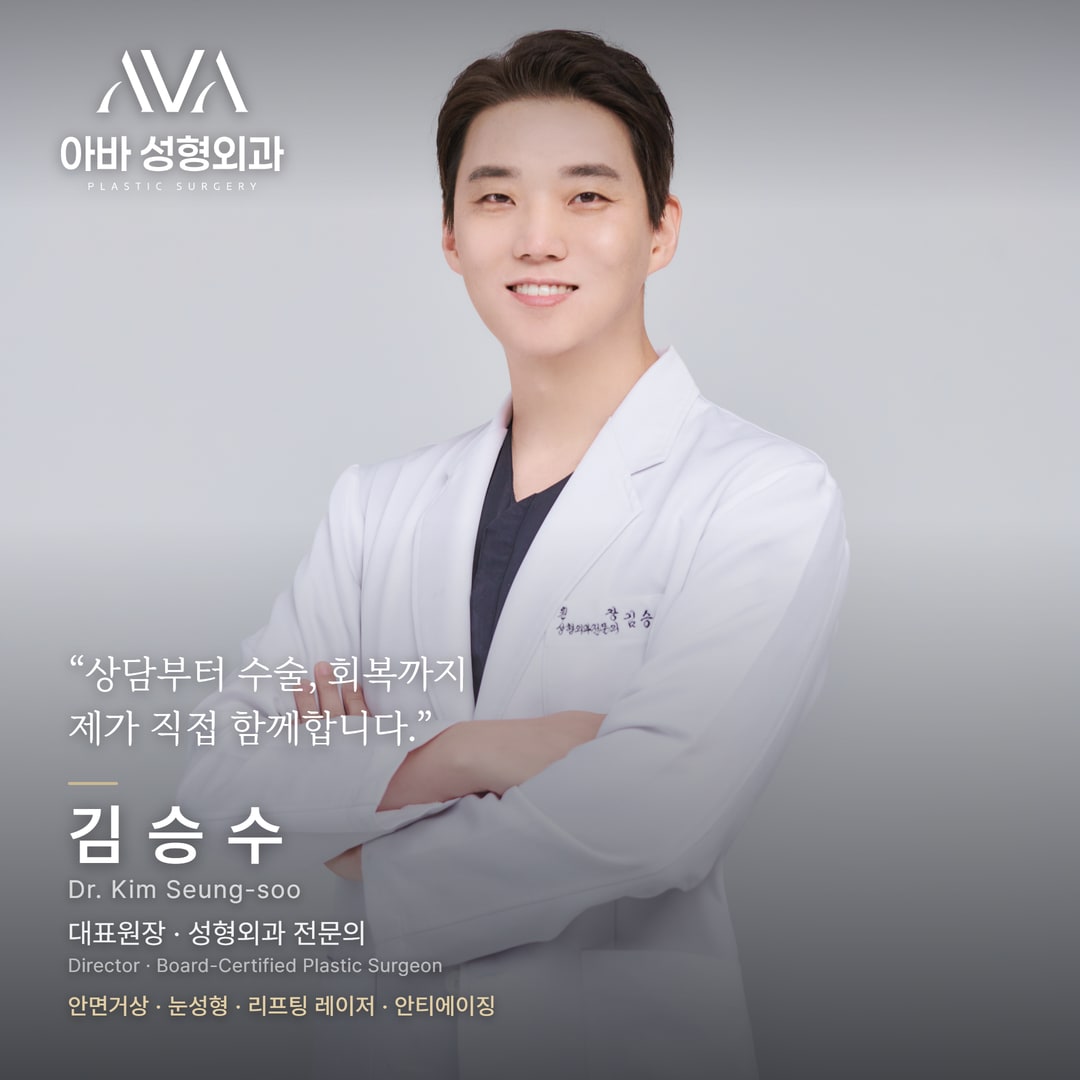
Facelift consultation in Seoul, Korea
Visit AVA Plastic Surgery near Exit 4 of Sinsa Station, on Gangnam-daero in Seoul. Our clinic is on the 4th floor of Inseong Building, 603 Gangnam-daero, Seocho-gu. A facelift consultation covers your concerns, previous treatments and recovery plans, including arrangements for your stay in Korea.
Facelift surgery in KoreaMeet Dr. KimDirections to Sinsa Station clinicRequest a facelift consultation
Recommended Related Columns by Dr. Seungsoo Kim
Dr. Seungsoo Kim’s Facelift 101: SMAS Deep-Plane Method, Recovery & vs. Thread Lifting
Read article →
Mini Facelift vs Full Facelift: Who Is a Short-Scar Lift Enough For?
Read article →
Facial Sagging After Weight Loss and When to Consider a Facelift
Read article →