Key Clinical Takeaways (TL;DR)
- Facelift technique names are defined by two anatomical variables: which tissue layer (dissection plane) is separated, and which structural layer carries the suspensory lifting tension.
- While SMAS plication or imbrication tightens fascia without wide sub-SMAS undermining, a deep-plane facelift enters the sub-SMAS glide space to release the zygomatic and masseteric cutaneous retaining ligaments so the anterior cheek and jawline can be repositioned.
- AVA Plastic Surgery's Dual-Deep Plane Facelift combines sub-SMAS ligament release with a three-layer dissection (skin, SMAS, and deep plane) so deep fascia bears the lifting load while skin closes with minimal tension along the ear and hairline.
"I've heard an SMAS facelift is good, so what is a deep plane facelift?"
"How is a Dual-Deep Plane facelift different from a deep plane facelift?"
These are the questions I hear most often in consultations. There are many technique names, and every explanation seems a little different, so the more you read, the more confusing it can get.
In fact, most facelift technique names come down to two things: which layer (plane) is dissected, and which layer carries the lifting force. In this article I will start with the layered structure of the face and then show, from a plastic surgeon's point of view, where the skin-only lift, the SMAS facelift, the deep plane facelift and AVA Plastic Surgery's Dual-Deep Plane facelift each sit.
How are the "layers" of the face organized?
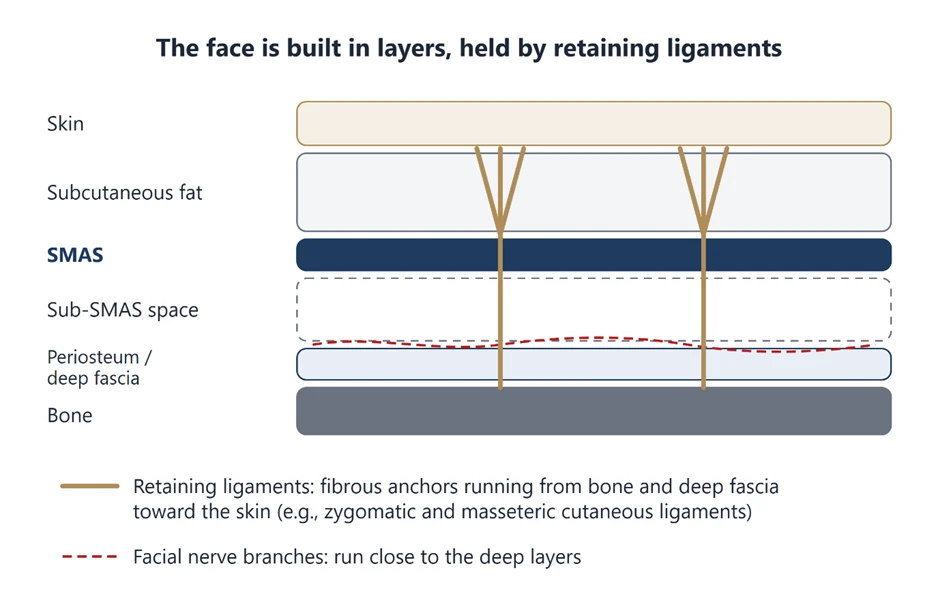
From the surface inward, the soft tissue of the face is usually described in these layers:
▲ The layers of facial soft tissue (skin, subcutaneous fat, SMAS, sub-SMAS space, periosteum and deep fascia), the retaining ligaments that pass through them to anchor the tissue, and the facial nerve branches running near the deep layers.
One structure worth knowing here is the retaining ligament. These are fibrous structures that start from bone or deep fascia and extend toward the skin, holding the soft tissue in place. Typical examples are the zygomatic ligament in the cheekbone area and the masseteric cutaneous ligament above the jawline. Because retaining ligaments divide the facial spaces and fat compartments and lie close to the facial nerve branches, they serve as anatomical landmarks for choosing the dissection plane and protecting the nerves during surgery [1]. That said, the names and extent of these ligaments are described slightly differently from one source to another [1].
What is the drawback of a skin-only lift?
Early facelifts lifted the skin off the subcutaneous fat, pulled it, and trimmed the excess. The approach is simple, but it leaves the deeper layers, which are the real cause of sagging, untouched and puts the pulling force on the skin itself.
Skin stretches again over time, so the effect is hard to maintain, and when tension concentrates on the incision line, the scar can widen or the earlobe can be pulled downward into a pixie ear. Pixie ear is covered in a separate column.
"SMAS facelift" covers several different methods
The literature generally divides ways of handling the SMAS as follows [2]:
- SMAS plication: the SMAS is folded and sutured to tighten it, without being dissected free.
- SMASectomy and imbrication: part of the SMAS is removed, or overlapped and sutured, to make it taut.
- SMAS flap: the SMAS is lifted off the underlying tissue as a flap, then repositioned upward and backward and secured.
- High SMAS: the SMAS flap is raised up to the level of the zygomatic arch so that the midface is included. This is covered in a separate column.
Methods 1 and 2 do not involve wide dissection beneath the SMAS, so they are relatively simple and can be a perfectly reasonable choice when sagging is mild or the main concern is the side of the face and the jawline. However, because the retaining ligaments remain in place, their ability to move tissue in front of the ligaments (around the nasolabial folds and the front of the cheek) may be limited.
A deep plane facelift "releases the ligaments"
The key to a deep plane facelift is entering the space beneath the SMAS and releasing retaining ligaments such as the zygomatic and masseteric cutaneous ligaments. Once the tissue held by those ligaments is freed, the front of the cheek and the jawline can move together with the side of the face; that is the logic of this approach. A traditional deep plane facelift often lifts the skin and SMAS together as a single unit (a composite flap).
Because facial nerve branches run beneath the SMAS, this approach requires a precise anatomical understanding to keep the depth and extent of dissection exactly right. Nerve injury is covered in a separate column.
So which method lasts longer?
To be honest, this question has not been settled. A systematic review comparing facelift techniques found that there are few head-to-head studies and the quality of evidence is low, making it difficult to say that one technique is clearly superior in effectiveness or safety [3]. A systematic review of SMAS techniques likewise notes that most studies are retrospective with varying follow-up periods, so long-term results cannot be stated with certainty [2].
That is why, rather than asking "which technique is best," I first ask "in which layer, and around which ligaments, has this person's sagging developed?"
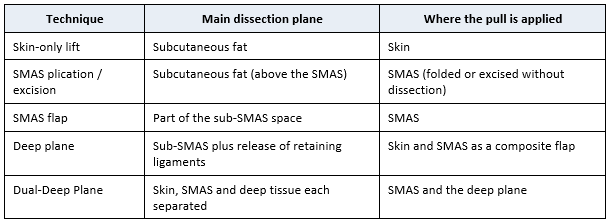
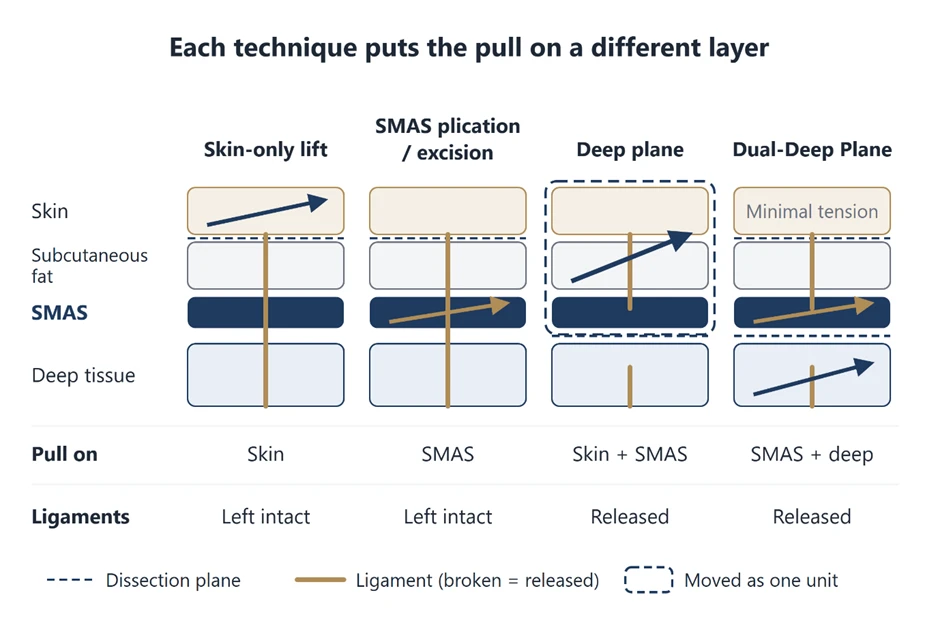
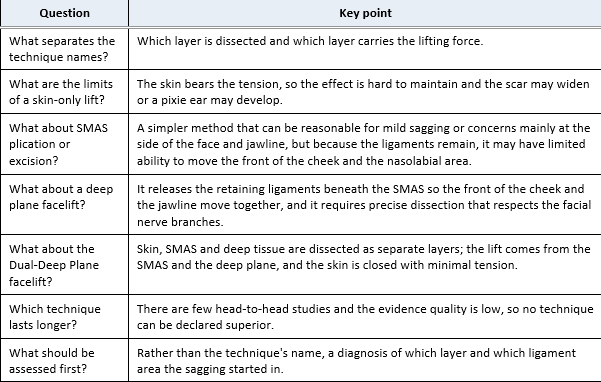
▲ A side-by-side comparison of the skin-only lift, SMAS plication/excision, deep plane and Dual-Deep Plane facelifts: which plane is dissected, which layer carries the pull, and whether the retaining ligaments are left intact or released.
Where does the Dual-Deep Plane facelift fit?
AVA Plastic Surgery's Dual-Deep Plane facelift builds on the deep plane principle of creating the lift in the deeper layers, and adds a three-level dissection in which the skin, the SMAS and the deep tissue are each dissected as separate layers.
- The lifting force is created in the SMAS and the deep plane.
- Tension that would fall on the incision line is shifted to the SMAS, and the skin is closed with minimal tension.
- The incisions follow the natural lines in front of and behind the ear and along the hairline.
Why we deliberately separate the skin and SMAS instead of moving them as one unit, and how that relates to scarring, is explained in detail in the column "Why Separating Skin Tension from SMAS Tension Changes the Scar." Because the layers are dissected separately, there are also points to consider during recovery, which we explain during your consultation.
What matters more than the technique's name
SMAS lift, deep plane and Dual-Deep Plane are not competing brand names; they are different answers to the question of which layer of the face to treat and how. A simpler method may suit someone with mild sagging, while someone whose sagging has progressed in front of the ligaments may need a deeper-layer approach. Before choosing a technique by name, the first step is an accurate diagnosis of which layer your sagging started in.
Key Takeaways
Here is a question-by-question summary of what we covered.
At AVA Plastic Surgery, Dr. Seung-Soo Kim personally oversees every case from consultation through surgery and recovery.
※ This article provides general medical information for educational purposes. Results, recovery and scarring vary between individuals, and every surgery carries risks such as bleeding, infection, swelling and asymmetry. Diagnosis and treatment decisions are made only through an in-person consultation.
References
1. Alghoul M, Codner MA. Retaining ligaments of the face: review of anatomy and clinical applications. Aesthet Surg J. 2013;33(6):769-782.
2. Mortada H, et al. Evolution of Superficial Muscular Aponeurotic System Facelift Techniques: A Comprehensive Systematic Review of Complications and Outcomes. JPRAS Open. 2023;39:166-180.
3. Chang S, Pusic A, Rohrich RJ. A systematic review of comparison of efficacy and complication rates among face-lift techniques. Plast Reconstr Surg. 2011;127(1):423-433.
Frequently Asked Clinical Questions (FAQ)
Q. What is the anatomical difference between a skin-only facelift, an SMAS facelift, and a deep-plane facelift?
A skin-only facelift undermines only subcutaneous fat and pulls the skin envelope, which can stretch over time and place excessive tension on the ear incision (increasing the risk of widened scars or pixie-ear deformity). SMAS facelifts tighten the Superficial Muscular Aponeurotic System via folding (plication), partial strip excision (SMASectomy/imbrication), or elevating an SMAS flap. A deep-plane facelift enters the sub-SMAS space and releases the retaining ligaments (such as the zygomatic and masseteric cutaneous ligaments) that tether sagging midface and jawline soft tissue.
Q. How does AVA's Dual-Deep Plane Facelift differ from a traditional composite deep-plane facelift?
A traditional deep-plane facelift typically elevates the skin and SMAS together as a single composite unit after releasing the deep retaining ligaments. AVA Plastic Surgery's Dual-Deep Plane approach performs a three-level dissection—separating skin, SMAS, and the deep sub-SMAS plane—so the SMAS and deep tissue can be advanced along their optimal vector while the skin is redraped independently with minimal closure tension along the natural contours of the ear and hairline.
Q. Does clinical literature prove that one facelift plane always lasts longer, and what surgical risks must be considered?
Published systematic reviews note that head-to-head comparative studies have heterogeneous follow-up periods, meaning no single named technique is universally superior for every patient. Instead, surgical selection should match the specific anatomical layer and retaining ligaments where your laxity originates. Because facial nerve branches course near the deep sub-SMAS plane and retaining ligaments, surgery requires thorough anatomical precision; potential risks include bleeding, hematoma, infection, swelling, contour irregularity, asymmetry, scarring, sensory changes, or temporary/rare facial nerve weakness, and recovery varies by individual.