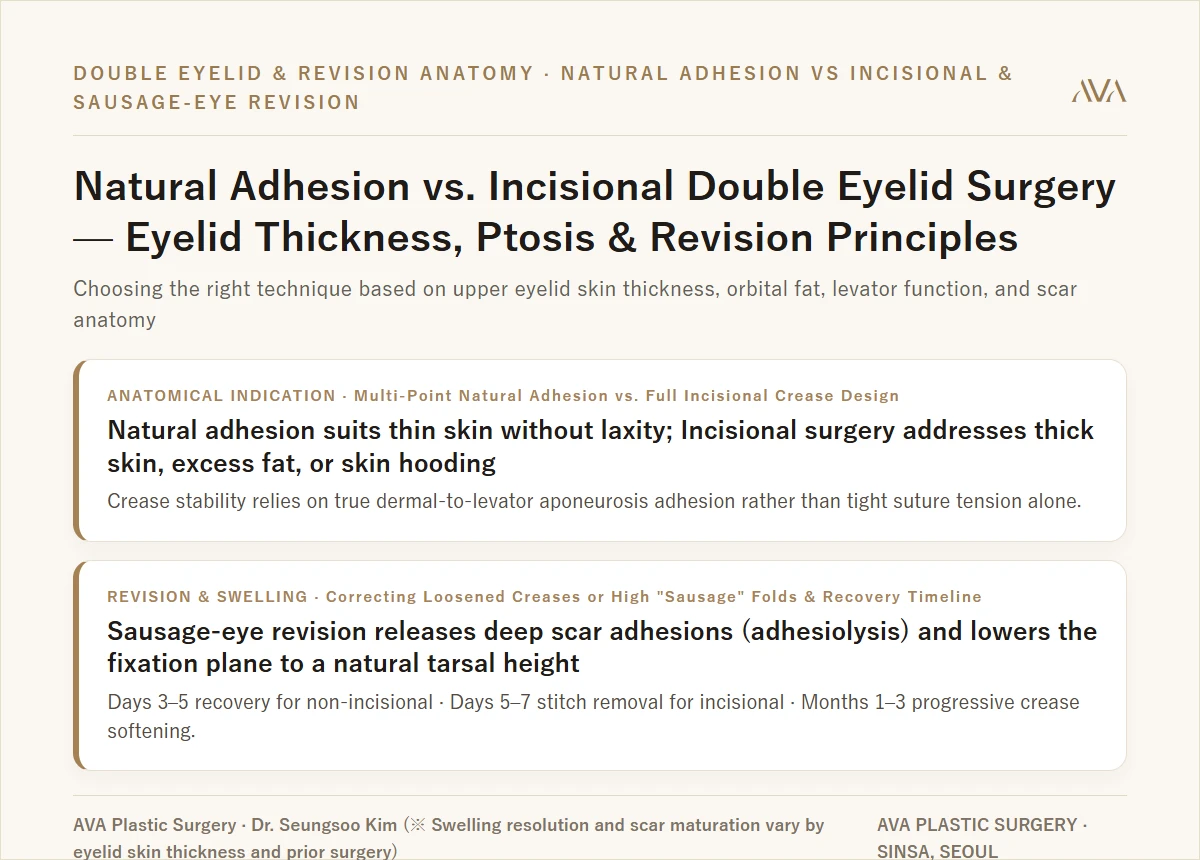
Natural Adhesion vs. Incisional Double Eyelid Surgery — Eyelid Thickness, Ptosis & Revision Principles
- Choosing between non-incisional (natural adhesion) and incisional double eyelid surgery depends on upper eyelid skin thickness, orbital/ROOF fat volume, skin laxity, and levator muscle function—not surgical preference alone.
- Natural adhesion induces biological dermal-to-levator aponeurosis bonding through micro-openings for thin eyelids, whereas incisional blepharoplasty directly addresses excess skin, heavy fat, and deep crease fixation.
- In revision eyelid surgery for loosened creases or high, puffy "sausage eyelids," meticulous scar adhesiolysis and lowering the tarsal fixation plane are essential before re-anchoring the fold.
"Dr. Kim, I want a natural crease without a visible scar—am I a candidate for non-incisional natural adhesion, or do I need an incisional double eyelid surgery? And if my old crease looks puffy like a 'sausage eyelid,' how can revision surgery fix it?" — The success of primary and revision eyelid surgery is determined not by surgical preference alone, but by matching the fixation method to your upper eyelid skin thickness, orbital and ROOF fat volume, and levator muscle strength.
Hello. I am Dr. Seungsoo Kim, Chief Director and Board-Certified Plastic Surgeon at AVA Plastic Surgery in Sinsa, Gangnam, Seoul.
During consultations for primary eyelid surgery or revision eyelid surgery, one of the most frequent questions patients ask is whether they should choose non-incisional (natural adhesion) double eyelid surgery or incisional double eyelid surgery. Neither method is universally "better"—each has distinct anatomical indications.
01. Natural Adhesion (Non-Incisional) vs. Incisional Double Eyelid: Anatomy Comes First
An upper eyelid crease forms dynamically when the levator aponeurosis pulls the upper eyelid skin inward as the eye opens. Consequently, the weight and thickness of the overlying tissues dictate how the crease must be anchored:
- When Natural Adhesion (Non-Incisional) Is Ideal: Best suited for patients with thin upper eyelid skin, good skin elasticity, minimal orbital fat bulging, and no significant skin hooding. Unlike traditional simple buried-suture techniques that rely solely on thread loop tension, our multi-point natural adhesion technique induces biological dermal-to-levator aponeurosis bonding through tiny micro-openings—leaving virtually no visible linear scar when the eyes are closed while resisting early loosening.
- When Incisional Double Eyelid Surgery Is Essential: Recommended for patients with thick upper eyelid skin, prominent preaponeurotic orbital fat or retro-orbicularis oculi fat (ROOF), redundant skin hooding, or moderate-to-severe eyelid ptosis. Through a precise crease incision, excess skin and heavy fat are conservatively sculpted and the dermis is securely anchored to the tarsal plate and levator aponeurosis, preventing a heavy or rolled fold.
02. Revision Eyelid Principles: Loosened Creases, Asymmetry & "Sausage Eyelid" Correction
Many international patients visit our Sinsa clinic for revision eyelid surgery because a previous crease has loosened over time or because the strip of skin between the lash line and crease remains chronically thick and puffy—commonly called a "sausage eyelid."
- Correcting a Loosened or Faded Crease: If your upper eyelid skin is thin and a previous suture method simply loosened without heavy scarring, revision natural adhesion may be possible. However, if the crease loosened because of thick eyelid tissue, excess fat, or unaddressed ptosis (causing your forehead to pull the brow upward), an incisional revision with levator adjustment is required to prevent recurrence.
- Resolving a High, Puffy "Sausage Eyelid" (Adhesiolysis & Lowering Fixation): A sausage eyelid typically results from (1) a crease anchored too high on the tarsal plate, (2) deep fibrotic scar tissue obstructing pre-tarsal lymphatic drainage, or (3) undiagnosed ptosis preventing full eyelid opening. In revision surgery, we perform meticulous layer-by-layer scar adhesiolysis to release the old high fixation, conservatively debulk deep scar tissue, and re-anchor the new crease at a lower, anatomically proportional height.
03. Recovery Timeline & Recommended Stay in Seoul (Days 5–7 to Month 3)
- Non-Incisional (Natural Adhesion) Timeline: Because no full-length skin incision is made, stitch removal is generally unnecessary. Acute swelling subsides within 3 to 5 days (recommended stay in Seoul: 4 to 5 days), and the crease settles naturally within 2 to 4 weeks.
- Incisional & Revision Eyelid Surgery Timeline: Fine sutures are removed on postoperative day 5 to 7 (recommended stay in Seoul: 7 to 8 days). Approximately 70% of major swelling resolves by weeks 2 to 4, while residual pre-tarsal fullness and incision redness progressively soften over 3 to 6 months.
※ Clinical Notice: Swelling duration, scar maturation, and final crease symmetry vary by individual eyelid thickness and prior surgical history. Potential risks include bleeding, infection, asymmetry, crease loosening, dry eyes, or temporary lagophthalmos. Always complete an in-person examination with a board-certified plastic surgeon before surgery.
Book Your 1:1 Consultation with Dr. Seungsoo Kim
Whether you are flying in from overseas or living in Korea, Dr. Seungsoo Kim personally oversees every step from initial consultation to surgery and recovery:
- 📅 Book a 1:1 Zoom Video Pre-Consultation or Seoul Clinic Visit (English Booking Hub) →
- 📖 Read Dr. Kim's Mother's Deep-Plane Facelift & Eyelid Surgery 2-Month Recovery Log →
- ✨ View Deep-Plane Facelift Guide & 1-Year Follow-Up Cases →
- 👁️ View Upper Eyelid, Sub-Brow & Forehead Lift Guide →
- 💬 Chat Directly on WhatsApp (+82 10-3705-3423) →
📍 AVA Plastic Surgery · 4F Insung Building, 603 Gangnam-daero, Seocho-gu, Seoul (1-min walk from Sinsa Station Exit 4) · TEL +82 2-545-1882
※ Surgical & Consultation Notice: 1:1 Zoom video consultations provide a preliminary educational assessment; final surgical candidacy and operative plans are confirmed through an in-person clinical examination by Dr. Seungsoo Kim in Seoul. Post-operative complications such as bleeding, infection, swelling, scarring, asymmetry, or sensory changes may occur, and results and recovery vary by individual.
Frequently Asked Clinical Questions (FAQ)
Q. How do I know whether I need non-incisional (natural adhesion) or incisional double eyelid surgery?
Non-incisional natural adhesion is ideal if you have thin upper eyelid skin, minimal orbital fat, and no significant skin hooding. Incisional double eyelid surgery is recommended if you have thick eyelid skin, heavy orbital or ROOF fat, excess skin laxity, or require simultaneous scar release and structural crease fixation.
Q. Why does a "sausage eyelid" happen after double eyelid surgery, and how is it corrected in revision surgery?
A puffy "sausage eyelid" typically occurs when the previous crease was anchored too high on the tarsal plate, when deep scar tissue impairs lymphatic drainage, or when unaddressed ptosis causes forehead overcompensation. Revision surgery releases the old high scar adhesion (adhesiolysis), conservatively trims scar tissue, and re-fixes the crease at a lower anatomical height.
Q. How many days should I stay in Seoul for double eyelid or revision eyelid surgery?
For non-incisional natural adhesion double eyelid surgery, a 4-to-5-day stay in Seoul is sufficient. For incisional double eyelid or revision eyelid surgery, sutures are removed on postoperative day 5 to 7, so a 7-to-8-day stay in Seoul is recommended before flying home.
Read the original Naver blog post ·