
Radiofrequency (RF) Lifting Anatomy — Thermage FLX & Oligio vs. InMode FX/FORMA vs. Microneedle RF
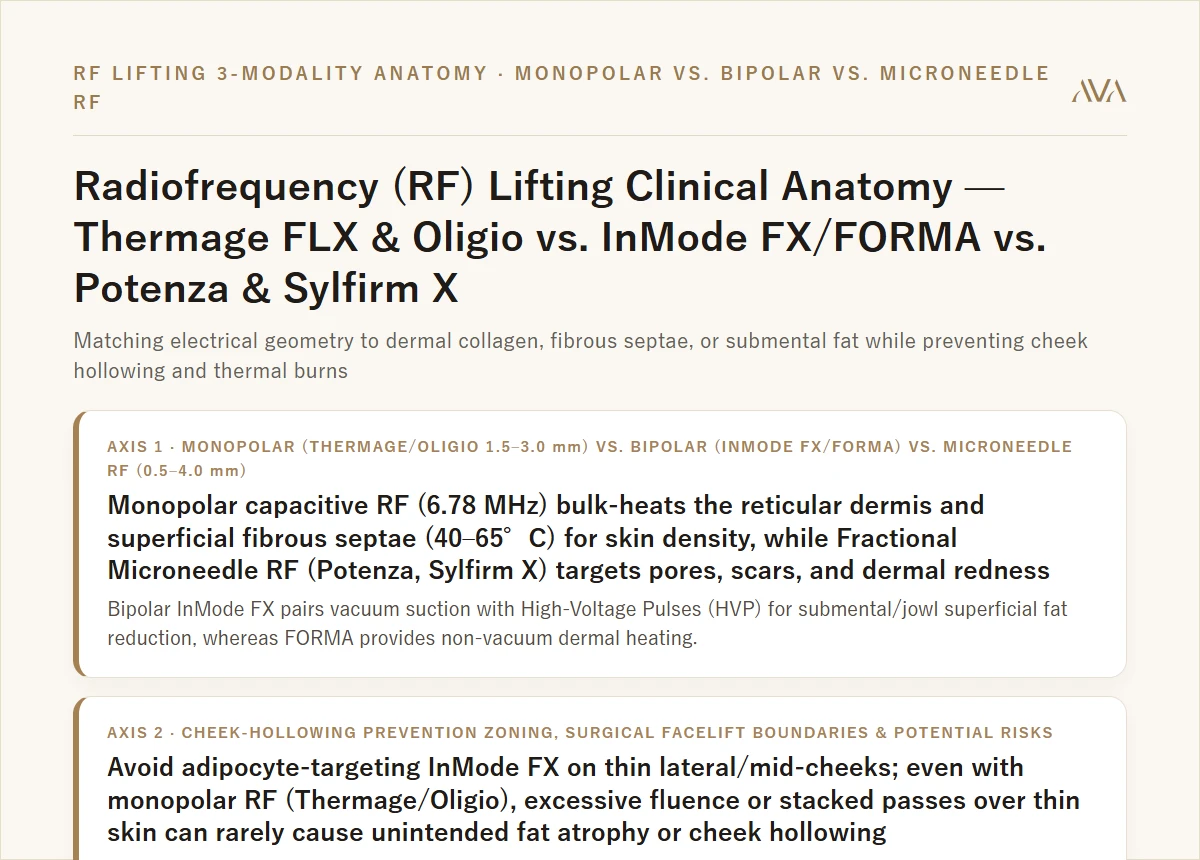
- Radiofrequency (RF) lifting is divided into three distinct clinical modalities by electrical geometry and anatomical target depth: (1) Monopolar capacitive RF (Thermage FLX, Oligio) for volumetric bulk heating of the reticular dermis and superficial fibrous septae (1.5–3.0 mm); (2) Bipolar RF with High-Voltage Pulse (InMode FX targeting superficial submental/jowl adipocytes vs. FORMA targeting dermal collagen); and (3) Fractional Microneedle RF (Potenza, Sylfirm X) delivering depth-controlled (0.5–4.0 mm) dermal coagulation and transdermal booster delivery.
- Applying adipocyte-targeting InMode FX onto volume-depleted lateral or mid-cheeks risks aggravating cheek hollowing; furthermore, even with monopolar RF (Thermage FLX, Oligio), excessive energy settings or aggressive overlapping passes on thin, volume-deficient cheeks can rarely induce unintended subcutaneous fat atrophy or contour depression—making physician-mapped zoning and energy titration essential.
- While RF modalities remodel dermal collagen and tighten mild-to-moderate skin laxity, they cannot physically release tethered retaining ligaments or excise redundant skin like a Dual-Deep Plane Facelift or Platysmaplasty; potential risks include transient erythema, edema, thermal burns/blisters, vacuum-induced purpura/bruising (3–7 days after InMode FX), folliculitis or post-inflammatory hyperpigmentation (PIH) after microneedle RF, and rare transient dysesthesia.
"Dr. Kim, Thermage FLX, Oligio, InMode FX/FORMA, and Potenza or Sylfirm X are all called 'radiofrequency (RF) lifting'—yet how do their target tissue layers and clinical indications actually differ? Which device should I choose if I have thin cheeks prone to hollowing, a heavy double chin and jowls, or enlarged pores and acne scars?" — Radiofrequency aesthetic devices are divided into three fundamentally distinct anatomical modalities based on electrode geometry and energy delivery: (1) Monopolar RF (Thermage FLX · Oligio) for 3D volumetric dermal and fibrous septae tightening, (2) Bipolar RF + High-Voltage Pulse / Thermal Control (InMode FX · FORMA) for submental/jowl fat contouring and dermal warming, and (3) Fractional Microneedle RF (Potenza · Sylfirm X) for depth-controlled dermal remodeling and transdermal booster delivery. Matching the right RF modality to your subcutaneous fat thickness and ligamentous laxity is essential to prevent unintended cheek hollowing or thermal injury.
Hello. I am Dr. Seungsoo Kim, Chief Director and Board-Certified Plastic Surgeon at AVA Plastic Surgery in Sinsa, Gangnam, Seoul.
In our earlier column Ultherapy vs. Thermage FLX — 4.5 mm SMAS Ultrasound vs. Dermal Radiofrequency, we compared micro-focused ultrasound (HIFU) against radiofrequency. Today, for patients exploring our Laser & RF Lifting Center and RF Lifting Clinical Hub, I will break down the three distinct radiofrequency (RF) mechanisms from a plastic surgeon's anatomical perspective.
01. Modality 1 — Monopolar RF (Thermage FLX · Oligio): 3D Volumetric Heating of the Dermis & Fibrous Septae
In Monopolar RF, high-frequency alternating current (approx. 6.78 MHz) flows from a single active treatment tip through the dermis and subcutaneous fibrous network toward a grounding return pad placed on the body. Tissue electrical impedance converts this current into uniform 3D volumetric heat (approx. 40–55°C) across the 1.5–3.0 mm full-thickness dermis and vertically oriented fibrous septae.
- Anatomical Target & Clinical Effect: Immediate thermal contraction of triple-helix collagen fibers and fibrous septae is followed by progressive neocollagenesis and elastin remodeling over 2 to 6 months—improving dermal density, fine crinkles, periorbital laxity, and surface skin envelope firmness.
- Thermage FLX vs. Oligio in Clinical Practice:
- Thermage FLX: Features real-time AccuREP™ impedance auto-tuning before every pulse, omnidirectional vibration comfort, and pulsed cryogen gas cooling to protect the epidermis while delivering robust deep-dermal and septal thermal energy.
- Oligio: Uses calibrated contact cooling and both stamping and continuous Moving/Auto modes tailored for East Asian dermal thickness, offering comfortable maintenance tightening for early laxity and fine lines.
- ※ Important Clinical Caveat on Subcutaneous Fat Atrophy (Cheek Hollowing): Patients often hear that "radiofrequency never causes cheek hollowing." While monopolar RF primarily targets the water-rich dermis and fibrous septae—making it far safer for thin faces than deep 4.5 mm HIFU—delivering excessive fluence (Joules) or aggressive overlapping passes over thin, volume-depleted lateral or anterior cheeks can allow conductive heat to reach the superficial fat layer and rarely trigger unintended subcutaneous fat atrophy (cheek hollowing). Careful zone-by-zone vector and energy customization by an experienced physician is therefore mandatory.
02. Modality 2 — Bipolar RF (InMode FX · FORMA): Targeted Submental/Jowl Adipocyte Contouring vs. Non-Vacuum Dermal Warming
In Bipolar RF, electrical current flows strictly between two closely spaced electrodes on the handpiece without a grounding pad, confining penetration depth to roughly half the inter-electrode distance. The InMode platform combines two distinct handpieces:
- InMode FX (Vacuum Suction + Bipolar RF + High-Voltage Pulse [HVP]):
- Mechanism: Gentle vacuum suction draws a pinched fold of submental or jowl tissue into the chamber. Bipolar RF first pre-heats the superficial subcutaneous fat to 40–43°C, after which microsecond High-Voltage Pulses (HVP) induce irreversible electroporation of hypertrophic adipocyte membranes, leading to gradual natural fat cell clearance (apoptosis) over several weeks.
- Indications & Zones to Avoid: Specifically indicated for double-chin fullness, heavy submandibular contours, and fleshy lower-cheek jowls. Conversely, InMode FX should NOT be applied over thin mid-cheeks or sunken lateral cheeks where fat loss would worsen facial hollowing.
- Expected Vacuum Purpura ("Hickey" Bruising): Because negative suction pulls fragile superficial capillaries, temporary reddish-purple vacuum purpura (bruising) along the jawline and under the chin is a normal reaction that resolves over 3 to 7 days (up to 10 days in sensitive skin). Plan treatment at least 1–2 weeks before major social events.
- InMode FORMA (Non-Vacuum Bipolar Dermal Tightening):
- Mechanism: Glides smoothly over the skin without suction or adipocyte-destroying HVP pulses, using a real-time thermal sensor to maintain a steady 41–43°C dermal temperature for pain-free collagen remodeling and zero bruising.
03. Modality 3 — Fractional Microneedle RF (Potenza · Sylfirm X): Depth-Controlled (0.5–4.0 mm) Dermal Remodeling & Drug Delivery
Rather than passing heat through the epidermis from the outside, Fractional Microneedle RF inserts ultra-fine gold-coated microneedles directly to a programmed dermal depth (0.5 mm to 4.0 mm) and emits radiofrequency energy from the needle tips or shafts—sparing the epidermis while remodeling enlarged pores, acne scars, crepey texture, and abnormal dermal microvasculature.
- Potenza vs. Sylfirm X:
- Potenza: Offers selectable Monopolar/Bipolar modes, insulated vs. non-insulated tips, and a specialized pneumatic Pumping Tip that uses positive/negative air pressure to drive Juvelook (PDLLA), Rejuran Healer (PN), or exosomes uniformly into the micro-channels right after RF coagulation.
- Sylfirm X: Combines ultra-short Pulsed Wave (PW) and Continuous Wave (CW) modes via non-insulated microneedles. PW mode selectively coagulates hyperactive dermal microvessels and strengthens a weakened basement membrane (helpful in redness- or melasma-prone skin), while CW mode provides thermal collagen contraction for pores and fine scars.
- Recovery Timeline: Expect mild pinpoint redness and warmth for 1–3 days followed by microscopic bronzing or sand-like micro-crusts for 3–7 days that shed naturally with gentle moisturizing and strict UV protection.
04. The Structural Boundary: When Non-Surgical RF Cannot Replace a Surgical Facelift
As a plastic surgeon who performs both energy-based treatments and deep-plane facial surgery, I always emphasize one honest anatomical boundary: "Radiofrequency devices thermally contract existing dermal collagen and contour modest superficial fat, but they cannot surgically release tethered retaining ligaments, reposition a descended SMAS-platysma layer, or excise redundant sagging skin."
- If you must use your fingers in front of a mirror to push sagging jowls and marionette folds upward toward your ears to see the jawline you want, repeating non-surgical RF sessions will yield diminishing returns. In moderate-to-severe gravitational laxity, a structural Mini Facelift, Dual-Deep Plane Facelift, or Micro-Cannula Facial & Submental Liposuction addresses the true anatomical root cause.
※ Clinical & Regulatory Notice: Skin tightening, contouring, and pore remodeling outcomes from monopolar, bipolar, and microneedle radiofrequency (RF) treatments vary according to baseline skin thickness, subcutaneous fat volume, and biological aging. RF procedures are contraindicated in patients with implanted electronic medical devices (such as cardiac pacemakers or defibrillators), metallic implants or metal threads directly within the treatment field, pregnancy, active skin infection, open wounds, or severe keloid predisposition. Potential risks and side effects include transient erythema, edema, warmth, tenderness, dryness, 3–7 days of vacuum purpura/bruising after InMode FX, pinpoint oozing, micro-crusting, folliculitis, or post-inflammatory hyperpigmentation (PIH) after microneedle RF, and—rarely—superficial or dermal thermal burns (blistering, crusting, or scarring), transient nerve irritation, or unintended subcutaneous fat atrophy (cheek hollowing) and contour asymmetry if excessive energy is applied over thin facial zones. Always complete a 1-on-1 in-person consultation with a board-certified physician before treatment.

Book Your 1:1 Consultation with Dr. Seungsoo Kim
Whether you are flying in from overseas or living in Korea, Dr. Seungsoo Kim personally oversees every step from initial consultation to surgery and recovery:
- 📅 Book a 1:1 Zoom Video Pre-Consultation or Seoul Clinic Visit (English Booking Hub) →
- 📖 Read Dr. Kim's Mother's Deep-Plane Facelift & Eyelid Surgery 2-Month Recovery Log →
- ✨ View Deep-Plane Facelift Guide & 1-Year Follow-Up Cases →
- 👁️ View Upper Eyelid, Sub-Brow & Forehead Lift Guide →
- 💬 Chat Directly on WhatsApp (+82 10-3705-3423) →
📍 AVA Plastic Surgery · 4F Insung Building, 603 Gangnam-daero, Seocho-gu, Seoul (1-min walk from Sinsa Station Exit 4) · TEL +82 2-545-1882
※ Surgical & Consultation Notice: 1:1 Zoom video consultations provide a preliminary educational assessment; final surgical candidacy and operative plans are confirmed through an in-person clinical examination by Dr. Seungsoo Kim in Seoul. Post-operative complications such as bleeding, infection, swelling, scarring, asymmetry, or sensory changes may occur, and results and recovery vary by individual.
Frequently Asked Clinical Questions (FAQ)
Q. How do Monopolar RF (Thermage FLX, Oligio), Bipolar RF (InMode FX/FORMA), and Fractional Microneedle RF (Potenza, Sylfirm X) differ in anatomical depth and indication?
Monopolar capacitive RF (Thermage FLX, Oligio; 6.78 MHz) cools the epidermis while delivering volumetric bulk heat (40–65°C) across the full thickness of the reticular dermis and superficial fibrous septae (1.5–3.0 mm) to improve skin density and fine crêpey laxity. Bipolar RF (InMode) splits into two handpieces: FX uses vacuum suction, bipolar heating (40–43°C), and high-voltage electroporation pulses (HVP) to reduce localized superficial fat pockets under the chin and lower jowl, whereas FORMA glides over the skin to heat dermal collagen without vacuum suction. Fractional Microneedle RF (Potenza, Sylfirm X) physically inserts insulated or non-insulated micro-electrodes (0.5–4.0 mm) into the papillary and reticular dermis to treat enlarged pores, acne scars, dermal redness, and basement-membrane laxity.
Q. If I have a thin face with hollow cheeks, can RF lifting cause cheek hollowing (fat atrophy)?
Preventing unintended facial volume loss requires strict modality selection and anatomical zoning. Because InMode FX is specifically engineered to disrupt superficial fat cell membranes, it should be restricted to excess submental or lower-jowl fat and avoided on hollow lateral or mid-cheeks. While monopolar RF (Thermage FLX, Oligio) primarily targets the collagen-rich dermis and fibrous septae, excessive fluence or repeated stacked passes over thin skin can still rarely cause unintended subcutaneous fat atrophy or cheek hollowing. A board-certified plastic surgeon therefore maps depressed cheek zones in advance, lowers energy settings over thin tissue, and focuses vectors on dermal tightening.
Q. How can RF lifting be safely sequenced with HIFU (Ultherapy) or Skin Boosters (Rejuran, Juvelook), and what side effects should I expect?
Because Micro-Focused Ultrasound (Ultherapy) creates focal thermal coagulation points in the deeper SMAS and deep fibrous septae (3.0–4.5 mm) while monopolar/bipolar RF heats the overlying dermis (1.5–3.0 mm), combining them addresses multi-layer laxity; however, total thermal load must be carefully titrated to prevent burns, blistering, or prolonged edema. When pairing microneedle RF (such as Potenza pumping tips) with skin boosters like Juvelook (PDLLA) or Rejuran (PN), depth-controlled dermal delivery enhances pore and texture remodeling. Expected side effects and risks include temporary redness, swelling, warmth, 3–7 days of vacuum purpura/bruising after InMode FX, pinpoint scabs, folliculitis, post-inflammatory hyperpigmentation (PIH), and rare thermal burns or contour irregularity.