Open vs. Closed Rhinoplasty & Rib Cartilage Revision — Structural Indications and Week-by-Week Swelling Timeline
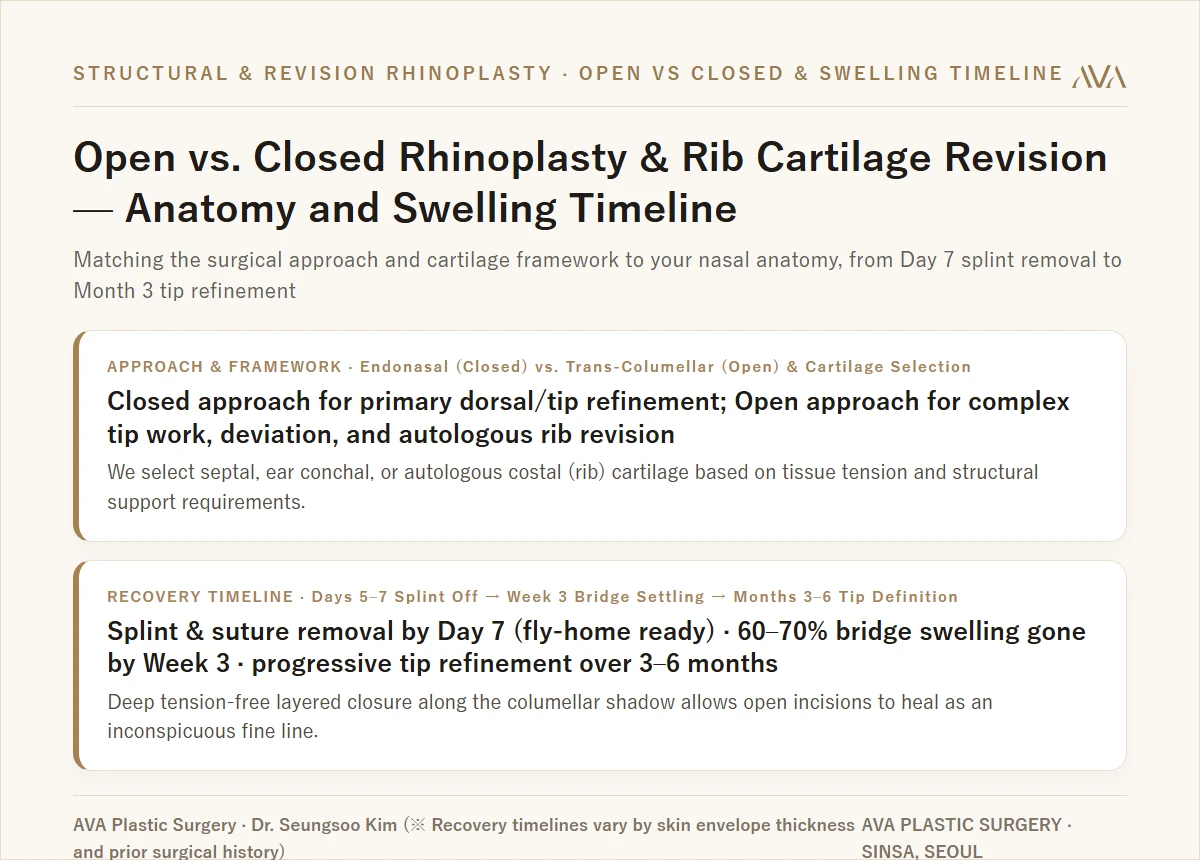
- Closed (endonasal) and Open (trans-columellar) rhinoplasty are chosen based on anatomical indications—tip cartilage complexity, septal deviation, and revision scar tissue—rather than one approach being universally superior.
- Tip support grafts (septal cartilage, ear conchal cartilage, or autologous rib cartilage) are selected according to native cartilage strength, skin envelope thickness, and whether revision reconstruction is needed.
- External splint and sutures are removed at Days 5–7, major bridge swelling settles by Weeks 2–3, and final nasal tip definition matures progressively over 3–6 months.
"Doctor, I want a refined nasal tip without a visible scar—can my surgery be done with a closed approach, or do I need open rhinoplasty? And how swollen will my nose look at Week 1 vs. Week 3?" — Choosing between closed (endonasal) and open (trans-columellar) rhinoplasty is not a question of one technique being universally better, but of matching the surgical exposure and cartilage framework to your specific anatomy.
Hello, I am Dr. Seungsoo Kim, Chief Director and Board-Certified Plastic Surgeon at AVA Plastic Surgery in Sinsa, Gangnam, Seoul.
Whether you are planning a primary structural rhinoplasty, alar base reduction, or a complex revision rhinoplasty in Seoul, two questions always come first: which incision approach fits my nose and how the swelling evolves week by week. Here is a clear anatomical breakdown.
01. Closed (Endonasal) vs. Open (Trans-Columellar) Rhinoplasty: Anatomical Indications
Rather than treating closed or open rhinoplasty as a one-size-fits-all philosophy, we select the approach based on the degree of tip cartilage modification, septal alignment, and prior scar tissue:
- Closed (Endonasal) Rhinoplasty: All incisions are placed inside the nostrils, avoiding any external incision across the columella. Because the soft-tissue envelope over the nasal tip is minimally disrupted, early post-operative swelling settles somewhat faster. It is well suited for primary patients seeking balanced dorsal bridge refinement and moderate, natural tip projection with good native cartilage support.
- Open (Trans-Columellar) Rhinoplasty: Combines internal incisions with a fine inverted-V step incision along the narrowest shadow of the columella. This provides direct binocular visualization of the lower lateral cartilages, nasal septum, and dorsal axis in their natural resting position. Open exposure is recommended when correcting a severely bulbous or drooping tip, a deviated or asymmetric nose, a short/upturned nose requiring septal extension, or during revision rhinoplasty where scar contracture must be meticulously released.
When an open approach is indicated, we close the deep perichondrial and subcutaneous layers first so the outer columellar skin edges meet with minimal tension, allowing the incision to mature into a faint line along the natural columellar shadow over several months.
02. Selecting the Nasal Tip Framework: Septal, Ear, or Autologous Rib Cartilage
A long-lasting nasal tip requires a stable internal tripod that can support the weight and tension of the overlying skin without drooping or warping over time:
- Septal Cartilage: Harvested from inside the nasal cavity during the same procedure. Straight and firm, it serves as the primary choice for columellar strut or septal extension grafting in primary rhinoplasty when sufficient septal volume exists.
- Ear (Conchal) Cartilage: Harvested through a hidden crease behind the ear. Its natural curvature and elasticity make it ideal for shaping soft, natural nasal tip contours or layering over structural support.
- Autologous Costal (Rib) Cartilage: Indicated when septal and ear cartilage have already been used in previous surgeries, when capsular contracture has foreshortened and tightened the skin envelope, or when strong structural counter-tension is required. We carve harvest-site rib cartilage following balanced cross-sectional principles and combine it with diced cartilage or fascia as needed to minimize warping risk.
03. Week-by-Week Rhinoplasty Swelling & Recovery Timeline
- Days 1 to 3 (Early Swelling Peak): An external thermoplastic splint protects the nasal bridge. Swelling and mild bruising around the eyes and glabella peak around 48 to 72 hours. Sleeping with your head elevated and using cool compresses around the cheeks/eyes (without pressing the nasal splint) helps comfort.
- Days 5 to 7 (Splint & Suture Removal — Fly-Home Milestone): The external splint and fine columellar/alar sutures are removed in clinic. International patients can safely board a flight home after this Day 7 checkup.
- Weeks 2 to 3 (Major Bridge Swelling Resolution): Approximately 60% to 70% of acute swelling along the bridge and root of the nose resolves by Week 3. While the nasal tip still feels firm to the touch, the profile looks natural in daily social settings.
- Months 3 to 6+ (Final Nasal Tip Definition): Because nasal tip skin is thicker and sebaceous, micro-swelling in the tip and supratip resolves gradually over 3 to 6 months (and up to 6 to 12 months in thick-skinned or revision cases), revealing the final refined tip contour.
※ Clinical Notice: Swelling resolution, cartilage graft stability, and scar maturation vary according to individual skin thickness, cartilage characteristics, and prior surgical history. Potential risks include bleeding, infection, asymmetry, implant or cartilage deviation, and contracture.
Book Your 1:1 Consultation with Dr. Seungsoo Kim
Whether you are flying in from overseas or living in Korea, Dr. Seungsoo Kim personally oversees every step from initial consultation to surgery and recovery:
- 📅 Book a 1:1 Zoom Video Pre-Consultation or Seoul Clinic Visit (English Booking Hub) →
- 📖 Read Dr. Kim's Mother's Deep-Plane Facelift & Eyelid Surgery 2-Month Recovery Log →
- ✨ View Deep-Plane Facelift Guide & 1-Year Follow-Up Cases →
- 👁️ View Upper Eyelid, Sub-Brow & Forehead Lift Guide →
- 💬 Chat Directly on WhatsApp (+82 10-3705-3423) →
📍 AVA Plastic Surgery · 4F Insung Building, 603 Gangnam-daero, Seocho-gu, Seoul (1-min walk from Sinsa Station Exit 4) · TEL +82 2-545-1882
※ Surgical & Consultation Notice: 1:1 Zoom video consultations provide a preliminary educational assessment; final surgical candidacy and operative plans are confirmed through an in-person clinical examination by Dr. Seungsoo Kim in Seoul. Post-operative complications such as bleeding, infection, swelling, scarring, asymmetry, or sensory changes may occur, and results and recovery vary by individual.
Frequently Asked Clinical Questions (FAQ)
Q. How do you decide between closed (scarless endonasal) and open rhinoplasty?
Closed rhinoplasty avoids an external columellar incision and works well for primary dorsal refinement and moderate tip projection. Open rhinoplasty provides direct binocular visualization of the lower lateral cartilages and septum, making it the preferred approach for complex tip reshaping, crooked noses, and revision rhinoplasty.
Q. When is autologous rib cartilage recommended for rhinoplasty in Korea?
Autologous costal (rib) cartilage is indicated when septal and ear cartilage have been depleted by prior surgeries, when contracture scar tissue requires strong structural counter-tension, or when significant septal extension is needed for a short or upturned nose.
Q. What does the rhinoplasty swelling timeline look like at Week 1, Week 3, and Month 3?
Splint and suture removal takes place around Days 5 to 7. By Week 3, approximately 60–70% of bridge swelling has resolved so contours look natural socially, while the thicker skin of the nasal tip continues to refine over 3 to 6 months.
Read the original Naver blog post ·