Revision Rhinoplasty & Contracted Nose Correction in Seoul — Capsular Release and Autologous Rib Cartilage Reconstruction
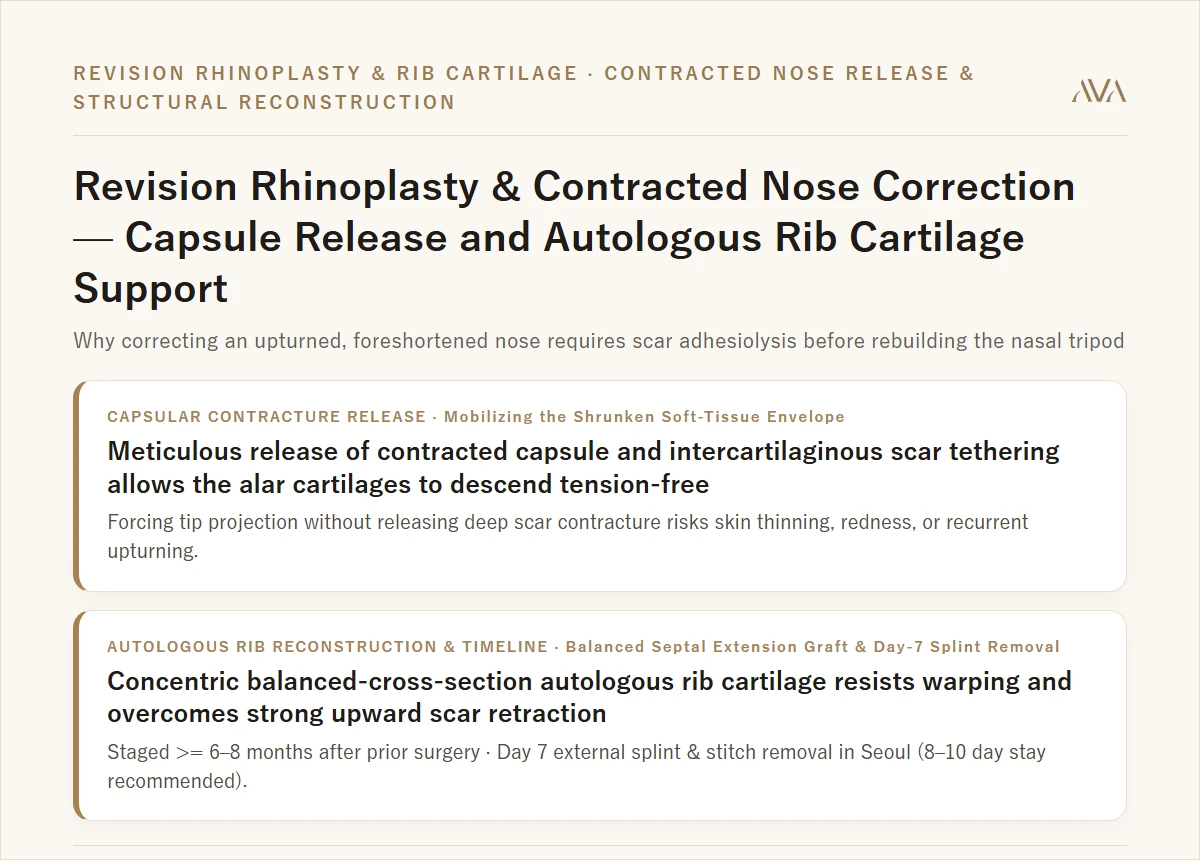
- Successful revision rhinoplasty for a contracted, upturned nose begins with thorough capsular and scar contracture release—not simply swapping one implant for another.
- When septal and ear cartilage have been depleted or strong scar retraction must be overcome to lengthen a foreshortened nose, autologous rib cartilage septal extension grafting provides the most reliable structural foundation.
- Elective revision is generally staged at least 6 months after prior surgery once tissue vascularity and scar remodeling stabilize, with external splint and stitch removal completed on postoperative day 7 in Seoul.
"Dr. Kim, my nasal tip has gradually pulled upward and become stiff after a previous silicone rhinoplasty—can revision surgery safely lengthen my nose again? How many months must I wait before revision, and why is autologous rib cartilage recommended?" — Correcting a contracted or upturned nose is never achieved by forcing a larger implant against tight skin; it requires meticulous layer-by-layer release of fibrotic scar contracture followed by a rigid, tension-resistant autologous cartilage framework.
Hello. I am Dr. Seungsoo Kim, Chief Director and Board-Certified Plastic Surgeon at AVA Plastic Surgery in Sinsa, Gangnam, Seoul.
Many domestic and international patients visit our clinic for revision rhinoplasty not merely for subtle aesthetic refinement, but because of structural complications after prior surgery—including capsular contracture causing a short, upturned "foreshortened" nasal tip, implant deviation or visibility, pinched nostrils, or collapsed tip support. Below are the three anatomical principles that govern safe, durable revision rhinoplasty.
01. Timing Your Revision Rhinoplasty: Why Waiting at Least 6 Months Matters
When a previous rhinoplasty heals poorly, wanting immediate correction is completely understandable. However, in the absence of acute infection or impending skin extrusion, standard surgical protocol is to wait at least 6 months (and 6 to 12 months after multiple prior revisions) before operating again.
- Why Tissue Maturation Is Non-Negotiable: During the first several months after surgery, internal nasal tissues remain in an active inflammatory and fibrotic remodeling phase—meaning the tissues are firm, vascular, and fragile. Attempting extensive dissection before scar tissue softens increases bleeding, risks tearing the delicate nasal skin envelope, and makes accurate symmetry judgment difficult.
- When Immediate Intervention Is Indicated: If acute purulent infection, severe implant displacement, or threatened skin perforation occurs, we intervene promptly to remove the foreign implant and irrigate the pocket, then allow the soft-tissue envelope to heal and soften before performing definitive autologous cartilage reconstruction.
02. Step One in Contracted Nose Repair: Complete Capsular & Scar Release
A contracted nose develops when thick fibrotic capsule and scar tissue form around a synthetic dorsal implant or previous graft, progressively pulling the lower lateral (alar) cartilages and skin envelope upward. The nasal bridge looks unnatural, the tip rotates cephalically, and nostril show increases.
Simply inserting a longer graft or implant to push a contracted tip downward without releasing the internal scar tether places excessive pressure on the nasal tip skin—leading to skin thinning, blanching, graft visibility, or even vascular compromise.
Therefore, the essential first step in our open revision approach is complete capsular release and scar adhesiolysis: excising or scoring the constricting capsule and freeing the retracted lower lateral cartilages and skin-soft tissue envelope so the nasal tip glides downward to its normal anatomical length without tension.
03. Rebuilding the Structural Tripod: Septal vs. Autologous Costal (Rib) Cartilage
Once the soft-tissue envelope is fully mobilized, a strong internal foundation must be built so contractile healing forces do not pull the tip upward again:
- Septal & Conchal (Ear) Cartilage Reconstruction: If the patient's native nasal septum was untouched during the primary surgery and contracture is mild, a septal extension graft combined with ear cartilage tip refinement can provide balanced support.
- Autologous Costal (Rib) Cartilage Reconstruction: In most complex revisions—where septal and ear cartilage have already been depleted or severe scar contracture requires powerful counter-tension—autologous rib cartilage harvested through a small 1.5 to 2.5 cm crease incision beneath the chest is the gold standard. Because it is 100% the patient's own living tissue, it offers high biocompatibility, abundant volume, and superior structural strength for septal extension and columellar struts.
- Preventing Rib Cartilage Warping & Softening the Nasal Tip: To minimize the natural tendency of costal cartilage to curve (warping), we use balanced central-core carving, symmetric cortical trimming, and oblique/laminated splinting grafts. Furthermore, while the internal support pillar uses firm rib cartilage, we cap the nasal tip with autologous perichondrium, fascia, or soft cartilage so the tip looks and feels natural rather than rigid.
04. Recovery Timeline & Recommended Stay in Seoul (Days 7–10 to Month 6)
- Days 7 to 10 (Splint & Suture Removal — Fly-Home Window): The external nasal splint and fine columellar sutures are removed around Day 7 (chest donor site sutures or skin adhesive are checked at Days 7 to 10). International patients typically plan a 8 to 10-day stay in Seoul before flying home.
- Weeks 2 to 4 (Social Recovery): Because revision dissection is more extensive than primary rhinoplasty, early swelling subsides slightly more gradually over the first 2 to 4 weeks.
- Months 3 to 12 (Tip Softening & Final Definition): Internal scar remodeling and lymphatic drainage in the nasal tip mature progressively over 6 to 12 months, revealing a refined, tension-free nasal profile.
※ Clinical Notice: Revision rhinoplasty and autologous rib cartilage reconstruction carry individual variations in swelling duration, scar maturation, and achievable lengthening depending on skin envelope elasticity and cartilage calcification. Potential risks include bleeding, infection, asymmetry, cartilage warping or resorption, pneumothorax (a rare rib-harvest complication), and recurrent contracture. Always complete an in-person clinical and CT/endoscopic evaluation with a board-certified plastic surgeon.
Book Your 1:1 Consultation with Dr. Seungsoo Kim
Whether you are flying in from overseas or living in Korea, Dr. Seungsoo Kim personally oversees every step from initial consultation to surgery and recovery:
- 📅 Book a 1:1 Zoom Video Pre-Consultation or Seoul Clinic Visit (English Booking Hub) →
- 📖 Read Dr. Kim's Mother's Deep-Plane Facelift & Eyelid Surgery 2-Month Recovery Log →
- ✨ View Deep-Plane Facelift Guide & 1-Year Follow-Up Cases →
- 👁️ View Upper Eyelid, Sub-Brow & Forehead Lift Guide →
- 💬 Chat Directly on WhatsApp (+82 10-3705-3423) →
📍 AVA Plastic Surgery · 4F Insung Building, 603 Gangnam-daero, Seocho-gu, Seoul (1-min walk from Sinsa Station Exit 4) · TEL +82 2-545-1882
※ Surgical & Consultation Notice: 1:1 Zoom video consultations provide a preliminary educational assessment; final surgical candidacy and operative plans are confirmed through an in-person clinical examination by Dr. Seungsoo Kim in Seoul. Post-operative complications such as bleeding, infection, swelling, scarring, asymmetry, or sensory changes may occur, and results and recovery vary by individual.
Frequently Asked Clinical Questions (FAQ)
Q. What causes a contracted upturned nose after rhinoplasty, and how is it corrected?
Capsular contracture occurs when chronic low-grade inflammation, repeated trauma, or foreign-body reaction around a silicone implant causes the surrounding fibrous capsule to thicken and shrink, pulling the nasal tip upward. Correction requires releasing the contracted capsule and scar tethering, mobilizing the soft-tissue envelope, and rebuilding rigid caudal-anterior tip support using autologous rib or septal cartilage.
Q. Is autologous rib cartilage mandatory for every revision rhinoplasty?
No. If your nasal septum or conchal ear cartilage was untouched in your primary surgery and skin elasticity remains supple, revision can often be completed with septal and ear cartilage. Autologous rib cartilage is specifically indicated when prior cartilage grafts are depleted, severe scar contracture requires strong counter-traction, or significant dorsal/columellar reconstruction is needed.
Q. How long should I wait before revision rhinoplasty, and how many days do I need in Seoul?
We generally wait at least 6 to 8 months after your previous rhinoplasty so internal scar tissue softens and dermal blood supply recovers (unless acute infection or impending extrusion requires earlier implant removal). International patients should plan an 8-to-10-day stay in Seoul so Dr. Seungsoo Kim can remove the nasal splint and sutures on postoperative day 7 before your flight home.
Read the original Naver blog post ·