Post-Op Swelling, Bruising & Scar Care Timeline — 4 Healing Stages & Aftercare Rules
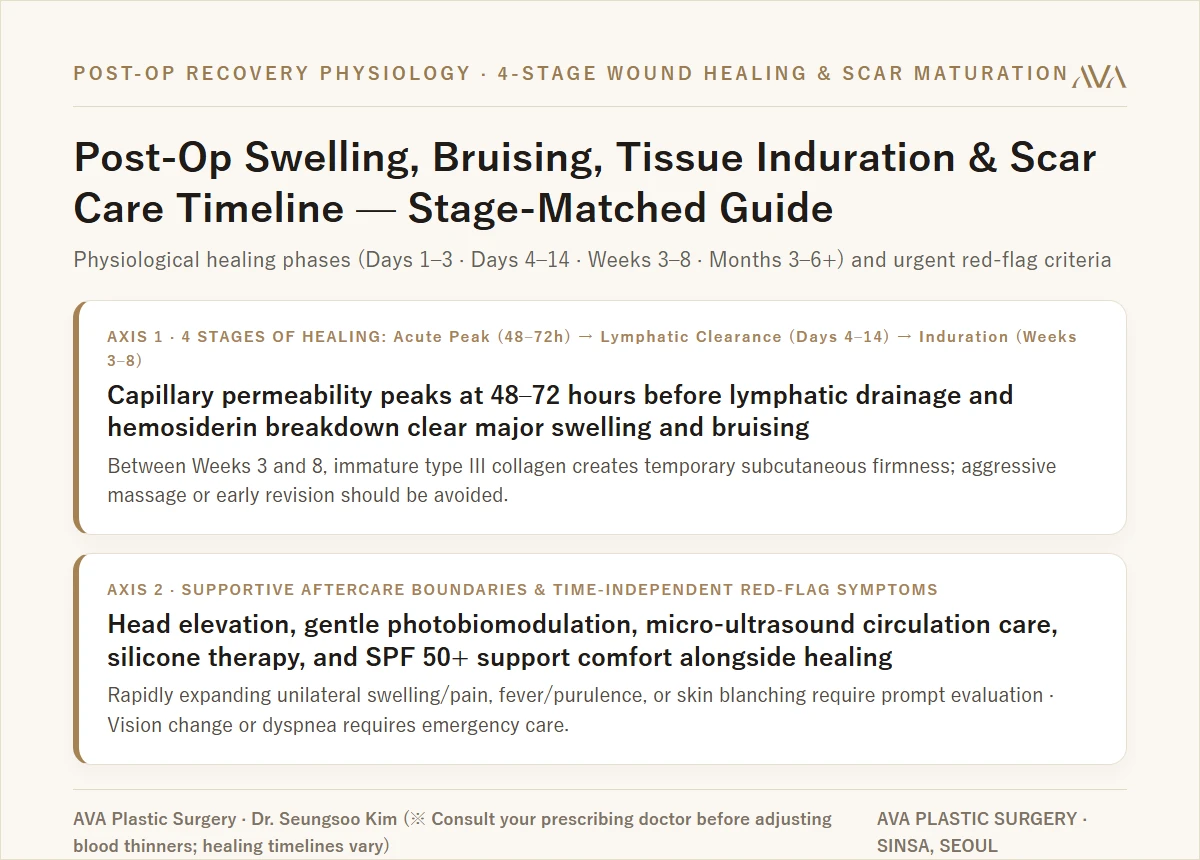
- Postoperative healing follows four distinct physiological phases: (1) Acute Hemostasis & Peak Edema (Days 0–3), (2) Ecchymosis Resolution & Suture Removal (Days 4–14), (3) Deep Subdermal Induration / "Bio-Bond" Remodeling (Weeks 3–8), and (4) Scar Collagen Maturation (Months 2–6+).
- During the first 48–72 hours, gentle gauze-wrapped cooling and 30–45° head elevation minimize capillary leakage, whereas mild warmth is used only when cleared by the surgeon after bleeding risk subsides (fat-grafted zones must never be compressed or exposed to extreme cold/heat).
- Regardless of postoperative day, red-flag signs—rapidly expanding unilateral tense swelling, severe throbbing pain, vision loss/diplopia/proptosis, shortness of breath, high fever, or purulent drainage—require immediate clinic contact or emergency room care, and prescribed anticoagulants must never be stopped without consulting the prescribing physician.
"Dr. Kim, why does my face look more swollen on Day 3 than right after surgery? When should I switch from cold packs to warm compresses? And why does the area under my skin feel firm or tight around Week 4—should I massage it?" — Half of a refined surgical result is achieved in the operating room through anatomical plane dissection and tension-free closure; the other half comes from navigating the four biological stages of tissue healing—(1) Days 0–3 Acute Edema & Hemostasis, (2) Days 4–14 Ecchymosis Clearance & Suture Removal, (3) Weeks 3–8 Deep Subdermal Induration ("Bio-Bond") Remodeling, and (4) Months 2–6+ Scar Collagen Maturation—with safe, stage-matched medical aftercare.
Hello. I am Dr. Seungsoo Kim, Chief Director and Board-Certified Plastic Surgeon at AVA Plastic Surgery in Sinsa, Gangnam, Seoul.
Whether you are recovering from a Dual-Deep Plane SMAS Facelift, eyelid surgery, structural rhinoplasty, or facial fat grafting, the most common source of postoperative anxiety is uncertainty: "Is what I am feeling today normal healing, or is it a complication?" In our Medical Skincare & Post-Op Recovery Clinic and Dermatology Aftercare Center, we guide every patient through a structured, stage-by-stage recovery protocol so you know exactly what to expect—and which warning signs require immediate medical attention.
01. The 4 Physiological Stages of Postoperative Recovery (Days 0–3 · Days 4–14 · Weeks 3–8 · Months 2–6+)
Soft tissue heals along a predictable biological sequence. Understanding each phase prevents premature worry and protects healing tissues from well-intentioned but harmful self-care:
- Stage 1 — Acute Hemostasis & Peak Edema (Post-Op Days 0 to 3; 48–72 Hour Peak):
- Physiological Changes: Capillary permeability peaks between 48 and 72 hours after surgery (Mornings of Day 2 and Day 3). It is completely normal for swelling and tightness to feel more pronounced on Day 3 than in the recovery room on Day 0, and for the left and right sides to swell or drain at slightly different rates.
- Core Aftercare (Gentle Cooling & Head Elevation): During the first 72 hours, apply gentle intermittent cooling wrapped in clean sterile gauze or a soft cloth (15–20 minutes on, followed by rest—never place ice directly on skin) and keep your head elevated at 30 to 45 degrees while resting and sleeping to reduce venous congestion.
- Stage 2 — Ecchymosis Resolution & Staged Suture Removal (Post-Op Days 4 to 14):
- Physiological Changes: As acute interstitial fluid drains via the lymphatic network, trapped red blood cell pigments break down from violet-blue to green and pale yellow-brown, often migrating downward toward the lower cheeks or neck under gravity before fading.
- Suture Removal & Transition to Mild Warmth: Fine eyelid, nasal, lip, and preauricular facelift sutures are removed on Post-Op Days 5 to 7, while retroauricular and scalp anchoring sutures in facelift patients are removed on Days 10 to 12. Once the risk of fresh bleeding has passed (typically Day 4–5 onward) and your surgeon confirms it is safe, gentle lukewarm compresses and light indoor walking help accelerate lymphatic clearance.
- ※ Critical Precautions (Numb Skin & Fat-Grafted Zones): Because dissected skin flaps (such as the cheek/preauricular skin after a facelift or the scalp after a forehead lift) have temporarily reduced sensation, never apply hot packs directly—patients cannot feel thermal injury, risking burns or delayed re-bleeding. Furthermore, areas treated with autologous fat grafting must never be compressed or exposed to extreme cold or heat, as adipocytes rely on fragile neovascular diffusion during the first 4 weeks.
- Stage 3 — Deep Subdermal Induration ("Bio-Bond") Formation & Softening (Weeks 3 to 8):
- What Is "Bio-Bond" Induration? Around Weeks 3 to 6—just after surface swelling subsides—many patients notice that deep planes under the chin, cheeks, or eyelid crease feel temporarily firm, tight, or slightly nodular. This is the normal proliferative remodeling phase, during which fibroblasts deposit immature Type III collagen across dissected planes to bond the repositioned tissue layers.
- Why Aggressive Self-Massage Backfires: Kneading or forcefully massaging firm subdermal tissue during Weeks 3 to 8 can tear fragile capillaries, prolong inflammation, and thicken scar adhesion. Instead, we use non-traumatic medical aftercare—including dual-frequency ultrasound micro-massage, hyperbaric oxygen therapy (HBOT), and multi-wavelength LED photobiomodulation—to calm fibroblasts and support lymphatic drainage while tissues soften naturally.
- Stage 4 — Collagen Remodeling & Scar Maturation (Months 2 to 6+):
- Physiological Changes: From Month 2 onward, disorganized Type III collagen is gradually replaced by aligned, supple Type I collagen. Incision lines transition from pink (active capillary remodeling) to a flat, pale, skin-toned line over 3 to 6+ months.
- Evidence-Based Scar Protocol: Starting once sutures are out and surface crusts have completely detached (typically 2 to 3 weeks post-op), apply medical-grade silicone scar gel or silicone sheeting daily and practice strict UV protection (SPF 50+ sunscreen, wide-brimmed hat, or parasol) for at least 3 to 6 months to prevent post-inflammatory hyperpigmentation (PIH). When indicated, targeted vascular/fractional laser or micro-injection therapy further refines the scar.
02. Perioperative Medication Rules & Time-Independent Emergency Red Flags
Every patient and caregiver should distinguish normal recovery milestones from warning signs that require immediate medical evaluation:
- Anticoagulants, Antiplatelets & Supplements (Physician Consultation Mandatory): Non-essential supplements that increase bleeding risk—such as high-dose Vitamin E, Omega-3 fish oil, ginseng, garlic extract, and ginkgo biloba—along with alcohol and all nicotine products should be paused 2 to 4 weeks before and after surgery. However, if you take prescribed aspirin, antiplatelet agents, or anticoagulants for cardiovascular, cerebrovascular, or clotting conditions, NEVER stop them on your own; abrupt discontinuation carries severe systemic risks (such as stroke or thrombosis), so any perioperative adjustment must be coordinated jointly between your prescribing physician and our surgical team.
- 4 Emergency Red-Flag Signs Requiring Immediate Clinic Contact or Emergency Room Care (Regardless of Post-Op Day):
- Suspected Acute Hematoma: Unlike normal symmetric puffiness, sudden, rapidly expanding, tense swelling on one side of the face, neck, or eyelid accompanied by severe throbbing pain not relieved by prescribed medication or active bright-red bleeding from the suture line.
- Orbital or Airway Emergency (Call 119 in Korea / Go to the Nearest Emergency Room Immediately): After eyelid surgery or facial filler, any sudden decrease in vision, blurred vision, double vision (diplopia), or severe retrobulbar eye pain/proptosis; or after facial, neck, or nasal surgery, shortness of breath, difficulty swallowing, or rapid neck expansion.
- Suspected Wound Infection: Rather than improving after Day 4, the incision shows spreading redness, increasing local heat, worsening tenderness, purulent (cloudy yellow/green) drainage, or a fever of 38.0°C (100.4°F) or higher.
- Suspected Skin Flap / Vascular Compromise: Skin along the nasal tip, lip, or elevated cheek flap turns chalky pale/white, dusky purple-gray, or develops a mottled net-like discoloration (livedo reticularis) or blistering.
※ Clinical Notice: Postoperative swelling, bruising, subdermal induration ("bio-bond"), and scar maturation timelines vary significantly according to individual skin thickness, age, underlying health conditions, smoking history, and whether the procedure is primary or revision surgery. All surgical and injectable procedures carry potential risks including bleeding, hematoma, seroma, infection, wound dehiscence, skin necrosis, temporary or persistent sensory changes, nerve injury, asymmetry, hypertrophic or keloid scarring, and hyperpigmentation. If you experience any concerning symptoms at any stage of recovery, contact your surgical team promptly for an in-person clinical evaluation.
Book Your 1:1 Consultation with Dr. Seungsoo Kim
Whether you are flying in from overseas or living in Korea, Dr. Seungsoo Kim personally oversees every step from initial consultation to surgery and recovery:
- 📅 Book a 1:1 Zoom Video Pre-Consultation or Seoul Clinic Visit (English Booking Hub) →
- 📖 Read Dr. Kim's Mother's Deep-Plane Facelift & Eyelid Surgery 2-Month Recovery Log →
- ✨ View Deep-Plane Facelift Guide & 1-Year Follow-Up Cases →
- 👁️ View Upper Eyelid, Sub-Brow & Forehead Lift Guide →
- 💬 Chat Directly on WhatsApp (+82 10-3705-3423) →
📍 AVA Plastic Surgery · 4F Insung Building, 603 Gangnam-daero, Seocho-gu, Seoul (1-min walk from Sinsa Station Exit 4) · TEL +82 2-545-1882
※ Surgical & Consultation Notice: 1:1 Zoom video consultations provide a preliminary educational assessment; final surgical candidacy and operative plans are confirmed through an in-person clinical examination by Dr. Seungsoo Kim in Seoul. Post-operative complications such as bleeding, infection, swelling, scarring, asymmetry, or sensory changes may occur, and results and recovery vary by individual.
Frequently Asked Clinical Questions (FAQ)
Q. When should I switch from cold compresses to warm compresses after facial plastic surgery—and when should both be avoided?
For the first 48 to 72 hours after surgery, gentle intermittent cooling over sterile gauze combined with 30–45° head elevation helps constrict micro-vessels and limit acute edema. Once the risk of fresh bleeding has passed (typically Day 4–5 onward) and your surgeon confirms it is safe, mild lukewarm compresses can support lymphatic clearance of residual bruising. However, because postoperative skin often has temporarily reduced sensation, intense heat risks thermal burns or re-bleeding, and areas treated with autologous fat grafting should avoid both direct pressure and extreme cold or heat to protect adipocyte survival.
Q. Why does the surgical area feel firm, tight, or lumpy ("bio-bond" induration) around Weeks 3 to 6?
Between Weeks 3 and 8, healing enters the proliferative remodeling phase: fibroblasts lay down disorganized type III collagen across dissected planes (such as the SMAS, submental neck, or eyelid crease), creating temporary subdermal firmness, tightness, or mild surface irregularity. Aggressive manual kneading during this stage can provoke inflammation; instead, non-traumatic medical aftercare (such as LDM ultrasound and LED photobiomodulation) supports natural collagen reorganization over 2 to 6 months.
Q. What are the emergency red-flag symptoms that must never be mistaken for normal postoperative swelling?
At any point during recovery, contact your surgical team immediately—or go to the nearest emergency department / call emergency services (119 in Korea)—if you experience: (1) sudden, tense, one-sided swelling accompanied by worsening pain (suspected hematoma), (2) any change in vision, double vision, severe orbital pain, or difficulty breathing/swallowing after periocular or neck/facial procedures, (3) spreading warmth, redness, fever above 38°C, or pus (infection), or (4) pale, mottled, or dusky purple skin discoloration along a flap or incision.