Revision Eyelid Surgery in Korea — Two-Line Fold Lowering, Scar Release & Ptosis Repair
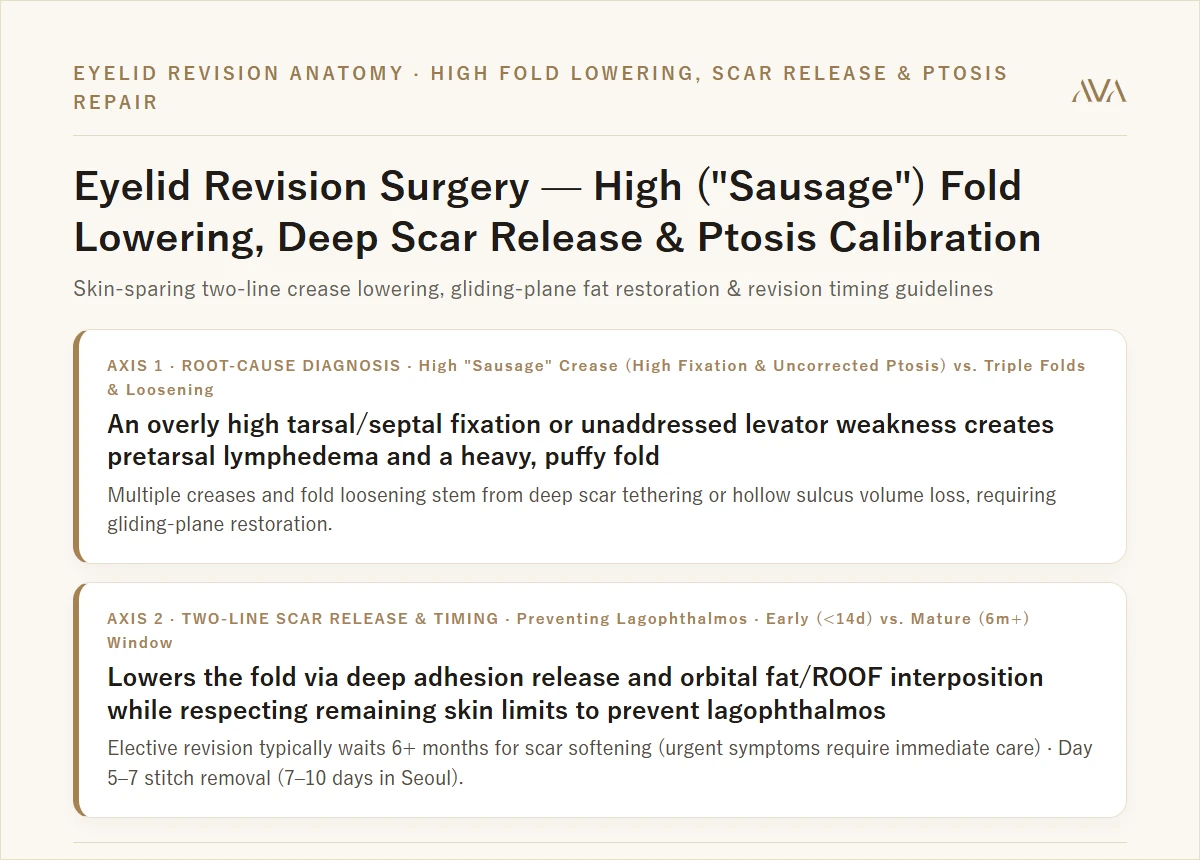
- Successful eyelid revision surgery begins by diagnosing the anatomical root cause: whether a heavy, puffy ("sausage") crease stems from an overly high tarsal/septal fixation, pretarsal lymphatic stasis, or unaddressed blepharoptosis (low MRD1), versus multiple creases or fold loosening caused by deep scar tethering and sunken upper-sulcus fat depletion.
- Lowering a high fold safely relies on skin-sparing two-line crease lowering—releasing the old high scar adhesion and interposing gliding orbital fat or ROOF tissue to prevent re-adhesion—while strictly respecting remaining skin reserves so lagophthalmos (incomplete eyelid closure) is avoided.
- Elective revision is typically performed after 6+ months of scar maturation (except early suture adjustment within 14 days, while acute red-flag symptoms such as vision changes, severe hematoma, or corneal exposure require immediate evaluation regardless of timing), with suture removal on Post-Op Day 5 to 7.
"Dr. Kim, it has been over a year since my double eyelid surgery, yet my crease still looks thick and swollen like I had surgery last week. Another clinic told me I don't have enough eyelid skin left to lower the fold—is there really a safe way to fix a high 'sausage eyelid' or triple creases?" — Successful revision blepharoplasty is never about simply cutting another line on the surface. It depends on Axis 1 (Root-Cause Diagnosis): identifying the exact anatomical plane where the prior fixation went wrong and checking for missed levator ptosis (MRD1), and Axis 2 (Skin-Sparing Two-Line Lowering & Scar Release): releasing deep internal adhesions and restoring a gliding fat plane while preserving enough skin for complete, comfortable eye closure.
Hello. I am Dr. Seungsoo Kim, Chief Director and Board-Certified Plastic Surgeon at AVA Plastic Surgery in Sinsa, Gangnam, Seoul.
Patients who visit us for revision eyelid surgery have already endured months of frustration waiting for "swelling to go down." Because revision surgery must work within the strict limits of remaining eyelid skin and internal scar tissue, every decision must follow clear anatomical principles. Here is how I evaluate and reconstruct complex revision eyelids across two diagnostic axes.
01. Axis 1 (Anatomical Root-Cause Diagnosis): High "Sausage" Folds vs. Triple Creases, Loosening & Asymmetry
In the consultation room, revision eyelid concerns generally fall into two structural categories:
- Why a Crease Looks Thick, High, and Puffy ("Sausage Eyelid"):
- Overly High Tarsal or Septal Fixation: When a crease is anchored higher than the natural superior border of the tarsal plate—or anchored into thick upper eyelid skin without accounting for brow-to-lash distance—the pretarsal strip bulges forward like a puffy roll.
- Pretarsal Scar Bulk & Lymphatic Stasis: Excessively deep, tight fixation sutures or unthinned fibrotic tissue beneath the incision line can block vertical lymphatic drainage, leaving the lower flap chronically edematous even years after surgery.
- Unaddressed Blepharoptosis (Low MRD1 / Weak Levator Function): This is the most frequently overlooked cause of a "high fold." If the levator muscle cannot pull the eyelid margin up crisp and high over the pupil, the skin above the crease fails to tuck inward—making the crease appear abnormally wide while the eyes still look sleepy. Combining revision fold lowering with levator ptosis correction restores normal pupil exposure (MRD1) and naturally narrows the visible fold height.
- Why Multiple / Triple Creases, Fold Loosening, and Asymmetry Occur:
- Triple Creases & Sunken Upper Sulcus: Over-resection of orbital fat or ROOF fat during a previous surgery depletes the natural cushion between the skin and levator aponeurosis. As raw tissue planes stick together at multiple heights, the eyelid folds into two or three irregular lines when opening.
- Fold Loosening & Asymmetry: When suture fixation cannot overcome thick eyelid skin, orbital fat weight, or habitual frontalis brow elevation from hidden ptosis, one or both creases gradually shallow out or become uneven.
02. Axis 2 (Skin-Sparing "Two-Line Lowering" & Deep Scar Release): Protecting Eyelid Closure
The single most important safety question in lowering a high double eyelid is: "How much upper eyelid skin is left when the eyes are gently closed?"
- When Sufficient Eyelid Skin Remains (Direct Scar Excision):
- If the previous surgery was non-incisional or removed very little skin, we can excise the narrow strip of skin between the old high scar and the new lower crease line—combining both lines into a single low incision.
- When Eyelid Skin Is Depleted (Skin-Sparing "Two-Line Lowering" + Adhesiolysis + Fat Interposition):
- If a prior surgery already excised substantial skin, cutting out the strip between the old high scar and the new lower line would leave the eyelid too short—causing lagophthalmos (incomplete eye closure), chronic dry eye, and corneal exposure.
- To lower the fold safely without sacrificing precious skin, we perform Skin-Sparing Two-Line Lowering (Korean du-jul-tta-gi technique): we create a new, lower incision at the ideal crease height while preserving the skin above it, enter the deep plane, and meticulously release the old high scar adhesion (deep adhesiolysis) from the tarsus and levator aponeurosis.
- Because released scar planes will try to stick back together during healing, we interpose a healthy gliding layer—either by advancing/repositioning residual orbital fat and ROOF tissue or placing micro-droplet autologous fat grafts—between the released planes. Once the new lower fold invaginates as the eye opens, the released upper scar tucks inside the new crease fold and softens out of view.
- ※ Anatomical Safety Limit: In patients who have undergone multiple aggressive excisions and already experience lagophthalmos (inability to close the eyes fully), further skin excision is strictly contraindicated; surgery must prioritize scar release and functional eyelid closure rather than cosmetic skin removal.
03. Revision Timing ("Golden Window"): Early Adjustment (<2 Weeks) vs. Mature Scar Revision (6+ Months)
- Early Revision Window (Within 10 to 14 Days Post-Op): Before firm fibrotic collagen forms, severe early asymmetry, an obviously misplaced fixation suture, or excessive eyelid eversion can often be corrected through an early adjustment while tissue planes are still separable.
- Mature Scar Window (6+ Months Post-Op): Between Week 3 and Month 4, internal wound healing is in its active proliferative and contractile phase—tissues are vascular, friable, and variably swollen, making millimeter-precise symmetry unpredictable. Unless an urgent functional complication exists, waiting at least 6 months (and 6 to 12 months for thick skin or multiple prior revisions) allows scar tissue to soften for a far safer, more accurate reconstruction.
- Acute Red-Flag Symptoms Requiring Immediate Evaluation: Do not wait 6 months if you experience acute warning signs after a recent surgery: (1) sudden severe orbital pain, rapid asymmetric swelling, or vision changes (suspected retrobulbar/acute hematoma); (2) severe inability to close the eye causing corneal exposure, sharp foreign-body pain, or persistent redness; or (3) purulent discharge, spreading warmth, and worsening erythema indicating acute infection. These require immediate in-person medical evaluation regardless of how recently surgery was performed.
04. Recovery Timeline: Day 5–7 Stitch Removal & Recommended Stay in Seoul
- Days 5 to 7 (Fine Suture Removal): Micro-sutures are removed in clinic between postoperative days 5 and 7 after Dr. Kim inspects wound healing and dynamic crease folding.
- Recommended Stay in Seoul for International Patients: Because incisional revision blepharoplasty involves deep scar release and frequent ptosis adjustment, we recommend planning a 7- to 10-day stay in Seoul so suture removal and early swelling checks are completed before you fly home. (Remote photo reviews and 1:1 Zoom consultations provide preliminary educational guidance; exact skin reserves, adhesion depth, and levator function are confirmed during your in-person examination in Seoul.)
- Weeks 2 to 6+ Months (Lymphatic Remodeling): Major bruising and swelling settle within 2 to 3 weeks, while deep revision lymphatic swelling and scar redness soften progressively over 3 to 6+ months.
※ Clinical Notice: Surgical outcomes and recovery timelines in revision blepharoplasty vary depending on the number of prior operations, remaining upper eyelid skin reserve, severity of internal scar adhesion, levator muscle function (MRD1), and globe prominence. Potential risks and side effects include bleeding, hematoma, infection, prolonged edema, residual asymmetry, recurrence of multiple creases, fold loosening, hypertrophic scarring, dry eye symptoms, and temporary or persistent lagophthalmos (incomplete eyelid closure). Always complete a thorough 1:1 in-person examination with a board-certified plastic surgeon before deciding on revision surgery.
Book Your 1:1 Consultation with Dr. Seungsoo Kim
Whether you are flying in from overseas or living in Korea, Dr. Seungsoo Kim personally oversees every step from initial consultation to surgery and recovery:
- 📅 Book a 1:1 Zoom Video Pre-Consultation or Seoul Clinic Visit (English Booking Hub) →
- 📖 Read Dr. Kim's Mother's Deep-Plane Facelift & Eyelid Surgery 2-Month Recovery Log →
- ✨ View Deep-Plane Facelift Guide & 1-Year Follow-Up Cases →
- 👁️ View Upper Eyelid, Sub-Brow & Forehead Lift Guide →
- 💬 Chat Directly on WhatsApp (+82 10-3705-3423) →
📍 AVA Plastic Surgery · 4F Insung Building, 603 Gangnam-daero, Seocho-gu, Seoul (1-min walk from Sinsa Station Exit 4) · TEL +82 2-545-1882
※ Surgical & Consultation Notice: 1:1 Zoom video consultations provide a preliminary educational assessment; final surgical candidacy and operative plans are confirmed through an in-person clinical examination by Dr. Seungsoo Kim in Seoul. Post-operative complications such as bleeding, infection, swelling, scarring, asymmetry, or sensory changes may occur, and results and recovery vary by individual.
Frequently Asked Clinical Questions (FAQ)
Q. Why does a double eyelid still look swollen and puffy ("sausage eye") even a year after surgery?
When a fold still appears thick and swollen past the 6-to-12-month mark, it is rarely simple edema. The most common culprits are an incision/fixation placed too high on the tarsal plate for thick Asian eyelid skin, deep scar tissue obstructing pretarsal venous and lymphatic drainage, or uncorrected levator ptosis forcing eyebrow compensation. Resolving it requires releasing the deep scar tether and recalibrating levator tension rather than just cutting away more skin.
Q. How does the skin-sparing "two-line" fold-lowering technique work when upper-eyelid skin is scarce?
Instead of excising the entire strip of skin between the old high crease and the new lower crease—which could leave the eye unable to close—we create a lower crease design, dissect and release the deep fibrotic adhesion of the old high line, and mobilize orbital fat or micro-fat grafts into the upper plane so the old crease cannot re-tether. However, if prior surgeries already removed excessive skin, the degree of lowering is anatomically bounded by safe eyelid closure.
Q. Why wait 6 months for eyelid revision, and how long should international patients stay in Seoul?
During the first 3 to 6 months after surgery, internal tissues undergo active collagen remodeling, vascularity, and stiffness, making millimeter-level symmetry unpredictable. Apart from early adjustments within the first 1 to 2 weeks (or urgent evaluation for acute pain, hematoma, or corneal irritation), waiting at least 6 months allows the scar plane to soften. Fine sutures are removed on Day 5 to 7, and we recommend a 7- to 10-day stay in Seoul.
Read the original Naver blog post ·