Collagen Volume Stimulators (Juvelook Volume, Sculptra, Ultracol) vs. HA Filler & Fat Grafting
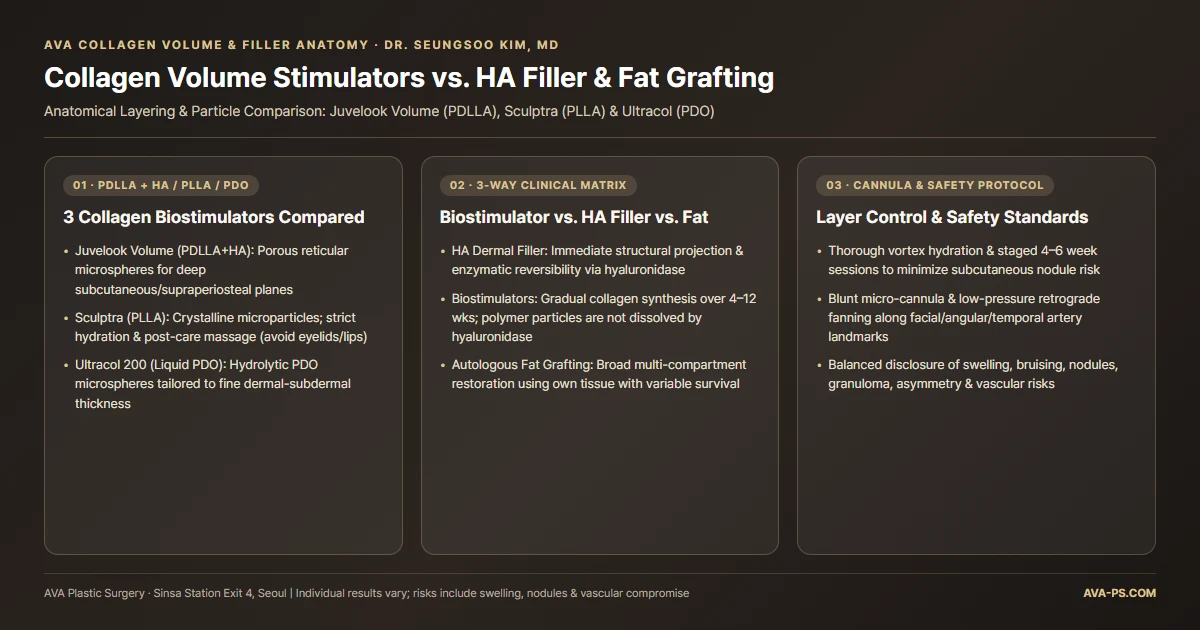
- Collagen volume biostimulators stimulate fibroblasts to synthesize autologous collagen over 4 to 12 weeks as biocompatible polymer microspheres gradually hydrolyze; porous reticular PDLLA+HA (Juvelook Volume / Lenisna), crystalline PLLA (Sculptra), and hydrolytic liquid PDO (Ultracol 200) differ in particle geometry, reconstitution protocol, and anatomical target planes.
- Whereas cross-linked Hyaluronic Acid (HA) fillers provide immediate structural projection and can be enzymatically dissolved with hyaluronidase, synthetic polymer particles (PDLLA, PLLA, PDO) themselves cannot be dissolved by hyaluronidase—making thorough vortex pre-hydration, plane-specific blunt micro-cannula fanning, and conservative 4-to-6-week staged dosing essential.
- All three volume modalities carry potential side effects—collagen biostimulators (swelling, bruising, palpable nodules, granuloma, asymmetry, vascular occlusion), HA fillers (Tyndall effect, delayed nodules, vascular compromise), and autologous micro-fat grafting (variable graft survival, oil cysts/calcification, fat embolism)—requiring strict arterial landmark avoidance and screening for contraindications (pregnancy/lactation, active skin infection, keloid tendency, or active autoimmune disease).
"Dr. Kim, for hollow cheeks, sunken temples, or deep nasolabial folds, should I choose a collagen biostimulator like Juvelook Volume, Sculptra, or Ultracol—or should I get Hyaluronic Acid (HA) filler or autologous fat grafting? And if a collagen stimulator feels lumpy, can it be dissolved with hyaluronidase like HA filler?" — Restoring facial volume safely is never about chasing a trending product name; it requires (1) matching the distinct particle architecture and reconstitution rules of porous PDLLA (Juvelook Volume), crystalline PLLA (Sculptra), and hydrolytic liquid PDO (Ultracol 200) to the right anatomical plane, and (2) recognizing that synthetic polymer microparticles cannot be enzymatically dissolved with hyaluronidase, making conservative staged dosing and blunt micro-cannula layer control essential.
Hello. I am Dr. Seungsoo Kim, Chief Director and Board-Certified Plastic Surgeon at AVA Plastic Surgery in Sinsa, Gangnam, Seoul.
In our Collagen Volume Booster Clinic and Skin & Biostimulator Center, many international and domestic patients ask for "collagen-growing injections" because they worry cross-linked fillers might look puffy over time, yet they want to avoid surgical downtime. However, collagen biostimulators, Hyaluronic Acid (HA) dermal fillers, and autologous micro-fat grafting are not competing versions of the same treatment—they are three distinct anatomical tools with different mechanisms of action, onset timelines, enzymatic reversibility, and safety boundaries.
01. Particle Architecture & Product-Specific Protocols: Juvelook Volume (PDLLA) vs. Sculptra (PLLA) vs. Ultracol 200 (PDO)
Collagen volume biostimulators work by delivering biocompatible polymer microspheres into targeted subdermal or supraperiosteal planes. As these microparticles gradually degrade via hydrolysis over several months, they stimulate host fibroblasts to synthesize new autologous Type I and Type III collagen over 4 to 12 weeks. Each of the three primary biostimulators has a distinct physical structure and clinical protocol:
- Juvelook Volume (Lenisna — Porous Reticular PDLLA + Non-Crosslinked HA Carrier):
- Particle Structure & Mechanism: Combines spherical, internally porous reticular PDLLA (Poly-D,L-Lactic Acid) microspheres with a non-crosslinked hyaluronic acid hydrogel carrier that provides initial hydration and smooth suspension.
- Anatomical Target Plane & Indications: Delivered via a blunt micro-cannula into the deep subcutaneous plane and supraperiosteal plane of the anterior mid-cheek, nasolabial fold base, marionette grooves, and sub-malar hollows. Because its particle size and concentration are higher than superficial "Juvelook Skin," it must not be injected intradermally into thin eyelid skin or the lip vermilion.
- Sculptra (Crystalline PLLA Microparticles):
- Particle Structure & Reconstitution Protocol: Composed of crystalline PLLA (Poly-L-Lactic Acid) microparticles that elicit robust, long-lasting collagen neogenesis, requiring thorough pre-hydration and uniform agitation prior to injection so particles do not clump.
- Anatomical Target Plane & Massage Rule: Ideal for broad structural framing in sunken temples, lateral cheek hollows ("peanut-shaped" facial contours), and the preauricular frame in the deep subcutaneous or supraperiosteal plane. Patients follow a structured post-treatment massage protocol (such as the classic 5-5-5 rule: 5 minutes, 5 times daily, for 5 days when directed) to ensure even dispersion. Sculptra is not recommended in hypermobile sphincter zones or ultra-thin skin such as the periorbital tear trough or lips due to elevated nodule risk.
- Ultracol 200 (Hydrolytic Liquid PDO Microspheres):
- Particle Structure & Mechanism: Formulates PDO (Polydioxanone)—the same absorbable polymer used in surgical sutures—into smooth liquid microspheres that degrade via hydrolysis into water ($ ext{H}_2 ext{O}$) and carbon dioxide ($ ext{CO}_2$).
- Anatomical Target Plane & Indications: Applied according to approved indications and individual skin thickness to reinforce fine subdermal and superficial subcutaneous elasticity and dermal thickness in delicate facial regions.
02. Why Polymer Biostimulators Cannot Be Dissolved with Hyaluronidase — Nodule Prevention & Vascular Safety
Before choosing between a filler and a collagen biostimulator, every patient should understand the fundamental difference in enzymatic reversibility:
- Hyaluronidase Does Not Dissolve PDLLA, PLLA, or PDO Polymer Particles: Cross-linked Hyaluronic Acid (HA) fillers can be enzymatically cleaved and dissolved with hyaluronidase if a patient desires contour adjustment or if vascular compression occurs. By contrast, synthetic polymer microparticles (PDLLA, PLLA, and PDO) cannot be enzymatically dissolved or immediately removed with hyaluronidase (in Juvelook Volume, only the initial non-crosslinked HA carrier component responds to hyaluronidase, whereas the PDLLA polymer scaffold remains until natural hydrolytic clearance).
- The 3 Clinical Rules for Preventing Subcutaneous Nodules & Granulomas: Because polymer particles cannot be erased on demand, safe biostimulator treatment relies on: (1) thorough, uniform vortex pre-hydration and dilution tailored to regional skin thickness, (2) blunt micro-cannula retrograde fanning in the proper deep subcutaneous or supraperiosteal plane away from superficial orbicularis oculi and orbicularis oris muscle fibers, and (3) conservative staged sessions spaced 4 to 6 weeks apart rather than attempting 100% volume correction in a single sitting.
- Arterial Safety Protocol: Even though biostimulators are reconstituted as liquid suspensions rather than stiff gels, intravascular injection into the facial, angular, supratrochlear, supraorbital, or superficial temporal arteries can still cause vascular occlusion, tissue ischemia, or vision-threatening complications. Blunt micro-cannula delivery, low-pressure retrograde micro-droplet fanning, and real-time capillary refill monitoring are mandatory.
03. 3-Way Clinical Decision Matrix: Collagen Biostimulators vs. HA Dermal Filler vs. Autologous Micro-Fat Grafting
Rather than declaring one modality superior, we match each option—or a layered combination—to your facial anatomy, timeline, and risk preferences:
- When Cross-Linked Hyaluronic Acid (HA) Filler Is Optimal: Best when you want immediate visible contour projection right after the appointment, crisp structural support with high elastic modulus ($G'$) in focal landmarks (such as the chin apex, nasal base, or lip border), or the reassurance of hyaluronidase reversibility. Potential trade-offs include the Tyndall effect (bluish light scattering if placed too superficially), hydrophilic water attraction over time, delayed inflammatory nodules, and vascular occlusion risk.
- When Collagen Volume Biostimulators (PDLLA / PLLA / PDO) Are Optimal: Best when you prefer gradual, natural-feeling dermal and subdermal thickening over 4 to 12 weeks as your own fibroblasts build a collagen matrix, particularly across broad midface, sub-malar, or temporal hollows. Patients must understand that initial post-injection fullness from the water carrier subsides within days before true collagen growth begins, and that polymer particles are not reversible with hyaluronidase.
- When Autologous Micro-Fat Grafting Is Optimal: Best when multiple facial compartments (forehead, temples, anterior cheeks, lateral cheeks, and nasolabial folds) require larger total volume simultaneously using your own harvested fat tissue without synthetic foreign material. Trade-offs include a minor surgical harvesting step under sedation, 1 to 2 weeks of postoperative swelling, individual variation in fat graft survival (typically 50–70% per session), potential oil cysts or micro-calcification, and intravascular fat embolism risk requiring meticulous multi-plane micro-cannula droplet placement.
※ Clinical & Regulatory Notice: Collagen volume biostimulators (Juvelook Volume, Sculptra, Ultracol), hyaluronic acid dermal fillers, and autologous fat grafting produce results and longevity that vary according to individual skin thickness, age, fibroblast response, and facial anatomy. Potential risks across these modalities include swelling, bruising, erythema, tenderness, infection, asymmetry, palpable subcutaneous nodules, delayed foreign-body granulomas, overcorrection or undercorrection, Tyndall effect (HA fillers), variable fat retention or calcification (fat grafting), and rare but serious vascular complications such as skin necrosis, vision loss, or cerebral ischemia if material enters an artery. Treatments may be contraindicated during pregnancy or lactation, or in patients with active skin infections, keloid/hypertrophic scarring tendencies, active autoimmune disease, or prior permanent fillers in the target area. Always complete a 1-on-1 in-person examination with a board-certified plastic surgeon before treatment.
Book Your 1:1 Consultation with Dr. Seungsoo Kim
Whether you are flying in from overseas or living in Korea, Dr. Seungsoo Kim personally oversees every step from initial consultation to surgery and recovery:
- 📅 Book a 1:1 Zoom Video Pre-Consultation or Seoul Clinic Visit (English Booking Hub) →
- 📖 Read Dr. Kim's Mother's Deep-Plane Facelift & Eyelid Surgery 2-Month Recovery Log →
- ✨ View Deep-Plane Facelift Guide & 1-Year Follow-Up Cases →
- 👁️ View Upper Eyelid, Sub-Brow & Forehead Lift Guide →
- 💬 Chat Directly on WhatsApp (+82 10-3705-3423) →
📍 AVA Plastic Surgery · 4F Insung Building, 603 Gangnam-daero, Seocho-gu, Seoul (1-min walk from Sinsa Station Exit 4) · TEL +82 2-545-1882
※ Surgical & Consultation Notice: 1:1 Zoom video consultations provide a preliminary educational assessment; final surgical candidacy and operative plans are confirmed through an in-person clinical examination by Dr. Seungsoo Kim in Seoul. Post-operative complications such as bleeding, infection, swelling, scarring, asymmetry, or sensory changes may occur, and results and recovery vary by individual.
Frequently Asked Clinical Questions (FAQ)
Q. How do Juvelook Volume (PDLLA), Sculptra (PLLA), and Ultracol 200 (PDO) differ in particle structure and anatomical indications?
Juvelook Volume (Lenisna) combines porous, reticular PDLLA microspheres with a non-crosslinked hyaluronic acid carrier, making it well-suited for deep subcutaneous and supraperiosteal volume restoration in the anterior mid-cheek, nasolabial folds, and sub-malar hollows. Sculptra uses crystalline PLLA microparticles that excel at broad structural framing across sunken temples and lateral cheeks ("peanut-shaped" contours), requiring thorough pre-hydration, post-treatment massage where indicated, and strict avoidance of thin periorbital or lip sphincter muscle zones. Ultracol 200 consists of liquid PDO microspheres that degrade via hydrolysis into water and carbon dioxide, tailored to fine dermal-subdermal thickening according to skin thickness.
Q. Can collagen volume biostimulators be dissolved with hyaluronidase like hyaluronic acid fillers?
No. Hyaluronidase enzymatically cleaves only hyaluronic acid (HA) glycosaminoglycan bonds; it does not dissolve synthetic polymer microparticles such as PDLLA, PLLA, or PDO (in Juvelook Volume, only the initial non-crosslinked HA carrier component responds to hyaluronidase, not the PDLLA scaffold). Because polymer particles cannot be erased on demand, preventing palpable nodules or overcorrection depends on uniform vortex hydration, precise deep-plane micro-cannula delivery away from superficial muscle sphincters, and conservative multi-session buildup spaced 4 to 6 weeks apart.
Q. How should I choose between collagen biostimulators, hyaluronic acid fillers, and autologous micro-fat grafting?
Choose Hyaluronic Acid (HA) filler when you want immediate contour projection, crisp structural definition (such as the chin apex or lips), or enzymatic reversibility. Choose a collagen biostimulator when you prefer gradual, natural-feeling dermal and subdermal thickening over 1 to 3 months without cross-linked gel buildup. Choose autologous micro-fat grafting when multiple facial compartments (forehead, temples, midface, and lateral cheeks) require larger total volume in a single surgical session. Because particulate biostimulators, HA gels, and fat grafts all carry potential side effects (swelling, bruising, nodules) and intravascular occlusion risk if injected into facial, angular, or superficial temporal arteries, anatomical plane selection and low-pressure blunt cannula technique are mandatory.