
Botulinum Toxin & Hyaluronic Acid Filler Anatomy — Muscle Vectors, Rheology & Safety
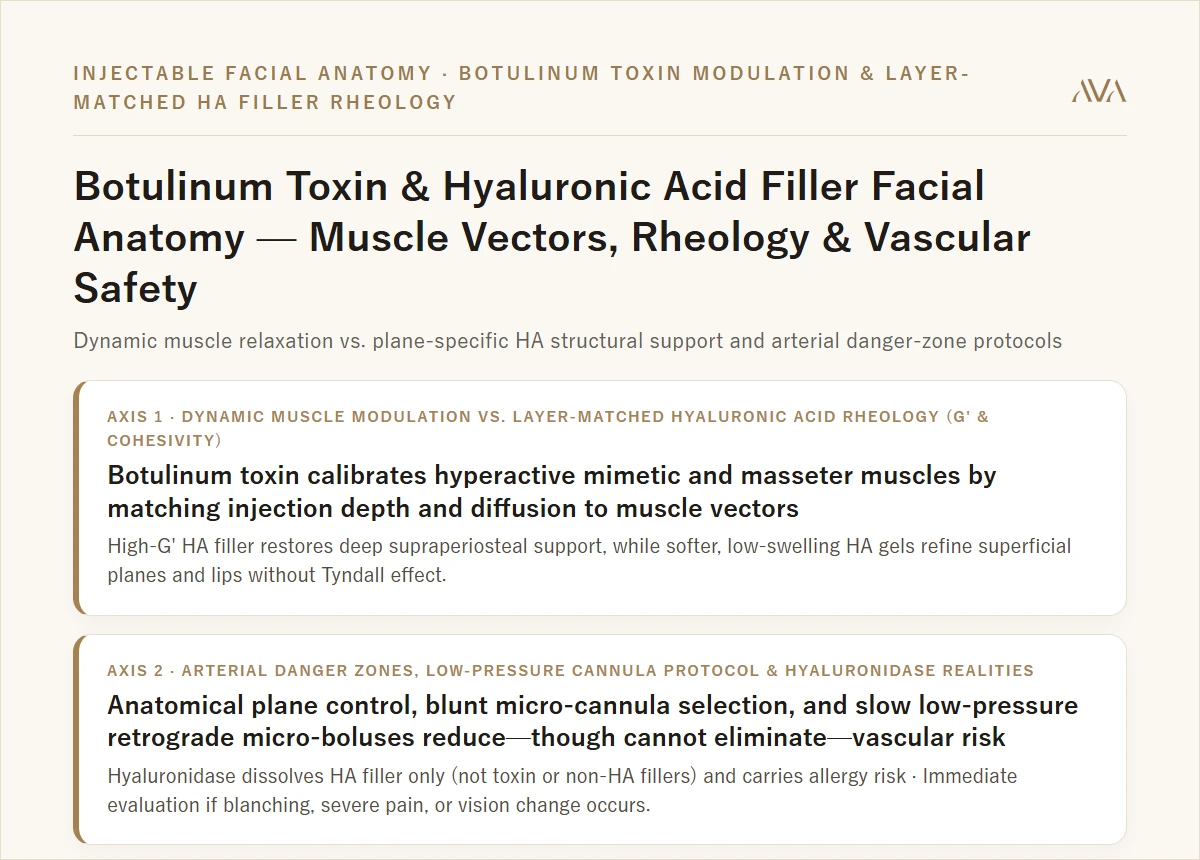
- Botulinum toxin relaxes hyperactive mimetic or hypertrophic muscles (glabella, forehead, crow's feet, masseter) at the neuromuscular junction, whereas hyaluronic acid (HA) filler restores structural volume across deep periosteal or mobile soft-tissue planes.
- In patients who unconsciously recruit the frontalis muscle to compensate for mild ptosis or low brows, standard lower-forehead toxin dosing can cause brow heaviness; pre-injection levator and brow-vector assessment is essential.
- Anatomical plane control, blunt micro-cannula technique, and low-pressure retrograde micro-droplet injection help reduce—though never completely eliminate—vascular risk in facial danger zones, while avoiding overfilled "pillow face" contours.
"Dr. Kim, for forehead lines, nasolabial folds, or a square jawline, should I choose botulinum toxin or hyaluronic acid filler? And how do you prevent an unnatural 'pillow face,' bluish Tyndall discoloration, or vascular complications?" — Injectable facial contouring succeeds not by syringe volume, but through Axis 1 (Dynamic Muscle Vector Modulation vs. Layer-Matched Hyaluronic Acid Rheology): pairing precise intramuscular botulinum toxin dosing with plane-specific HA gel elasticity (G'), and Axis 2 (Arterial Danger-Zone Safety & Hyaluronidase Realities): respecting glabellar, nasolabial, and nasal vascular anatomy with slow low-pressure technique and clear emergency protocols.
Hello. I am Dr. Seungsoo Kim, Chief Director and Board-Certified Plastic Surgeon at AVA Plastic Surgery in Sinsa, Gangnam, Seoul.
Non-surgical injectables—specifically botulinum toxin and hyaluronic acid (HA) dermal fillers—are often perceived as simple lunch-break procedures. Yet from an anatomical perspective, blind needle placement across the face navigates a dense three-dimensional lattice of mimetic muscles, retaining ligaments, fat compartments, and anastomosing arteries. As we share with patients visiting our Botulinum Toxin Clinic and Hyaluronic Acid Filler Clinic, these two modalities are never interchangeable substitutes: one calibrates dynamic muscular pull, while the other restores static structural support.
01. Axis 1 (Mechanism & Layer Anatomy): Botulinum Toxin (Dynamic Muscle Vectors) vs. Hyaluronic Acid Filler (Layer-Matched Rheology G')
Facial lines and contour shadows arise from two distinct biomechanical mechanisms—repetitive muscular contraction versus structural volume depletion and ligamentous tethering:
- Botulinum Toxin — Neuromuscular Modulation Calibrated to Muscle Depth & Compensatory Vectors:
- Upper-Face Mimetic Muscles (Frontalis, Glabellar Corrugator/Procerus & Orbicularis Oculi): Treating horizontal forehead lines without evaluating how much the frontalis muscle compensates for hidden brow or eyelid ptosis can cause heavy brow descent or an unnatural lateral "Spock / Samurai brow" arch. We map individual frontalis resting tone and eyebrow elevation before micro-dosing at the appropriate intramuscular plane.
- Lower-Face Masseter Hypertrophy, Salivary Glands & Intradermal Micro-Droplet Technique: For square jawline slimming, botulinum toxin is placed deep into the lower belly of the masseter muscle within the anatomical safety zone (posterior to the risorius and zygomaticus major origin) to avoid asymmetric smile pull. Superficial intradermal micro-droplet injections ("skin toxin" for fine pore/texture refinement) or parotid/submandibular salivary gland contouring target completely different planes—and depending on specific product labeling, certain intradermal or glandular applications may constitute off-label clinical use that is discussed transparently during consultation.
- Hyaluronic Acid (HA) Filler — Matching Viscoelastic Rheology (Elastic Modulus G' & Cohesivity) to Tissue Depth:
- Deep Supraperiosteal Structural Support (Anterior Cheek, Temple, Chin & Deep Pyriform Space): Deep skeletal resorption requires a high-G' (high elastic modulus), cohesive hyaluronic acid gel placed directly on bone (supraperiosteal plane) in small structural pillars that resist muscular shear without lateral spreading.
- Superficial Subdermal & Labial Planes (Tear Trough, Fine Lines & Lip Border/Vermilion): Placing a stiff, high-water-affinity filler too superficially under thin eyelid or perioral skin creates visible beading or bluish light scattering known as the Tyndall effect. Superficial planes and mobile lips require low-to-moderate G', flexible HA gels layered in micro-aliqouts.
- Avoiding "Pillow Face" Overfilling: When deep nasolabial folds or marionette lines stem primarily from SMAS and retaining-ligament descent rather than true volume loss, chasing the fold with excessive filler adds weight to the lower face. In those cases, energy-based lifting (Ultherapy / Thermage FLX) or surgical SMAS elevation should precede conservative volume touch-ups.
02. Axis 2 (Facial Arterial Danger Zones & Hyaluronidase): Vascular Safety Protocols and Realistic Limits
The face contains critical arterial communications between the external carotid system (facial, angular, and superficial temporal arteries) and the internal carotid system (ophthalmic artery branches including the supratrochlear, supraorbital, and dorsal nasal arteries). Three High-Risk Arterial Danger Zones demand strict anatomical discipline:
- ① Glabella & Central Forehead (Supratrochlear & Supraorbital Arteries) and ③ Nasal Dorsum / Tip (Dorsal Nasal & Lateral Nasal Arteries): Because these vessels anastomose directly with the ophthalmic artery system, high-pressure intravascular injection carries a rare but catastrophic risk of skin necrosis or retrograde retinal artery occlusion affecting vision.
- ② Nasolabial Fold & Pyriform Fossa (Facial & Angular Arteries): Because the facial artery transitions from deep near the oral commissure to more superficial or variable planes near the nasal ala, plane-specific depth control is mandatory.
- Blunt Micro-Cannula & Slow Low-Pressure Retrograde Injection (Risk Reduction, Not Zero Risk): In high-risk zones, we prioritize an anatomical plane check, blunt-tip micro-cannulas (typically 25G–27G or larger where appropriate), and slow, low-pressure retrograde micro-bolus deposition. Clinical honesty requires stating clearly that neither a blunt cannula nor pre-injection aspiration guarantees 100% elimination of intravascular entry or external vascular compression—continuous visual monitoring of skin perfusion (blanching or livedo reticularis) and patient comfort during every pass is essential.
- Realistic Role & Limitations of Hyaluronidase: A major safety advantage of hyaluronic acid fillers is reversibility via hyaluronidase enzymatic dissolution. However, patients must understand three clinical realities: ① Hyaluronidase dissolves cross-linked hyaluronic acid filler only—it cannot reverse botulinum toxin effects or dissolve non-HA fillers (such as calcium hydroxylapatite, PLLA/PDLLA, or PCL); ② hyaluronidase itself carries a risk of immediate or delayed hypersensitivity and allergic reactions (urticaria, angioedema, or rare anaphylaxis); and ③ while early high-dose hyaluronidase is the cornerstone of managing suspected HA vascular compromise, it does not guarantee complete prevention of tissue injury if delayed. If you experience pale/white skin blanching, mottled purple discoloration, severe or worsening pain, or any visual disturbance after filler injection, contact the clinic or seek emergency medical care immediately.
03. Treatment Specifications, Onset/Longevity Timeline & Aftercare
- Procedure Time & Anesthesia: Approximately 15 to 30 minutes with topical anesthetic cream, cryo-cooling, or local anesthesia; no hospitalization required (immediate return to daily routine).
- Onset & Longevity Timeline:
- Botulinum Toxin: Dynamic expression lines begin softening at Days 3 to 7 and peak around Week 2; masseter jawline slimming becomes noticeable at Weeks 3 to 4 through gradual disuse atrophy and typically lasts 3 to 6 months (appropriate treatment intervals are maintained to minimize neutralizing antibody resistance).
- Hyaluronic Acid Filler: Volume contour is visible immediately, settles over 1 to 2 weeks as minor post-injection swelling subsides, and typically lasts 6 to 18 months depending on cross-linking rheology and regional mobility.
- Post-Treatment Precautions: Avoid rubbing, massaging, or applying heavy pressure to treated areas for at least 4 hours after botulinum toxin (and 1 to 2 weeks after filler molding), and avoid saunas, steam rooms, alcohol, and strenuous exercise for 5 to 7 days.
※ Clinical Notice: Injectable outcomes and longevity with botulinum toxin and hyaluronic acid fillers vary by individual muscle mass, skin thickness, tissue elasticity, and vascular anatomy. Potential risks and side effects include injection-site pain, swelling, bruising, erythema, bleeding, infection, asymmetry, unintended toxin diffusion causing temporary eyelid or brow ptosis, facial stiffness, or chewing weakness, filler nodules, granulomas, Tyndall bluish discoloration, filler migration, delayed inflammatory swelling, hypersensitivity or allergic reaction to hyaluronidase, and rare but serious vascular occlusion leading to skin necrosis or visual impairment. Certain applications (such as intradermal micro-droplet toxin or salivary gland contouring) may involve off-label use depending on product labeling. Always undergo a 1:1 in-person anatomical assessment with a board-certified plastic surgeon before treatment.

Book Your 1:1 Consultation with Dr. Seungsoo Kim
Whether you are flying in from overseas or living in Korea, Dr. Seungsoo Kim personally oversees every step from initial consultation to surgery and recovery:
- 📅 Book a 1:1 Zoom Video Pre-Consultation or Seoul Clinic Visit (English Booking Hub) →
- 📖 Read Dr. Kim's Mother's Deep-Plane Facelift & Eyelid Surgery 2-Month Recovery Log →
- ✨ View Deep-Plane Facelift Guide & 1-Year Follow-Up Cases →
- 👁️ View Upper Eyelid, Sub-Brow & Forehead Lift Guide →
- 💬 Chat Directly on WhatsApp (+82 10-3705-3423) →
📍 AVA Plastic Surgery · 4F Insung Building, 603 Gangnam-daero, Seocho-gu, Seoul (1-min walk from Sinsa Station Exit 4) · TEL +82 2-545-1882
※ Surgical & Consultation Notice: 1:1 Zoom video consultations provide a preliminary educational assessment; final surgical candidacy and operative plans are confirmed through an in-person clinical examination by Dr. Seungsoo Kim in Seoul. Post-operative complications such as bleeding, infection, swelling, scarring, asymmetry, or sensory changes may occur, and results and recovery vary by individual.
Frequently Asked Clinical Questions (FAQ)
Q. How does a plastic surgeon decide between botulinum toxin and hyaluronic acid filler?
Dynamic lines that appear primarily during facial expression (frowning, squinting, raising the brows) or muscular jawline fullness respond to botulinum toxin relaxation. Static hollows or deep structural shadows present at rest—such as pyriform aperture depression, anterior midface volume loss, or chin retrusion—require structural support with layer-matched hyaluronic acid filler or fat grafting.
Q. Why do some patients experience heavy eyelids after forehead botulinum toxin, and how is it prevented?
Patients with underlying upper eyelid ptosis or brow descent often rely on constant frontalis muscle contraction to keep their upper lids clear. Relaxing the lower frontalis fibers removes this compensation and drops the brow. Evaluating eyelid opening mechanics before injection allows customized micro-dosing higher on the forehead or addressing the structural brow/eyelid ptosis first.
Q. What are the vascular safety rules for HA fillers and the realistic role of hyaluronidase?
High-risk arterial pathways—including the angular, dorsal nasal, supratrochlear, and facial arteries—require strict depth control, slow low-pressure retrograde injection, and appropriate use of blunt micro-cannulas. While hyaluronidase can enzymatically dissolve hyaluronic acid filler (it does not affect botulinum toxin or non-HA fillers), neither cannula use nor hyaluronidase guarantees zero risk; hyaluronidase itself can trigger hypersensitivity reactions, and any sign of vascular compromise requires immediate emergency medical intervention.
Read the original Naver blog post ·