SMAS Lift vs Deep Plane vs Dual-Deep Plane Facelift — คำว่า “ชั้นการเลาะ (Plane)” มีความหมายอย่างไรต่อผลลัพธ์?
- Facelift technique names are defined by two anatomical variables: which tissue layer (dissection plane) is separated, and which structural layer carries the suspensory lifting tension.
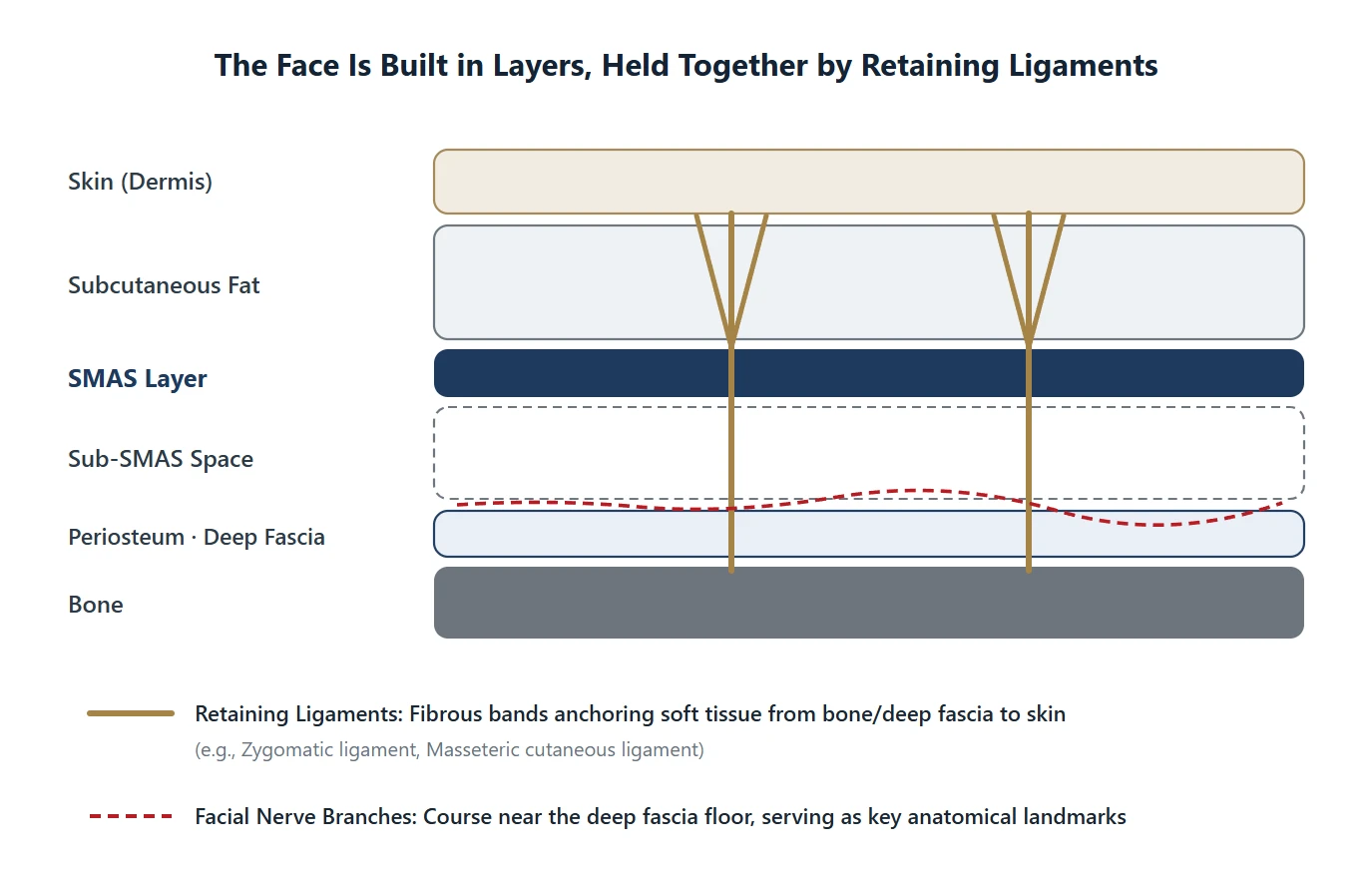
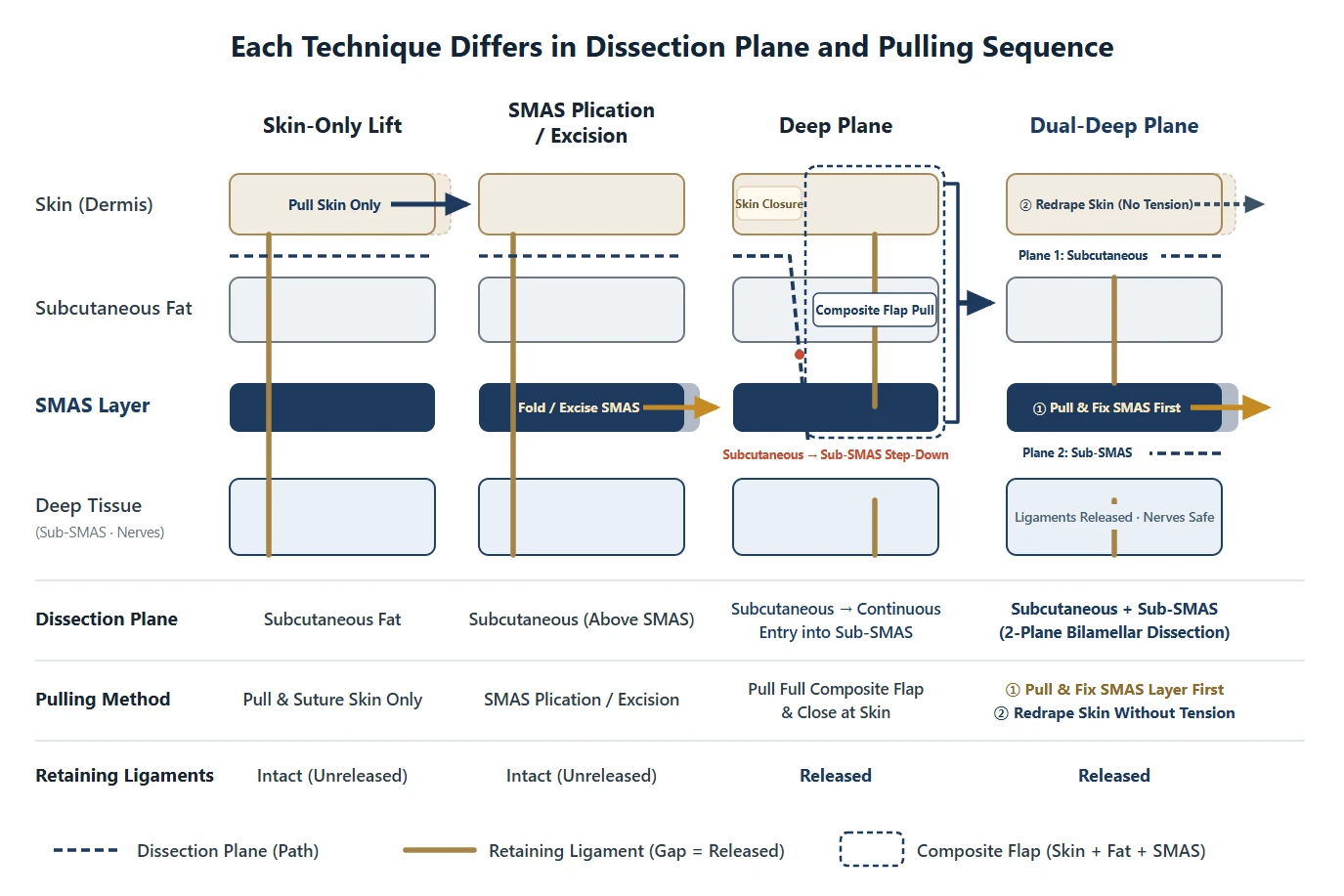
- While SMAS plication or imbrication tightens fascia without wide sub-SMAS undermining, a deep-plane facelift enters the sub-SMAS glide space to release the zygomatic and masseteric cutaneous retaining ligaments so the anterior cheek and jawline can be repositioned.
- AVA Plastic Surgery's Dual-Deep Plane Facelift uses two dissection planes: within the subcutaneous layer and beneath the SMAS. The SMAS flap is lifted and fixed first, and the skin is redraped separately to minimize closure tension.
สรุปประเด็นสำคัญโดย นพ. คิม ซึงซู: ทำความเข้าใจโครงสร้างใบหน้า 5 ชั้น เส้นเอ็นยึดผิว และความแตกต่างของการเลาะชั้นเนื้อเยื่อแบบ SMAS ดั้งเดิม, Deep Plane และเทคนิค Dual-Deep Plane ของ AVA Plastic Surgery บทความนี้เขียนขึ้นเพื่ออธิบายโครงสร้างทางกายวิภาค ขอบเขตของชั้นเนื้อเยื่อ (Anatomical Planes) และเกณฑ์การตัดสินใจเลือกวิธีรักษาที่เหมาะสมและปลอดภัยสำหรับคนไข้แต่ละบุคคล
สวัสดีครับ ผม นพ. คิม ซึงซู (Dr. Seungsoo Kim) ศัลยแพทย์ตกแต่งเฉพาะทางและผู้อำนวยการบริหารคลินิก AVA Plastic Surgery ย่านชินซา–คังนัม กรุงโซลครับ

01. การวินิจฉัยโครงสร้างทางกายวิภาคและสาเหตุที่แท้จริงของปัญหา
ในการผ่าตัดศัลยกรรมตกแต่งและการดูแลฟื้นฟูใบหน้า ผลลัพธ์ที่ดูเป็นธรรมชาติและอยู่ได้นานไม่ได้เกิดจากการดึงผิวหนังชั้นนอกให้ตึงเพียงอย่างเดียว แต่เกิดจากการวินิจฉัยอย่างแม่นยำว่าปัญหาอยู่ที่ชั้นใดของใบหน้า ไม่ว่าจะเป็นชั้นผิวหนังแท้ (Dermis), ชั้นไขมันตื้นและลึก (Fat Compartments), ชั้นพังผืดกล้ามเนื้อ SMAS / Platysma หรือเส้นเอ็นยึดผิว (Retaining Ligaments) การวางแผนการรักษาในหัวข้อ “SMAS Lift vs Deep Plane vs Dual-Deep Plane Facelift — คำว่า “ชั้นการเลาะ (Plane)” มีความหมายอย่างไรต่อผลลัพธ์?” จึงเริ่มต้นจากการวัดสัดส่วนโครงสร้างใบหน้าและความยืดหยุ่นของเนื้อเยื่ออย่างละเอียด
02. หลักการเลือกเทคนิคการรักษาและการแยกชั้นเนื้อเยื่ออย่างปลอดภัย
ที่ AVA Plastic Surgery เราให้ความสำคัญกับการรักษาตามชั้นกายวิภาคที่ถูกต้อง (Anatomical Plane-Specific Approach) สำหรับเคสที่ต้องผ่าตัดยกกระชับหรือปรับโครงสร้าง เราจะเลาะคลายจุดยึดรั้งในชั้นลึกด้วยความแม่นยำภายใต้การมองเห็นโดยตรงเพื่อปกป้องเส้นประสาทและหลอดเลือดสำคัญ พร้อมให้ชั้นโครงสร้างลึกเป็นตัวรับแรงดึงและเย็บปิดผิวหนังด้านนอกแบบไร้แรงตึง (Tension-Free Closure) ส่วนในเคสที่สามารถดูแลด้วยเครื่องยกกระชับหรือสกินบูสเตอร์ เราจะกำหนดความลึกของพลังงานและชนิดของตัวยาให้ตรงกับความหนาของผิวคนไข้แต่ละท่าน
03. ไทม์ไลน์การพักฟื้น การดูแลหลังหัตถการ และการวางแผนเดินทางมาโซล
ระยะเวลาการยุบบวมและการเข้าที่ของเนื้อเยื่อจะแตกต่างกันไปตามสภาพผิวและขอบเขตของหัตถการ โดยทั่วไปอาการบวมหลักจะค่อยๆ ลดลงในช่วง 1–2 สัปดาห์แรก (ซึ่งเป็นช่วงตัดไหมสำหรับการผ่าตัด) จากนั้นเนื้อเยื่อชั้นลึกจะค่อยๆ นุ่มลงและเข้าที่อย่างเป็นธรรมชาติในช่วง 6 สัปดาห์ถึง 3–6 เดือน ทีมแพทย์และพยาบาลของเรามีระบบดูแลแผลและลดบวมแบบ 1:1 เพื่อให้คนไข้ที่เดินทางมาจากประเทศไทยสามารถกลับไปใช้ชีวิตประจำวันได้อย่างมั่นใจ

04. ช่องทางปรึกษาและนัดหมาย 1:1 กับ นพ. คิม ซึงซู
ท่านสามารถศึกษาข้อมูลหัตถการที่เกี่ยวข้องหรือส่งภาพถ่ายเพื่อประเมินเบื้องต้นกับทีมงานได้ทางช่องทางด้านล่างนี้ครับ:
- ✨ ดึงหน้า Deep-Plane (Dual-Deep Plane) →
- 📅 นัดหมายปรึกษาออนไลน์หรือจองคิวเข้าพบคุณหมอที่คลินิก →
- 💬 ปรึกษาทาง WhatsApp (+82 10-3705-3423 · ส่งรูปประเมินเบื้องต้น) →
- 📖 อ่านคอลัมน์ “ทำไมผมถึงผ่าตัดดึงหน้า Deep-Plane และผ่าตัดตาให้คุณแม่ของตัวเอง” →
📍 AVA Plastic Surgery · ชั้น 4 อาคารอินซอง 603 คังนัมแดโร เขตซอโช กรุงโซล (สถานี Sinsa ทางออก 4 เดิน 1 นาที) · โทร +82 2-545-1882
※ ข้อมูลทางการแพทย์: ผลลัพธ์และระยะเวลาพักฟื้นขึ้นอยู่กับสภาพเนื้อเยื่อของแต่ละบุคคล ความเสี่ยงและผลข้างเคียงที่อาจเกิดขึ้น ได้แก่ เลือดออก เลือดคั่ง การติดเชื้อ อาการบวมช้ำ ความไม่สมมาตร รอยแผลเป็น หรืออาการชาชั่วคราว ควรรับการตรวจประเมินแบบ 1:1 กับศัลยแพทย์ตกแต่งเฉพาะทางก่อนตัดสินใจ
คำถามที่พบบ่อยทางคลินิก (FAQ)
Q. What is the anatomical difference between a skin-only facelift, an SMAS facelift, and a deep-plane facelift?
A skin-only facelift undermines only subcutaneous fat and pulls the skin envelope, which can stretch over time and place excessive tension on the ear incision (increasing the risk of widened scars or pixie-ear deformity). SMAS facelifts tighten the Superficial Muscular Aponeurotic System via folding (plication), partial strip excision (SMASectomy/imbrication), or elevating an SMAS flap. A deep-plane facelift enters the sub-SMAS space and releases the retaining ligaments (such as the zygomatic and masseteric cutaneous ligaments) that tether sagging midface and jawline soft tissue.
Q. How does AVA's Dual-Deep Plane Facelift differ from a traditional composite deep-plane facelift?
A traditional deep-plane facelift typically elevates the skin and SMAS together as a composite unit after releasing the retaining ligaments. AVA Plastic Surgery's Dual-Deep Plane approach uses two dissection planes, within the subcutaneous layer and beneath the SMAS. The intervening SMAS flap, including some subcutaneous fat, is advanced and fixed first; the skin is then redraped separately with minimal closure tension. Two dissection planes should not be confused with the tissue layers separated by them.
Q. Does clinical literature prove that one facelift plane always lasts longer, and what surgical risks must be considered?
Published systematic reviews note that head-to-head comparative studies have heterogeneous follow-up periods, meaning no single named technique is universally superior for every patient. Instead, surgical selection should match the specific anatomical layer and retaining ligaments where your laxity originates. Because facial nerve branches course near the deep sub-SMAS plane and retaining ligaments, surgery requires thorough anatomical precision; potential risks include bleeding, hematoma, infection, swelling, contour irregularity, asymmetry, scarring, sensory changes, or temporary/rare facial nerve weakness, and recovery varies by individual.
บทความแนะนำในหัวข้อใกล้เคียงโดย นพ.คิม ซึงซู
แก้ไขดึงหน้าครั้งที่สอง ② แผลเป็นหน้าหูกว้างและนูน — ทำไมการตัดเฉพาะแผลเป็นออกเฉยๆ จึงทำให้แผลยิ่งกว้างกว่าเดิม?
อ่านบทความ →
ร่องแก้มลึก ควรฉีดฟิลเลอร์เติมเต็มหรือดึงหน้ายกกระชับ? — คู่มือวิเคราะห์ร่องแก้ม 3 รูปแบบตามหลักกายวิภาค
อ่านบทความ →เจาะลึกการดึงหน้า (Facelift 101): ชั้น SMAS, เส้นเอ็นยึดผิว (Retaining Ligaments) และความแตกต่างจากการร้อยไหม・เครื่องยกกระชับ
อ่านบทความ →