กายวิภาค 3 กลไกคลื่นวิทยุยกกระชับ (RF Lifting) — Monopolar (Thermage FLX・Oligio) vs Bipolar (InMode FX・FORMA) vs Microneedle RF (Potenza・Sylfirm X)
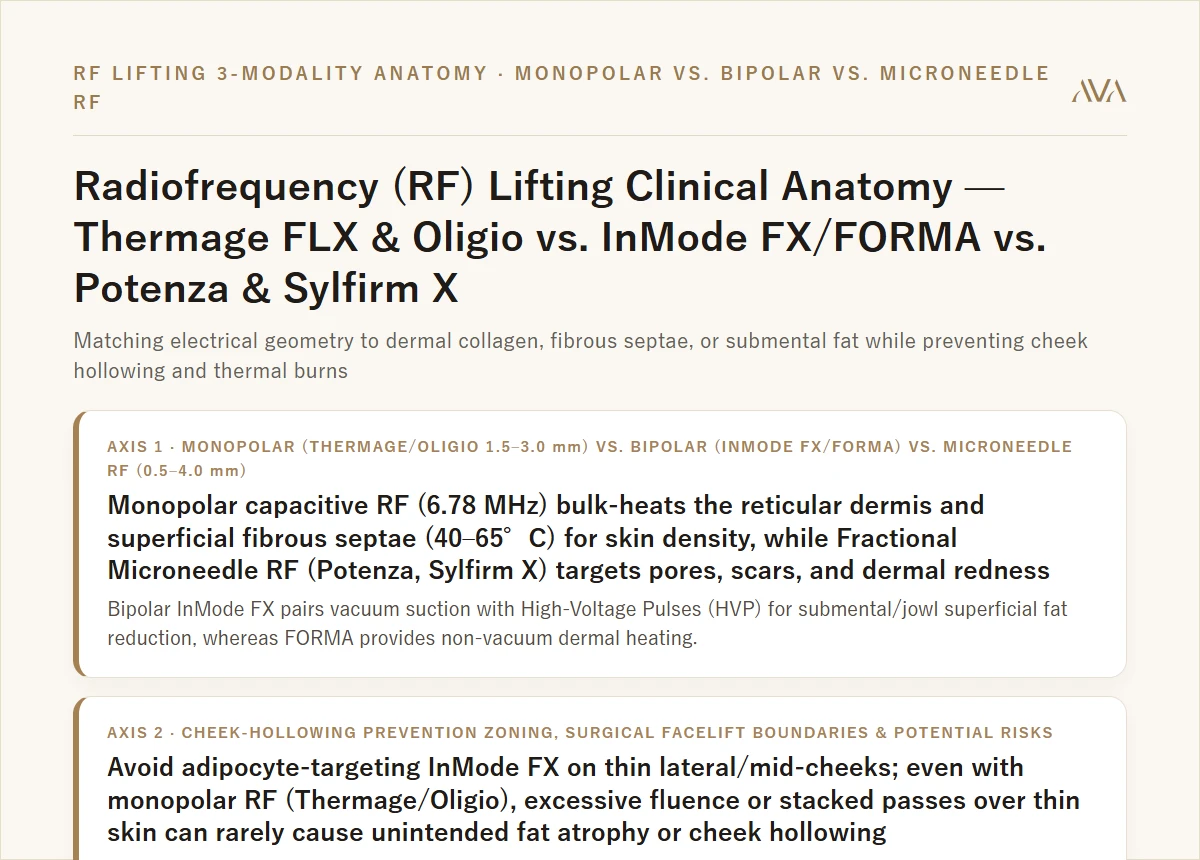
- Radiofrequency (RF) lifting is divided into three distinct clinical modalities by electrical geometry and anatomical target depth: (1) Monopolar capacitive RF (Thermage FLX, Oligio) for volumetric bulk heating of the reticular dermis and superficial fibrous septae (1.5–3.0 mm); (2) Bipolar RF with High-Voltage Pulse (InMode FX targeting superficial submental/jowl adipocytes vs. FORMA targeting dermal collagen); and (3) Fractional Microneedle RF (Potenza, Sylfirm X) delivering depth-controlled (0.5–4.0 mm) dermal coagulation and transdermal booster delivery.
- Applying adipocyte-targeting InMode FX onto volume-depleted lateral or mid-cheeks risks aggravating cheek hollowing; furthermore, even with monopolar RF (Thermage FLX, Oligio), excessive energy settings or aggressive overlapping passes on thin, volume-deficient cheeks can rarely induce unintended subcutaneous fat atrophy or contour depression—making physician-mapped zoning and energy titration essential.
- While RF modalities remodel dermal collagen and tighten mild-to-moderate skin laxity, they cannot physically release tethered retaining ligaments or excise redundant skin like a Dual-Deep Plane Facelift or Platysmaplasty; potential risks include transient erythema, edema, thermal burns/blisters, vacuum-induced purpura/bruising (3–7 days after InMode FX), folliculitis or post-inflammatory hyperpigmentation (PIH) after microneedle RF, and rare transient dysesthesia.
สรุปประเด็นสำคัญโดย นพ. คิม ซึงซู: เปรียบเทียบเครื่องยกกระชับกลุ่ม RF ทั้ง 3 กลไก: การให้ความร้อนแบบ 3 มิติในชั้นหนังแท้ (Thermage/Oligio), การสลายไขมันเหนียงพร้อมกระชับผิว (InMode) และไมโครนีดเดิล RF รักษาหลุมสิวรูขุมขน บทความนี้เขียนขึ้นเพื่ออธิบายโครงสร้างทางกายวิภาค ขอบเขตของชั้นเนื้อเยื่อ (Anatomical Planes) และเกณฑ์การตัดสินใจเลือกวิธีรักษาที่เหมาะสมและปลอดภัยสำหรับคนไข้แต่ละบุคคล
สวัสดีครับ ผม นพ. คิม ซึงซู (Dr. Seungsoo Kim) ศัลยแพทย์ตกแต่งเฉพาะทางและผู้อำนวยการบริหารคลินิก AVA Plastic Surgery ย่านชินซา–คังนัม กรุงโซลครับ
01. การวินิจฉัยโครงสร้างทางกายวิภาคและสาเหตุที่แท้จริงของปัญหา
ในการผ่าตัดศัลยกรรมตกแต่งและการดูแลฟื้นฟูใบหน้า ผลลัพธ์ที่ดูเป็นธรรมชาติและอยู่ได้นานไม่ได้เกิดจากการดึงผิวหนังชั้นนอกให้ตึงเพียงอย่างเดียว แต่เกิดจากการวินิจฉัยอย่างแม่นยำว่าปัญหาอยู่ที่ชั้นใดของใบหน้า ไม่ว่าจะเป็นชั้นผิวหนังแท้ (Dermis), ชั้นไขมันตื้นและลึก (Fat Compartments), ชั้นพังผืดกล้ามเนื้อ SMAS / Platysma หรือเส้นเอ็นยึดผิว (Retaining Ligaments) การวางแผนการรักษาในหัวข้อ “กายวิภาค 3 กลไกคลื่นวิทยุยกกระชับ (RF Lifting) — Monopolar (Thermage FLX・Oligio) vs Bipolar (InMode FX・FORMA) vs Microneedle RF (Potenza・Sylfirm X)” จึงเริ่มต้นจากการวัดสัดส่วนโครงสร้างใบหน้าและความยืดหยุ่นของเนื้อเยื่ออย่างละเอียด
02. หลักการเลือกเทคนิคการรักษาและการแยกชั้นเนื้อเยื่ออย่างปลอดภัย
ที่ AVA Plastic Surgery เราให้ความสำคัญกับการรักษาตามชั้นกายวิภาคที่ถูกต้อง (Anatomical Plane-Specific Approach) สำหรับเคสที่ต้องผ่าตัดยกกระชับหรือปรับโครงสร้าง เราจะเลาะคลายจุดยึดรั้งในชั้นลึกด้วยความแม่นยำภายใต้การมองเห็นโดยตรงเพื่อปกป้องเส้นประสาทและหลอดเลือดสำคัญ พร้อมให้ชั้นโครงสร้างลึกเป็นตัวรับแรงดึงและเย็บปิดผิวหนังด้านนอกแบบไร้แรงตึง (Tension-Free Closure) ส่วนในเคสที่สามารถดูแลด้วยเครื่องยกกระชับหรือสกินบูสเตอร์ เราจะกำหนดความลึกของพลังงานและชนิดของตัวยาให้ตรงกับความหนาของผิวคนไข้แต่ละท่าน

03. ไทม์ไลน์การพักฟื้น การดูแลหลังหัตถการ และการวางแผนเดินทางมาโซล
ระยะเวลาการยุบบวมและการเข้าที่ของเนื้อเยื่อจะแตกต่างกันไปตามสภาพผิวและขอบเขตของหัตถการ โดยทั่วไปอาการบวมหลักจะค่อยๆ ลดลงในช่วง 1–2 สัปดาห์แรก (ซึ่งเป็นช่วงตัดไหมสำหรับการผ่าตัด) จากนั้นเนื้อเยื่อชั้นลึกจะค่อยๆ นุ่มลงและเข้าที่อย่างเป็นธรรมชาติในช่วง 6 สัปดาห์ถึง 3–6 เดือน ทีมแพทย์และพยาบาลของเรามีระบบดูแลแผลและลดบวมแบบ 1:1 เพื่อให้คนไข้ที่เดินทางมาจากประเทศไทยสามารถกลับไปใช้ชีวิตประจำวันได้อย่างมั่นใจ

04. ช่องทางปรึกษาและนัดหมาย 1:1 กับ นพ. คิม ซึงซู
ท่านสามารถศึกษาข้อมูลหัตถการที่เกี่ยวข้องหรือส่งภาพถ่ายเพื่อประเมินเบื้องต้นกับทีมงานได้ทางช่องทางด้านล่างนี้ครับ:
- ✨ ยกกระชับ Ultherapy・Thermage・ร้อยไหม →
- ✨ สกินบูสเตอร์ (Rejuran・Juvelook) →
- ✨ มินิเฟซลิฟต์ (Mini Facelift) →
- ✨ ดึงหน้า Deep-Plane (Dual-Deep Plane) →
- 📅 นัดหมายปรึกษาออนไลน์หรือจองคิวเข้าพบคุณหมอที่คลินิก →
- 💬 ปรึกษาทาง WhatsApp (+82 10-3705-3423 · ส่งรูปประเมินเบื้องต้น) →
- 📖 อ่านคอลัมน์ “ทำไมผมถึงผ่าตัดดึงหน้า Deep-Plane และผ่าตัดตาให้คุณแม่ของตัวเอง” →
📍 AVA Plastic Surgery · ชั้น 4 อาคารอินซอง 603 คังนัมแดโร เขตซอโช กรุงโซล (สถานี Sinsa ทางออก 4 เดิน 1 นาที) · โทร +82 2-545-1882
※ ข้อมูลทางการแพทย์: ผลลัพธ์และระยะเวลาพักฟื้นขึ้นอยู่กับสภาพเนื้อเยื่อของแต่ละบุคคล ความเสี่ยงและผลข้างเคียงที่อาจเกิดขึ้น ได้แก่ เลือดออก เลือดคั่ง การติดเชื้อ อาการบวมช้ำ ความไม่สมมาตร รอยแผลเป็น หรืออาการชาชั่วคราว ควรรับการตรวจประเมินแบบ 1:1 กับศัลยแพทย์ตกแต่งเฉพาะทางก่อนตัดสินใจ
คำถามที่พบบ่อยทางคลินิก (FAQ)
Q. How do Monopolar RF (Thermage FLX, Oligio), Bipolar RF (InMode FX/FORMA), and Fractional Microneedle RF (Potenza, Sylfirm X) differ in anatomical depth and indication?
Monopolar capacitive RF (Thermage FLX, Oligio; 6.78 MHz) cools the epidermis while delivering volumetric bulk heat (40–65°C) across the full thickness of the reticular dermis and superficial fibrous septae (1.5–3.0 mm) to improve skin density and fine crêpey laxity. Bipolar RF (InMode) splits into two handpieces: FX uses vacuum suction, bipolar heating (40–43°C), and high-voltage electroporation pulses (HVP) to reduce localized superficial fat pockets under the chin and lower jowl, whereas FORMA glides over the skin to heat dermal collagen without vacuum suction. Fractional Microneedle RF (Potenza, Sylfirm X) physically inserts insulated or non-insulated micro-electrodes (0.5–4.0 mm) into the papillary and reticular dermis to treat enlarged pores, acne scars, dermal redness, and basement-membrane laxity.
Q. If I have a thin face with hollow cheeks, can RF lifting cause cheek hollowing (fat atrophy)?
Preventing unintended facial volume loss requires strict modality selection and anatomical zoning. Because InMode FX is specifically engineered to disrupt superficial fat cell membranes, it should be restricted to excess submental or lower-jowl fat and avoided on hollow lateral or mid-cheeks. While monopolar RF (Thermage FLX, Oligio) primarily targets the collagen-rich dermis and fibrous septae, excessive fluence or repeated stacked passes over thin skin can still rarely cause unintended subcutaneous fat atrophy or cheek hollowing. A board-certified plastic surgeon therefore maps depressed cheek zones in advance, lowers energy settings over thin tissue, and focuses vectors on dermal tightening.
Q. How can RF lifting be safely sequenced with HIFU (Ultherapy) or Skin Boosters (Rejuran, Juvelook), and what side effects should I expect?
Because Micro-Focused Ultrasound (Ultherapy) creates focal thermal coagulation points in the deeper SMAS and deep fibrous septae (3.0–4.5 mm) while monopolar/bipolar RF heats the overlying dermis (1.5–3.0 mm), combining them addresses multi-layer laxity; however, total thermal load must be carefully titrated to prevent burns, blistering, or prolonged edema. When pairing microneedle RF (such as Potenza pumping tips) with skin boosters like Juvelook (PDLLA) or Rejuran (PN), depth-controlled dermal delivery enhances pore and texture remodeling. Expected side effects and risks include temporary redness, swelling, warmth, 3–7 days of vacuum purpura/bruising after InMode FX, pinpoint scabs, folliculitis, post-inflammatory hyperpigmentation (PIH), and rare thermal burns or contour irregularity.
บทความแนะนำในหัวข้อใกล้เคียงโดย นพ.คิม ซึงซู

ร้อยไหมอยู่ได้นานแค่ไหน? — 2 ปัจจัยสำคัญที่กำหนดความคงทน (ไหมเงี่ยง 360° 3D และการดูดไขมันแก้มห้อยร่วมด้วย)
อ่านบทความ →
Ultherapy vs Thermage FLX — ความแตกต่างของชั้นผิวเป้าหมาย (4.5mm SMAS vs ชั้นหนังแท้) และเส้นแบ่งที่ควรเปลี่ยนเป็นการผ่าตัดดึงหน้า
อ่านบทความ →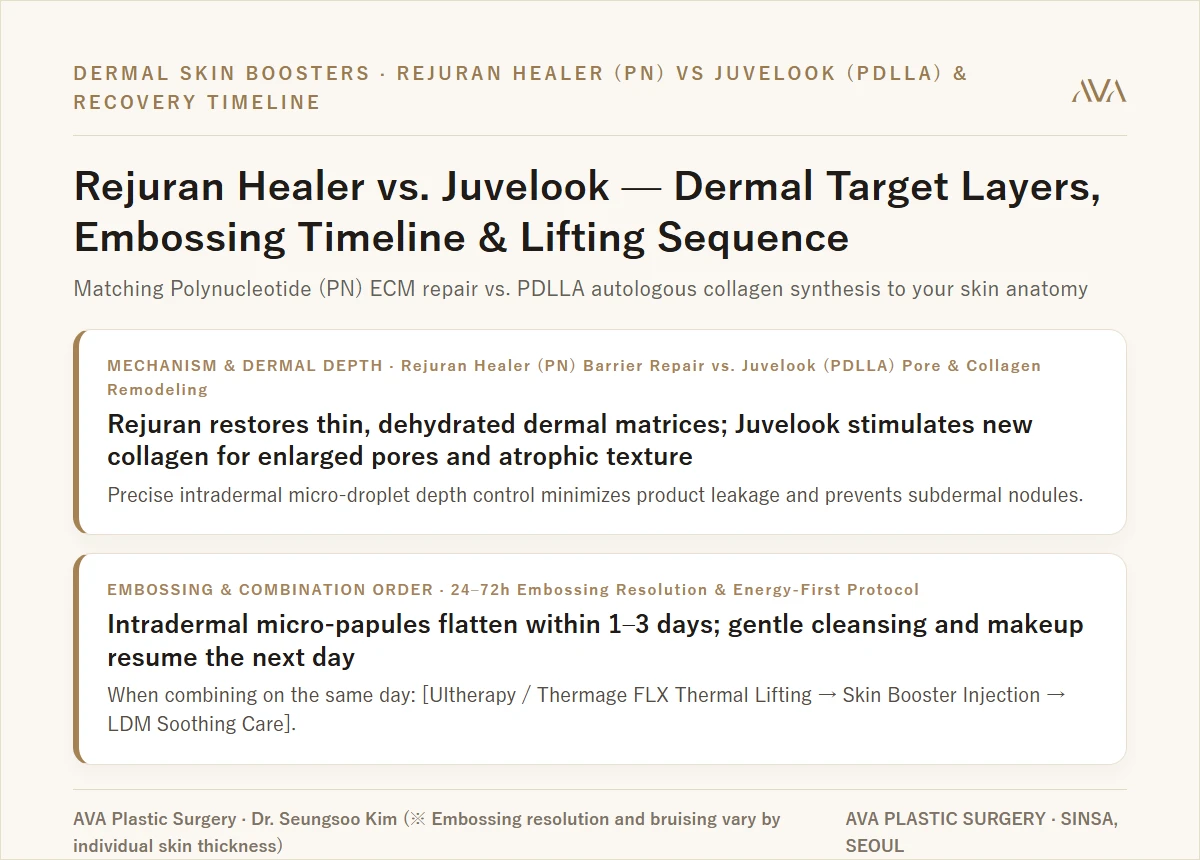
เปรียบเทียบสกินบูสเตอร์ Rejuran Healer vs Juvelook — ความลึกของชั้นหนังแท้ ระยะเวลาตุ่มนูนยุบ และลำดับการทำร่วมกับ Ultherapy・Thermage
อ่านบทความ →