สารกระตุ้นคอลลาเจน (Juvelook Volume・Sculptra・Ultracol) vs ฟิลเลอร์ HA และการเติมไขมัน — โครงสร้างอนุภาค ชั้นผิวเป้าหมาย และการป้องกันก้อนแข็ง (Nodule)
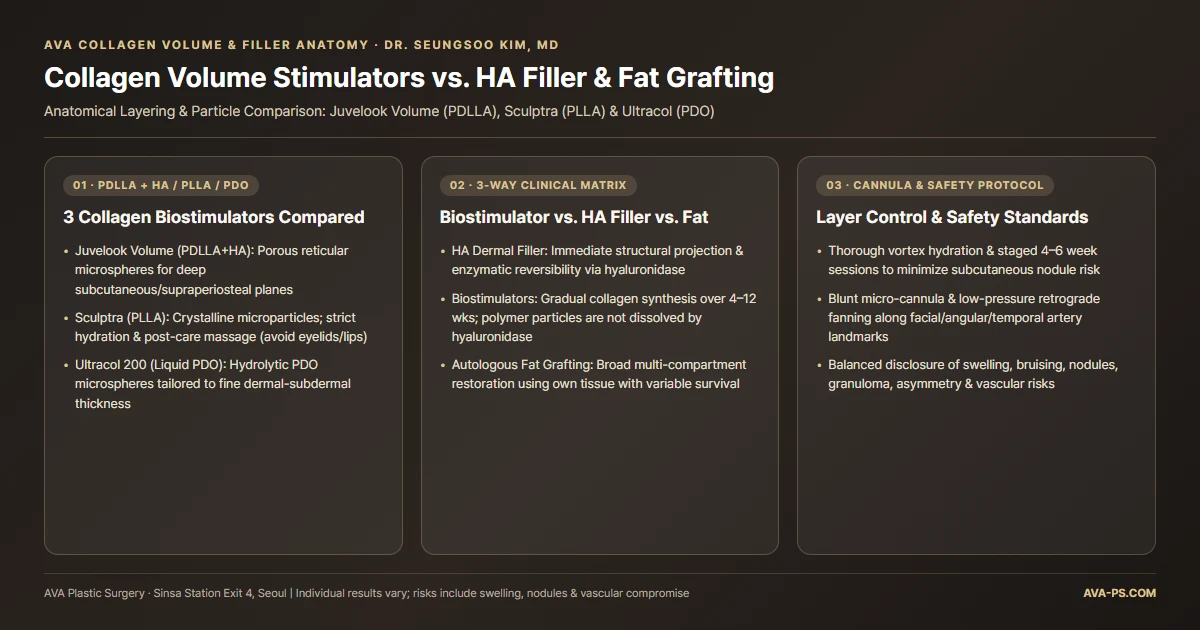
- Collagen volume biostimulators stimulate fibroblasts to synthesize autologous collagen over 4 to 12 weeks as biocompatible polymer microspheres gradually hydrolyze; porous reticular PDLLA+HA (Juvelook Volume / Lenisna), crystalline PLLA (Sculptra), and hydrolytic liquid PDO (Ultracol 200) differ in particle geometry, reconstitution protocol, and anatomical target planes.
- Whereas cross-linked Hyaluronic Acid (HA) fillers provide immediate structural projection and can be enzymatically dissolved with hyaluronidase, synthetic polymer particles (PDLLA, PLLA, PDO) themselves cannot be dissolved by hyaluronidase—making thorough vortex pre-hydration, plane-specific blunt micro-cannula fanning, and conservative 4-to-6-week staged dosing essential.
- All three volume modalities carry potential side effects—collagen biostimulators (swelling, bruising, palpable nodules, granuloma, asymmetry, vascular occlusion), HA fillers (Tyndall effect, delayed nodules, vascular compromise), and autologous micro-fat grafting (variable graft survival, oil cysts/calcification, fat embolism)—requiring strict arterial landmark avoidance and screening for contraindications (pregnancy/lactation, active skin infection, keloid tendency, or active autoimmune disease).
สรุปประเด็นสำคัญโดย นพ. คิม ซึงซู: เปรียบเทียบกลไกของ PDLLA (Juvelook Volume), PLLA (Sculptra) และ PDO (Ultracol) กับฟิลเลอร์และการเติมไขมัน พร้อมหลักการละลายตัวยาและฉีดถูกชั้นผิวเพื่อป้องกันการเกิดก้อน บทความนี้เขียนขึ้นเพื่ออธิบายโครงสร้างทางกายวิภาค ขอบเขตของชั้นเนื้อเยื่อ (Anatomical Planes) และเกณฑ์การตัดสินใจเลือกวิธีรักษาที่เหมาะสมและปลอดภัยสำหรับคนไข้แต่ละบุคคล
สวัสดีครับ ผม นพ. คิม ซึงซู (Dr. Seungsoo Kim) ศัลยแพทย์ตกแต่งเฉพาะทางและผู้อำนวยการบริหารคลินิก AVA Plastic Surgery ย่านชินซา–คังนัม กรุงโซลครับ
01. การวินิจฉัยโครงสร้างทางกายวิภาคและสาเหตุที่แท้จริงของปัญหา
ในการผ่าตัดศัลยกรรมตกแต่งและการดูแลฟื้นฟูใบหน้า ผลลัพธ์ที่ดูเป็นธรรมชาติและอยู่ได้นานไม่ได้เกิดจากการดึงผิวหนังชั้นนอกให้ตึงเพียงอย่างเดียว แต่เกิดจากการวินิจฉัยอย่างแม่นยำว่าปัญหาอยู่ที่ชั้นใดของใบหน้า ไม่ว่าจะเป็นชั้นผิวหนังแท้ (Dermis), ชั้นไขมันตื้นและลึก (Fat Compartments), ชั้นพังผืดกล้ามเนื้อ SMAS / Platysma หรือเส้นเอ็นยึดผิว (Retaining Ligaments) การวางแผนการรักษาในหัวข้อ “สารกระตุ้นคอลลาเจน (Juvelook Volume・Sculptra・Ultracol) vs ฟิลเลอร์ HA และการเติมไขมัน — โครงสร้างอนุภาค ชั้นผิวเป้าหมาย และการป้องกันก้อนแข็ง (Nodule)” จึงเริ่มต้นจากการวัดสัดส่วนโครงสร้างใบหน้าและความยืดหยุ่นของเนื้อเยื่ออย่างละเอียด
02. หลักการเลือกเทคนิคการรักษาและการแยกชั้นเนื้อเยื่ออย่างปลอดภัย
ที่ AVA Plastic Surgery เราให้ความสำคัญกับการรักษาตามชั้นกายวิภาคที่ถูกต้อง (Anatomical Plane-Specific Approach) สำหรับเคสที่ต้องผ่าตัดยกกระชับหรือปรับโครงสร้าง เราจะเลาะคลายจุดยึดรั้งในชั้นลึกด้วยความแม่นยำภายใต้การมองเห็นโดยตรงเพื่อปกป้องเส้นประสาทและหลอดเลือดสำคัญ พร้อมให้ชั้นโครงสร้างลึกเป็นตัวรับแรงดึงและเย็บปิดผิวหนังด้านนอกแบบไร้แรงตึง (Tension-Free Closure) ส่วนในเคสที่สามารถดูแลด้วยเครื่องยกกระชับหรือสกินบูสเตอร์ เราจะกำหนดความลึกของพลังงานและชนิดของตัวยาให้ตรงกับความหนาของผิวคนไข้แต่ละท่าน
03. ไทม์ไลน์การพักฟื้น การดูแลหลังหัตถการ และการวางแผนเดินทางมาโซล
ระยะเวลาการยุบบวมและการเข้าที่ของเนื้อเยื่อจะแตกต่างกันไปตามสภาพผิวและขอบเขตของหัตถการ โดยทั่วไปอาการบวมหลักจะค่อยๆ ลดลงในช่วง 1–2 สัปดาห์แรก (ซึ่งเป็นช่วงตัดไหมสำหรับการผ่าตัด) จากนั้นเนื้อเยื่อชั้นลึกจะค่อยๆ นุ่มลงและเข้าที่อย่างเป็นธรรมชาติในช่วง 6 สัปดาห์ถึง 3–6 เดือน ทีมแพทย์และพยาบาลของเรามีระบบดูแลแผลและลดบวมแบบ 1:1 เพื่อให้คนไข้ที่เดินทางมาจากประเทศไทยสามารถกลับไปใช้ชีวิตประจำวันได้อย่างมั่นใจ
04. ช่องทางปรึกษาและนัดหมาย 1:1 กับ นพ. คิม ซึงซู
ท่านสามารถศึกษาข้อมูลหัตถการที่เกี่ยวข้องหรือส่งภาพถ่ายเพื่อประเมินเบื้องต้นกับทีมงานได้ทางช่องทางด้านล่างนี้ครับ:
- ✨ สกินบูสเตอร์ (Rejuran・Juvelook) →
- ✨ โบท็อกซ์・ฟิลเลอร์ →
- ✨ เติมไขมันหน้าเด็ก (Fat Grafting) →
- 📅 นัดหมายปรึกษาออนไลน์หรือจองคิวเข้าพบคุณหมอที่คลินิก →
- 💬 ปรึกษาทาง WhatsApp (+82 10-3705-3423 · ส่งรูปประเมินเบื้องต้น) →
- 📖 อ่านคอลัมน์ “ทำไมผมถึงผ่าตัดดึงหน้า Deep-Plane และผ่าตัดตาให้คุณแม่ของตัวเอง” →
📍 AVA Plastic Surgery · ชั้น 4 อาคารอินซอง 603 คังนัมแดโร เขตซอโช กรุงโซล (สถานี Sinsa ทางออก 4 เดิน 1 นาที) · โทร +82 2-545-1882
※ ข้อมูลทางการแพทย์: ผลลัพธ์และระยะเวลาพักฟื้นขึ้นอยู่กับสภาพเนื้อเยื่อของแต่ละบุคคล ความเสี่ยงและผลข้างเคียงที่อาจเกิดขึ้น ได้แก่ เลือดออก เลือดคั่ง การติดเชื้อ อาการบวมช้ำ ความไม่สมมาตร รอยแผลเป็น หรืออาการชาชั่วคราว ควรรับการตรวจประเมินแบบ 1:1 กับศัลยแพทย์ตกแต่งเฉพาะทางก่อนตัดสินใจ
คำถามที่พบบ่อยทางคลินิก (FAQ)
Q. How do Juvelook Volume (PDLLA), Sculptra (PLLA), and Ultracol 200 (PDO) differ in particle structure and anatomical indications?
Juvelook Volume (Lenisna) combines porous, reticular PDLLA microspheres with a non-crosslinked hyaluronic acid carrier, making it well-suited for deep subcutaneous and supraperiosteal volume restoration in the anterior mid-cheek, nasolabial folds, and sub-malar hollows. Sculptra uses crystalline PLLA microparticles that excel at broad structural framing across sunken temples and lateral cheeks ("peanut-shaped" contours), requiring thorough pre-hydration, post-treatment massage where indicated, and strict avoidance of thin periorbital or lip sphincter muscle zones. Ultracol 200 consists of liquid PDO microspheres that degrade via hydrolysis into water and carbon dioxide, tailored to fine dermal-subdermal thickening according to skin thickness.
Q. Can collagen volume biostimulators be dissolved with hyaluronidase like hyaluronic acid fillers?
No. Hyaluronidase enzymatically cleaves only hyaluronic acid (HA) glycosaminoglycan bonds; it does not dissolve synthetic polymer microparticles such as PDLLA, PLLA, or PDO (in Juvelook Volume, only the initial non-crosslinked HA carrier component responds to hyaluronidase, not the PDLLA scaffold). Because polymer particles cannot be erased on demand, preventing palpable nodules or overcorrection depends on uniform vortex hydration, precise deep-plane micro-cannula delivery away from superficial muscle sphincters, and conservative multi-session buildup spaced 4 to 6 weeks apart.
Q. How should I choose between collagen biostimulators, hyaluronic acid fillers, and autologous micro-fat grafting?
Choose Hyaluronic Acid (HA) filler when you want immediate contour projection, crisp structural definition (such as the chin apex or lips), or enzymatic reversibility. Choose a collagen biostimulator when you prefer gradual, natural-feeling dermal and subdermal thickening over 1 to 3 months without cross-linked gel buildup. Choose autologous micro-fat grafting when multiple facial compartments (forehead, temples, midface, and lateral cheeks) require larger total volume in a single surgical session. Because particulate biostimulators, HA gels, and fat grafts all carry potential side effects (swelling, bruising, nodules) and intravascular occlusion risk if injected into facial, angular, or superficial temporal arteries, anatomical plane selection and low-pressure blunt cannula technique are mandatory.
บทความแนะนำในหัวข้อใกล้เคียงโดย นพ.คิม ซึงซู
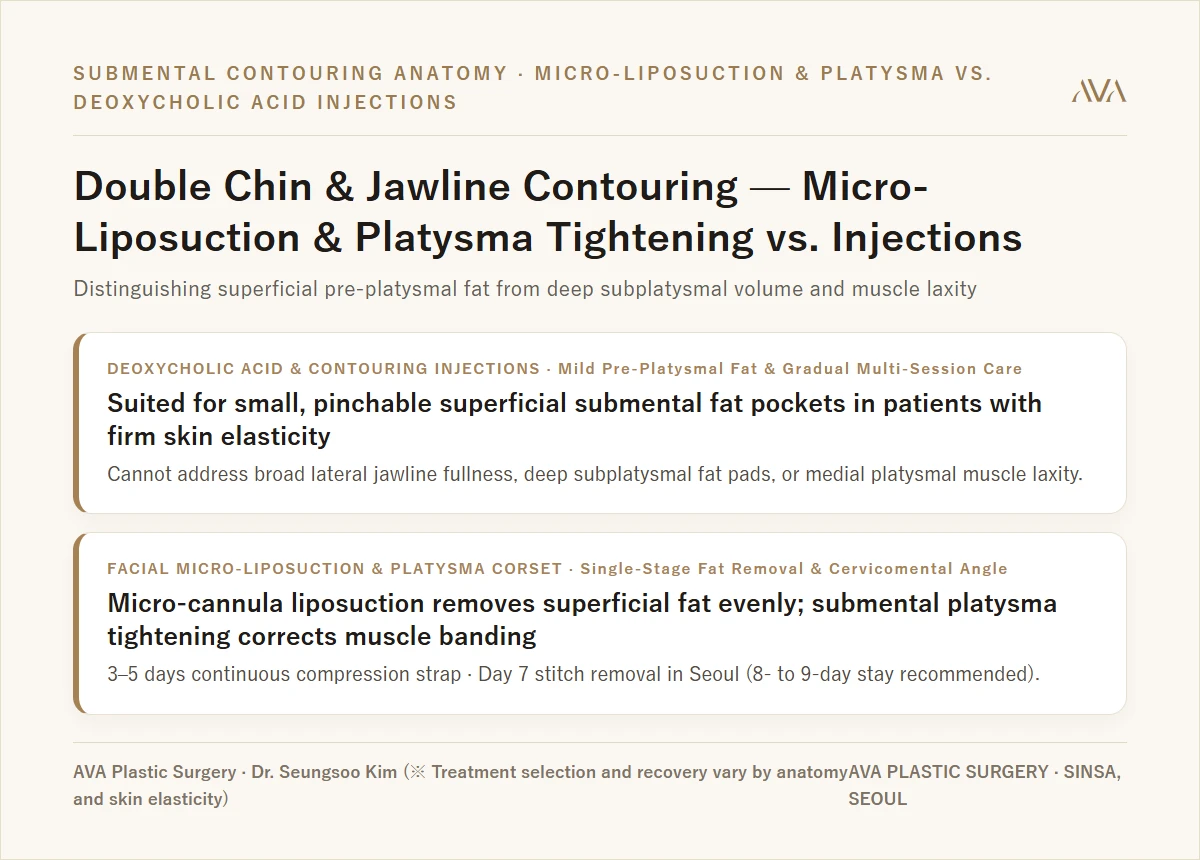
ปรับกรอบหน้าและลดเหนียง — เส้นแบ่งทางกายวิภาคระหว่างการดูดไขมันกรอบหน้า・เย็บกล้ามเนื้อคอ กับการฉีดสลายไขมัน (Deoxycholic acid)
อ่านบทความ →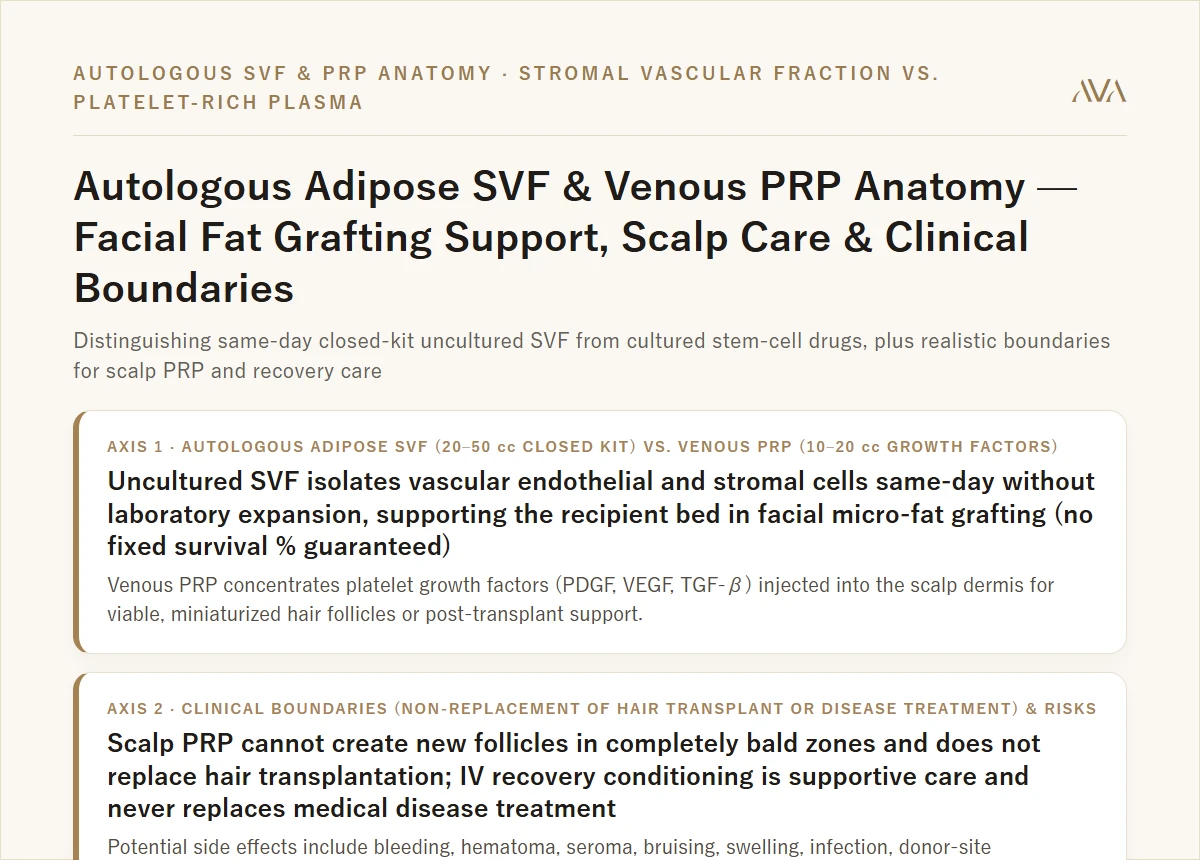
กายวิภาคการฟื้นฟูระดับเซลล์ด้วย SVF จากไขมันตัวเอง & PRP เกล็ดเลือดเข้มข้น — ข้อบ่งชี้ในการเติมไขมัน ดูแลรากผม และการฟื้นตัวหลังผ่าตัด
อ่านบทความ →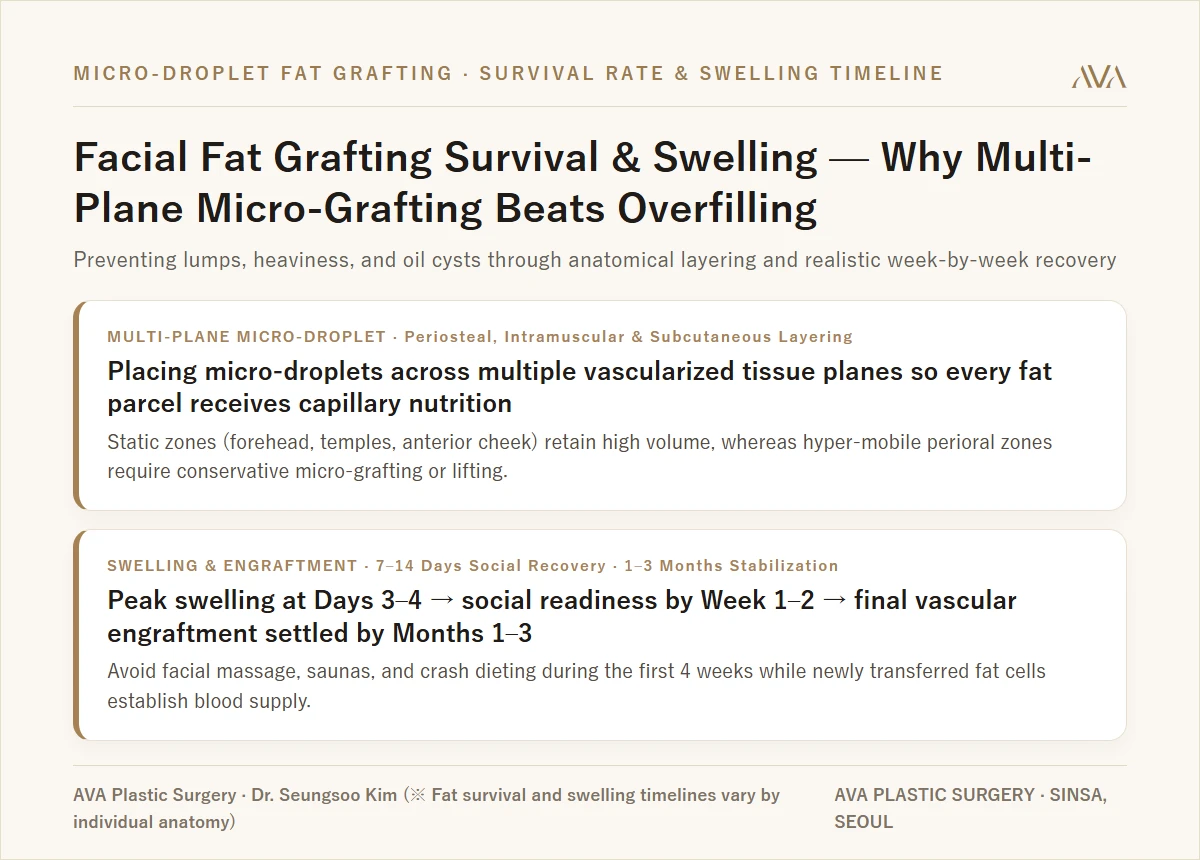
อัตราการติดของไขมันและไทม์ไลน์การยุบบวมของการเติมไขมันหน้าเด็ก (Facial Fat Grafting) — ทำไมการฉีดเรียงหลายชั้นทีละหยดเล็กๆ จึงสำคัญกว่าปริมาณ?
อ่านบทความ →