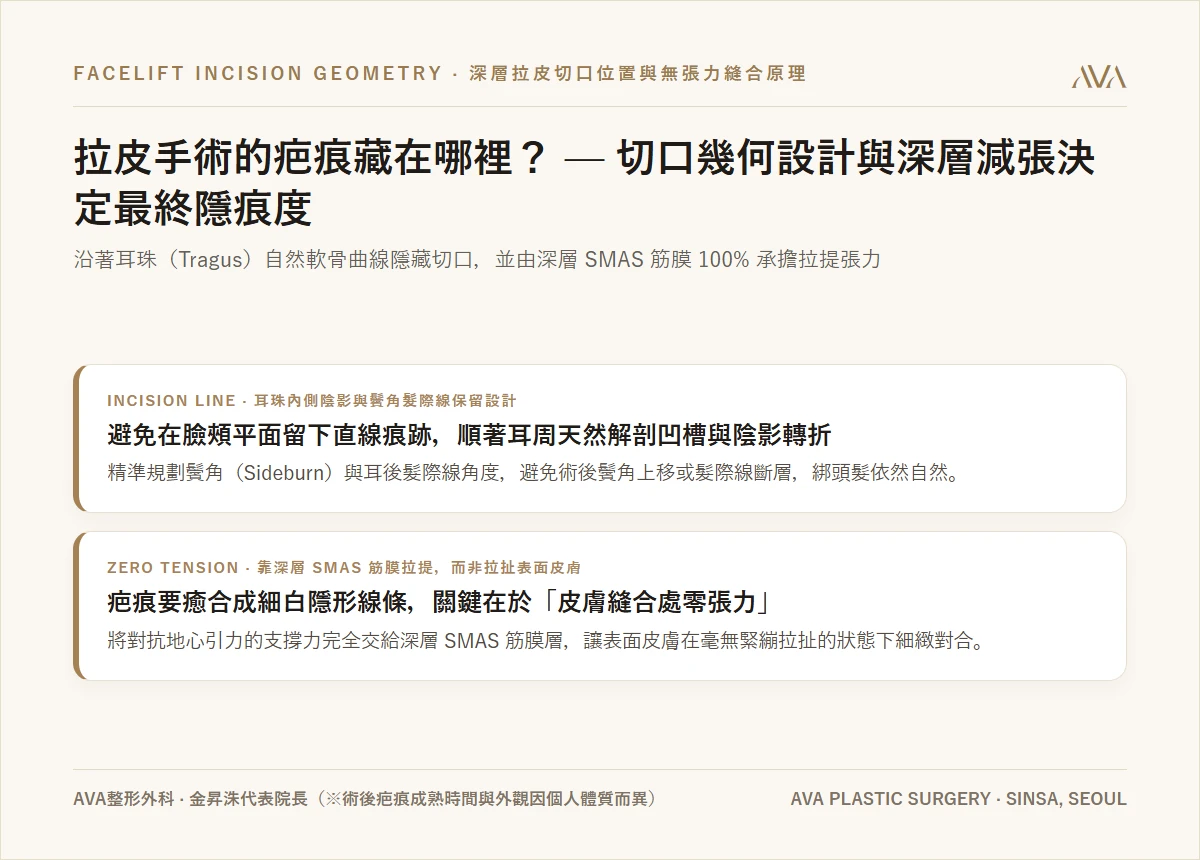
SMAS 拉皮、深层拉皮(Deep Plane)与双深层拉皮 — 「剥离层(Plane)」真正的解剖意义
- Facelift technique names are defined by two anatomical variables: which tissue layer (dissection plane) is separated, and which structural layer carries the suspensory lifting tension.
- While SMAS plication or imbrication tightens fascia without wide sub-SMAS undermining, a deep-plane facelift enters the sub-SMAS glide space to release the zygomatic and masseteric cutaneous retaining ligaments so the anterior cheek and jawline can be repositioned.
- AVA Plastic Surgery's Dual-Deep Plane Facelift uses two dissection planes: within the subcutaneous layer and beneath the SMAS. The SMAS flap is lifted and fixed first, and the skin is redraped separately to minimize closure tension.
所有拉皮手术的名称都取决于两件事:「在哪一个解剖平面(Plane)进行剥离」以及「由哪一层组织承受拉提张力」。本文完整拆解皮下层与 SMAS 下层双平面剥离、支持韧带释放,以及让 SMAS 承受重力、表皮无张力缝合的「双深层拉皮(Dual-Deep Plane)」解剖学原理。
您好,我是首尔江南(新沙站)AVA 整形外科的代表院长、整形外科专科医师金乘秀(Dr. Seungsoo Kim)。

01. 脸部五层解剖与支持韧带:为何只拉紧皮肤很快就会松弛回弹?
脸部软组织由外而内分为:①皮肤、②皮下脂肪、③SMAS 表浅肌腱膜系统(连通颈阔肌)、④深层滑动间隙与支持韧带(颧骨韧带、咬肌韧带、下腭韧带)、⑤骨膜与深筋膜。嘴边肉(Jowls)、木偶纹与深层法令纹的根源在于 SMAS 筋膜下垂与韧带拉扯。若仅剥离皮下并用力拉扯皮肤,脆弱的真皮层承受过大张力,不仅容易回弹,更会导致耳前疤痕变宽与精灵耳(耳垂被拉长变形)。
02. 传统 SMAS 拉皮 vs 单一 Deep Plane vs 双深层拉皮(Dual-Deep Plane)
传统 SMAS 折叠或仅做浅层筋膜拉提时,若未释放前方的支持韧带,拉提力量难以传递至法令纹与嘴角。古典 Deep Plane 虽进入 SMAS 下层释放韧带,但皮肤与筋膜连成一体(Composite flap),只能往同一方向拉提。AVA 整形外科采用的「双深层拉皮(Dual-Deep Plane)」同时在皮下平面与 SMAS 下深层平面进行双层独立剥离:深层 SMAS 沿抗重力方向垂直向上稳固悬吊,表层皮肤则依自然纹理无张力贴合缝合。
03. 颜面神经保护原则与自然表情、持久轮廓的平衡
在 SMAS 下深层平面剥离时,主刀医师必须精准掌握颜面神经各分支(颞支、颧支、颊支、下腭缘支)与深筋膜的解剖关系,于安全的无血管滑动层直视操作。彻底释放支持韧带并由深层筋膜承重,才能在保留自然生动表情的同时,达到长久稳定的年轻化效果。

04. 预约金乘秀代表院长 1:1 深层拉皮与年轻化门诊
想了解您的脸部骨骼、皮肤厚度与 SMAS 筋膜条件适合哪一种拉皮与复合年轻化设计吗?欢迎透过以下中文专属管道预约评估:
- 📅 预约 1:1 Zoom 视频门诊或首尔到院咨询(中文预约中心) →
- 💬 加入官方 LINE 中文咨询(@864xbnzp · 发送照片初步评估) →
- ✨ 查看双深层筋膜拉皮(Dual-Deep Plane Facelift)手术介绍 →
- 📖 阅读〈亲自为母亲执刀深层拉皮与眼部手术 — 术后 2 个月无修图 5 角度纪录〉 →
📍 AVA 整形外科(AVA Plastic Surgery) · 首尔特别市 瑞草区 江南大路 603 仁成大楼 4 楼(新沙站 4 号出口步行 1 分钟) · TEL +82 2-545-1882
※ 医疗注意事项(风险告知):深层筋膜拉皮及相关复合手术的效果与恢复时间因个人组织条件而异;可能伴随之风险包含出血、血肿、感染、肿胀、瘀青、不对称、疤痕增生、暂时性感觉迟钝或罕见之颜面神经功能影响等。手术前务必由整形外科专科医师进行 1:1 面对面评估。
常见临床问题(FAQ)
Q. What is the anatomical difference between a skin-only facelift, an SMAS facelift, and a deep-plane facelift?
A skin-only facelift undermines only subcutaneous fat and pulls the skin envelope, which can stretch over time and place excessive tension on the ear incision (increasing the risk of widened scars or pixie-ear deformity). SMAS facelifts tighten the Superficial Muscular Aponeurotic System via folding (plication), partial strip excision (SMASectomy/imbrication), or elevating an SMAS flap. A deep-plane facelift enters the sub-SMAS space and releases the retaining ligaments (such as the zygomatic and masseteric cutaneous ligaments) that tether sagging midface and jawline soft tissue.
Q. How does AVA's Dual-Deep Plane Facelift differ from a traditional composite deep-plane facelift?
A traditional deep-plane facelift typically elevates the skin and SMAS together as a composite unit after releasing the retaining ligaments. AVA Plastic Surgery's Dual-Deep Plane approach uses two dissection planes, within the subcutaneous layer and beneath the SMAS. The intervening SMAS flap, including some subcutaneous fat, is advanced and fixed first; the skin is then redraped separately with minimal closure tension. Two dissection planes should not be confused with the tissue layers separated by them.
Q. Does clinical literature prove that one facelift plane always lasts longer, and what surgical risks must be considered?
Published systematic reviews note that head-to-head comparative studies have heterogeneous follow-up periods, meaning no single named technique is universally superior for every patient. Instead, surgical selection should match the specific anatomical layer and retaining ligaments where your laxity originates. Because facial nerve branches course near the deep sub-SMAS plane and retaining ligaments, surgery requires thorough anatomical precision; potential risks include bleeding, hematoma, infection, swelling, contour irregularity, asymmetry, scarring, sensory changes, or temporary/rare facial nerve weakness, and recovery varies by individual.
同领域主题 — 金乘秀代表院长相关专栏 3 选